Loading…


Loading…
Loading…
Loading…
Edexcel GCSE Combined Science · 1SC0
Edexcel 1SC0 · Magnets and magnetic fields Check the specification (PDF) (opens in a new tab)
An electric current is a flow of charge. When charge flows through a wire, it produces a magnetic field around the wire. The wire does not have to be made from a magnetic material: a copper wire carrying a current produces a magnetic field even though copper is not attracted to a magnet.
A plotting compass can detect this field. Its needle is a small magnet, and its north-seeking end points in the direction of the magnetic field at its position. Switching the current on can therefore change the direction in which a nearby compass points. Switching it off removes the field produced by the current, although the Earth's magnetic field remains.
Pass a long, straight insulated wire vertically through a hole in a horizontal sheet of card. Connect the wire to a low-voltage direct-current supply, with a switch and a variable resistor in series to control the current. Keep the other connecting leads away from the card so that their magnetic fields do not confuse the pattern.
Place plotting compasses on the card around the wire. With the switch open, note their directions: they respond mainly to the Earth's field. Close the switch briefly. The needles change direction, showing that the current has produced a magnetic effect. When the wire's field dominates, the needles lie approximately along tangents to circles centred on the wire.
Mark the direction of the north-seeking end at several positions around the wire. These directions reveal which way the field circles. Open the switch, reverse the supply connections and switch on again: the field direction reverses.
To reveal the shape more clearly, remove the compasses, sprinkle iron filings thinly onto the card and tap it gently while the current flows. The filings form a circular pattern. They do not show which way round the field points; compasses are needed for that.
Use a controlled, low-voltage supply and switch off between observations because the wire can become hot. Keep filings away from eyes.
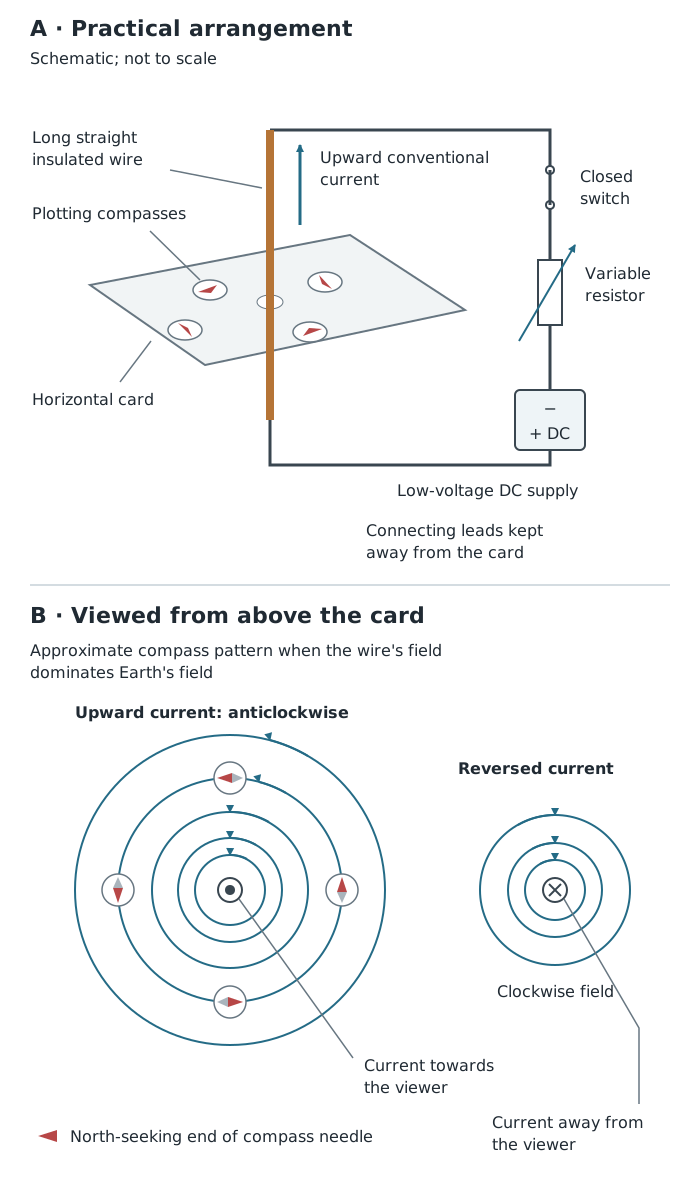
With the switch closed, a current produces a circular magnetic field around a straight wire. Reversing the current reverses the field direction.
The magnetic field around a long straight conductor forms concentric circles: circles sharing a centre, with the wire at that centre. The circles lie in planes perpendicular to the wire. The current flows along the wire, but the magnetic field goes around it.
Use the right-hand grip rule to find the direction:
Conventional current travels from the positive terminal towards the negative terminal through the external circuit. Electrons in a metal move in the opposite direction.
For example, viewed from above a vertical wire, an upward current comes towards you and produces an anticlockwise field. A downward current goes away from you and produces a clockwise field. Reversing the current reverses the field direction without changing its circular shape.
At the same distance from a straight wire, a larger current produces a stronger magnetic field. With the current kept constant, the field becomes weaker as the distance from the wire increases.
Field-line drawings represent strength by the concentration of lines. Around a straight wire, lines are drawn closer together near the wire and further apart farther away. These are qualitative relationships; no equation is needed here.
A solenoid is a long coil of insulated wire. Each loop is called a turn. Insulation prevents neighbouring turns from making electrical contact, so the current follows the wire around every turn.
Every turn produces a magnetic field. The field of the whole solenoid is the combined effect of these individual fields, making the solenoid an example of an electromagnet.
Along the centre of the solenoid, the fields from the turns point in the same direction, so they add together. This produces a very strong, almost uniform field along the centre. ‘Almost uniform’ means that its strength and direction are nearly constant in this central region. On a diagram, it is represented by straight, parallel, closely and evenly spaced field lines. Near the ends, the lines spread out, so the field is less uniform there.
Outside the solenoid, contributions from different turns oppose one another and partly cancel. The resulting field is much weaker, not absent. Its lines spread out and curve around the coil.
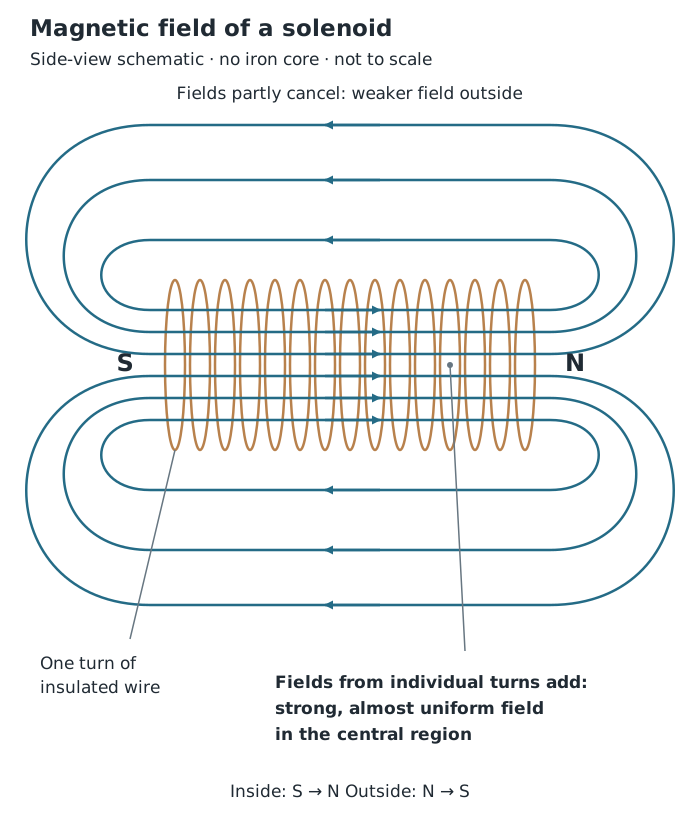
The fields of the individual turns add along the centre of a solenoid and partly cancel outside it.
The overall field resembles that of a bar magnet: one end of the solenoid acts as a north pole and the other as a south pole. Outside, field lines run from north to south; inside, they return from south to north, forming continuous loops.
Reversing the current reverses the magnetic field and swaps the poles. Switching off the current removes the field produced by the coil. Unlike a permanent magnet, the solenoid's magnetism can therefore be controlled by its electrical circuit.
Get unlimited access to all revision notes, key terms, and exam tips.
Get unlimited access to all revision notes, key terms, and exam tips.
Describe the field around a straight wire as concentric circles centred on the wire, not lines running along it.
Use conventional current and your right hand for the grip rule, not the direction of electron movement.
Plotting compasses show field direction; iron filings show the pattern but not its direction.
For field strength around a straight conductor, state the qualitative relationships: larger current gives a stronger field; greater distance gives a weaker field.
Explain both parts of the solenoid pattern: the fields add inside and partly cancel outside. Say ‘almost uniform’ and ‘weaker outside’, not ‘perfectly uniform’ and ‘zero outside’.
Magnetic field
A region in which a magnetic pole experiences a force. Its direction is the direction in which the north-seeking end of a compass points.
Conventional current
The direction of positive charge flow: from the positive terminal towards the negative terminal through the external circuit.
Right-hand grip rule
A rule for finding the magnetic field direction around a straight conductor: point your right thumb along the conventional current, and your curled fingers show the field direction.
Solenoid
A long coil of insulated wire that produces a magnetic field when it carries a current.
Electromagnet
A magnet whose magnetic field is produced by an electric current, usually flowing through a coil of wire.
Uniform magnetic field
A magnetic field with the same strength and direction at every point, represented by straight, parallel, equally spaced field lines.
Put your knowledge into practice — try past paper questions for Combined Science
Magnetic field
A region in which a magnetic pole experiences a force. Its direction is the direction in which the north-seeking end of a compass points.
Conventional current
The direction of positive charge flow: from the positive terminal towards the negative terminal through the external circuit.
Right-hand grip rule
A rule for finding the magnetic field direction around a straight conductor: point your right thumb along the conventional current, and your curled fingers show the field direction.
Solenoid
A long coil of insulated wire that produces a magnetic field when it carries a current.
Electromagnet
A magnet whose magnetic field is produced by an electric current, usually flowing through a coil of wire.
Uniform magnetic field
A magnetic field with the same strength and direction at every point, represented by straight, parallel, equally spaced field lines.