Loading…


Loading…
Loading…
Loading…
Edexcel GCSE Combined Science · 1SC0
Edexcel 1SC0 Check the specification (PDF) (opens in a new tab)
A potential difference, or voltage, can be produced without a cell or battery. This is electromagnetic induction: a potential difference is induced when a conductor cuts magnetic field lines, or when the magnetic field passing through a coil changes. If the conductor forms part of a complete circuit, the induced potential difference drives a current.
Imagine a coil connected to a sensitive voltmeter. Pushing a bar magnet into the coil changes the magnetic field passing through it, so the meter deflects. Holding the magnet stationary gives no induced potential difference because the field through the coil is no longer changing. Pulling the same magnet back out reverses the polarity of the induced potential difference, so the meter deflects the other way.
The size of the induced potential difference depends on how rapidly the magnetic field through the coil changes and how many turns experience that change. Keeping other conditions the same:
Reversing the direction of movement reverses the polarity of the induced potential difference. Reversing the magnet's poles while keeping the movement the same also reverses the polarity. In a complete circuit, reversing the polarity reverses the induced current.
An induced current produces its own magnetic field. This field opposes the change that caused the induction.
For example, push a magnet north-pole first towards a coil in a complete circuit. The near end of the coil becomes a north pole, repelling the approaching magnet and resisting its movement. Pull the north pole away instead, and the near end of the coil becomes a south pole. It now attracts the departing magnet, again resisting the movement.
These two situations explain why ‘opposes the change’ matters: the coil repels an approaching magnet but attracts a departing one. Its response acts against the movement in both cases.
A transformer has a primary coil, connected to an alternating supply, and a secondary coil, connected to the output circuit. Both are wound around an iron core. Iron is useful because it is easily magnetised.
The alternating current in the primary coil repeatedly changes direction, producing a changing magnetic field. The iron core links this changing field to the secondary coil. The changing magnetic field through the secondary coil induces an alternating potential difference across it. If the secondary circuit is complete, an alternating current flows.
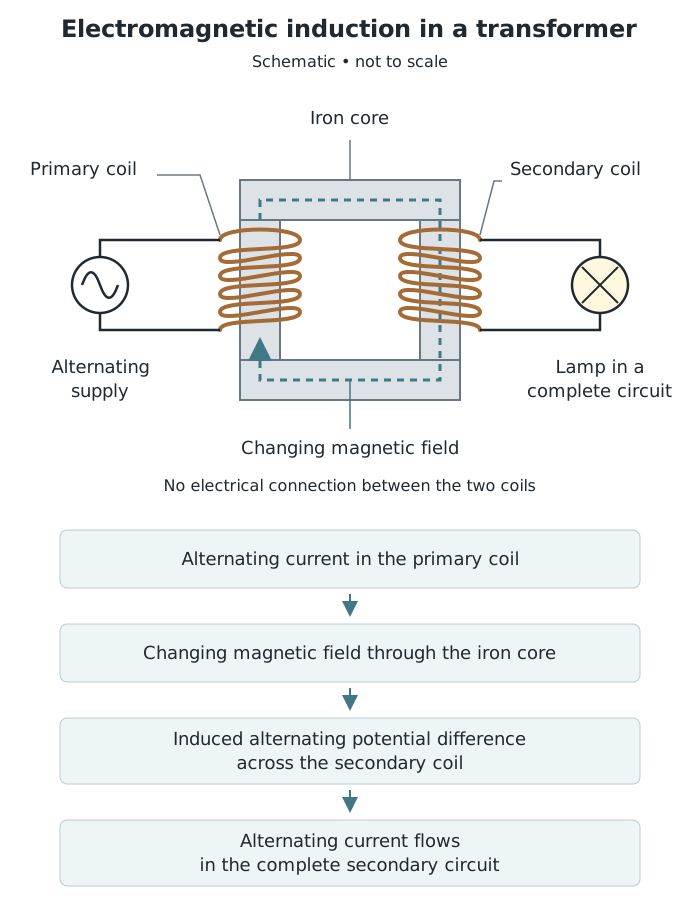
A changing magnetic field links the two separate circuits and induces an alternating output voltage.
The two coils are separate circuits: current does not flow directly from one coil into the other. Energy is transferred through the changing magnetic field. A steady direct current does not maintain a changing field, so it cannot produce a continuous output voltage in this way.
A step-up transformer increases the alternating potential difference. It has more turns on the secondary coil than on the primary coil. A step-down transformer decreases the alternating potential difference and has fewer turns on the secondary coil.
Transformers do not create extra energy. Increasing the voltage does not mean increasing the available power: for an ideal transformer, a higher output voltage is accompanied by a lower output current.
The National Grid transfers electrical energy over long distances. Its transmission cables have resistance, so current heats them. Energy transferred to the cables and surroundings by heating is no longer available to consumers.
Electrical power is related to current and potential difference by:
Here, is power in watts (W), is potential difference in volts (V), and is current in amperes (A). For the same power, increasing the voltage reduces the current. A smaller current causes less heating in the transmission cables, reducing wasted energy and improving the efficiency of transmission.
A step-up transformer near the power station, before long-distance transmission, raises the voltage. Step-down transformers in local areas, before the supply reaches buildings, lower it for domestic use. Homes receive a much lower voltage than the long-distance transmission lines; the domestic mains supply is about 230 V.
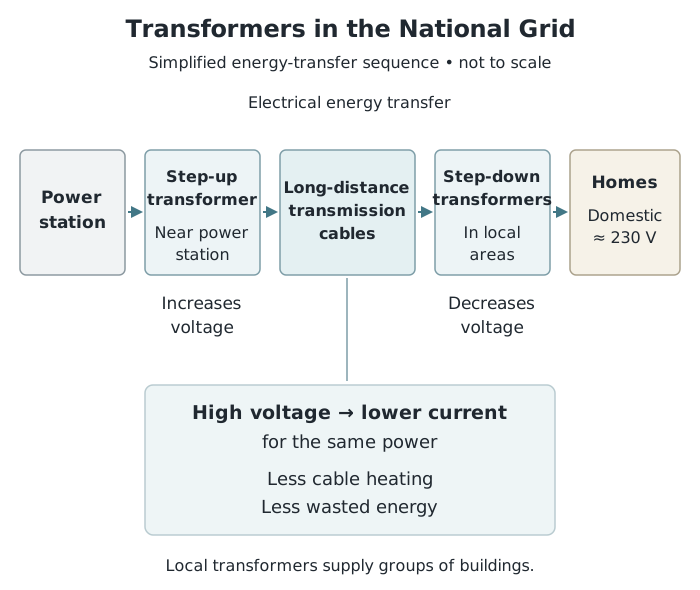
Voltage is raised for efficient long-distance transmission and reduced locally for domestic use.
The key is the combination: high voltage reduces losses during transmission, while the voltage is reduced locally to a level suitable for domestic appliances.
For a transformer with 100% efficiency, the input power equals the output power:
The subscripts and mean primary and secondary. Both potential differences are measured in volts and both currents in amperes. Real transformers waste some energy, so this equality is an ideal assumption.
For example, suppose an ideal transformer has a primary potential difference of 230 V and a primary current of 0.20 A. Its secondary potential difference is 12 V. The input power is , so:
The lower secondary voltage allows a larger secondary current while the power remains 46 W.
You can also rearrange the equation to find a voltage. For an ideal transformer with a primary voltage of 100 V, a primary current of 2 A and a secondary current of 0.5 A:
This transformer steps the voltage up while reducing the current. Both sides transfer the same power, 200 W.
Get unlimited access to all revision notes, key terms, and exam tips.
AC in primary → changing magnetic field in iron core → alternating potential difference in secondary → AC if the secondary circuit is complete.
Power station → step-up transformer → high-voltage transmission → local step-down transformers → domestic supply.
For the same power, : higher voltage → lower current → less cable heating → less wasted energy → greater efficiency.
For 100% efficiency:
Voltages: V. Currents: A. Input power equals output power; stepping voltage up reduces current, and stepping voltage down increases current.
Get unlimited access to all revision notes, key terms, and exam tips.
For induction, say ‘more turns on the coil’ and ‘a stronger magnetic field’: ‘more coils’ and ‘a bigger magnet’ are not equivalent.
Distinguish an induced potential difference from an induced current: current flows only when there is a complete circuit.
Explain high-voltage transmission using the full chain: for the same power, higher voltage means lower current, so less energy is wasted heating the cables.
Use VₚIₚ = VₛIₛ only for a transformer assumed to have 100% efficiency. Convert currents to amperes and voltages to volts before substituting.
The induced magnetic field opposes the change that produces it, not necessarily the original magnetic field.
Potential difference
The energy transferred per unit charge between two points in a circuit, measured in volts (V). It is also called voltage.
Electromagnetic induction
The production of a potential difference across a conductor when it cuts magnetic field lines or when the magnetic field passing through a coil changes.
Alternating current
An electric current that repeatedly changes direction.
Transformer
A device that uses electromagnetic induction between two coils to change the size of an alternating voltage.
Primary coil
The coil of a transformer connected to the input alternating supply.
Secondary coil
The coil of a transformer across which the output alternating potential difference is induced.
Step-up transformer
A transformer that increases the size of an alternating potential difference.
Step-down transformer
A transformer that decreases the size of an alternating potential difference.
National Grid
The network of cables and transformers that transfers electrical energy from power stations to consumers.
Put your knowledge into practice — try past paper questions for Combined Science
Potential difference
The energy transferred per unit charge between two points in a circuit, measured in volts (V). It is also called voltage.
Electromagnetic induction
The production of a potential difference across a conductor when it cuts magnetic field lines or when the magnetic field passing through a coil changes.
Alternating current
An electric current that repeatedly changes direction.
Transformer
A device that uses electromagnetic induction between two coils to change the size of an alternating voltage.
Primary coil
The coil of a transformer connected to the input alternating supply.
Secondary coil
The coil of a transformer across which the output alternating potential difference is induced.
Step-up transformer
A transformer that increases the size of an alternating potential difference.
Step-down transformer
A transformer that decreases the size of an alternating potential difference.
National Grid
The network of cables and transformers that transfers electrical energy from power stations to consumers.