Loading…


Loading…
Loading…
Loading…
Edexcel GCSE Combined Science · 1SC0
Edexcel 1SC0 · Magnets and magnetic fields Check the specification (PDF) (opens in a new tab)
A bar magnet has two poles: north and south. Two magnets can exert forces on each other without touching. Unlike poles attract, so a north pole and a south pole pull towards each other. Like poles repel: two north poles or two south poles push apart.
Iron, cobalt and nickel are magnetic metals. Steel contains iron and is also a magnetic material. Being a magnetic material is not the same as already being a magnet: an unmagnetised piece of iron is attracted to either pole of a magnet, but does not initially have fixed north and south poles of its own.
A permanent magnet retains its magnetism and produces its own magnetic field. Steel can be used to make permanent magnets because it retains magnetism. Permanent magnets are useful in compasses, where a magnetic needle must remain magnetised, and in loudspeakers and electric generators, where a lasting magnetic field is needed.
Cobalt and nickel are also used as ingredients of permanent-magnet alloys. For example, Alnico contains aluminium, nickel, cobalt and iron. Alnico permanent magnets are used in electric guitar pickups and electric motors, providing a lasting magnetic field. These uses involve cobalt and nickel within an alloy, rather than necessarily as pure metals.
An induced magnet forms when a magnetic material is placed in another magnetic field. The material becomes magnetised, developing a north pole and a south pole. For example, bringing the north pole of a permanent magnet near an unmagnetised iron object induces a south pole at the object's nearer end and a north pole at its farther end. The nearer unlike poles attract, pulling the iron towards the magnet.
Temporary magnetic materials lose most or all of their induced magnetism when the external field is removed. Iron is useful as a temporary magnetic core in an electromagnet: it strengthens the magnetic effect while the electromagnet is operating, but does not need to remain strongly magnetised afterwards. This is the practical contrast with a permanent magnetic material such as steel: sometimes a lasting magnet is useful, and sometimes magnetism needs to be switched on and off.
A magnetic field is a region where a magnet or magnetic material experiences a magnetic force. Field lines are a drawing convention that represents this invisible field; they are not physical threads surrounding a magnet.
Around a bar magnet, the field lines curve from one pole to the other. Outside the magnet, arrows point from north to south. At any point, the arrow shows the direction in which the north pole of a small compass would point.
The concentration of lines represents field strength. Closely spaced lines show a stronger field; widely spaced lines show a weaker field. A bar magnet's field is strongest near its poles and becomes weaker farther away.
A uniform magnetic field has the same strength and direction throughout a region. It is represented by straight, parallel, equally spaced field lines. An approximately uniform field can be produced in the central part of a narrow gap between broad, facing north and south poles. Near the edges, the lines curve and the field is no longer uniform.
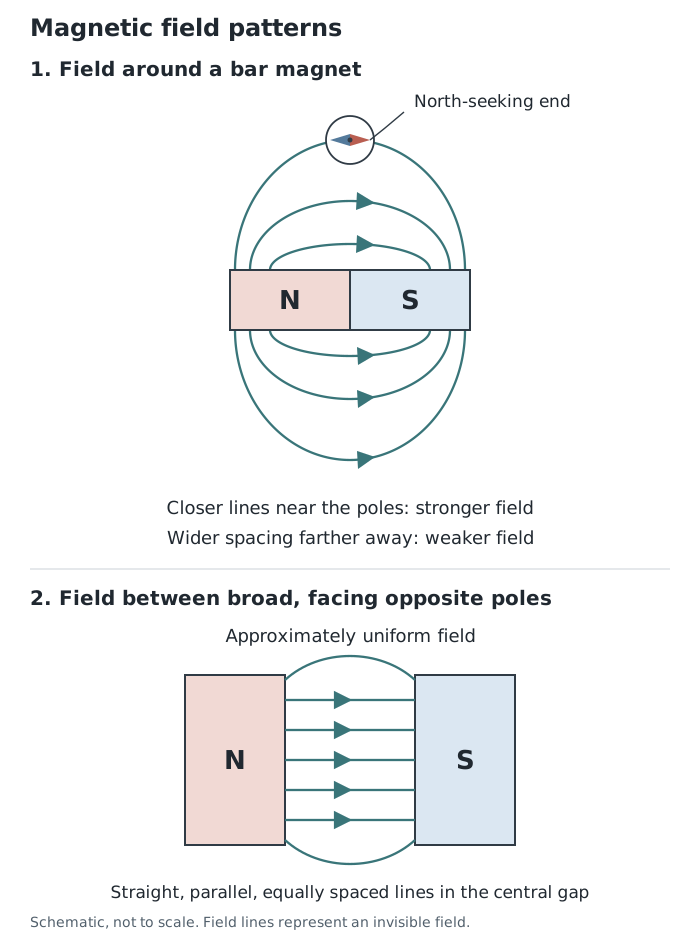
Field-line arrows show direction; line spacing represents relative strength. The central gap between facing opposite poles can have an approximately uniform field.
A plotting compass contains a small magnetic needle that can turn freely. Its north-seeking end points along the local magnetic field. One compass reading therefore gives the field direction at one position; moving the compass lets you trace the field's shape.
To map a bar magnet's field, use a bar magnet, paper, a pencil and a plotting compass:
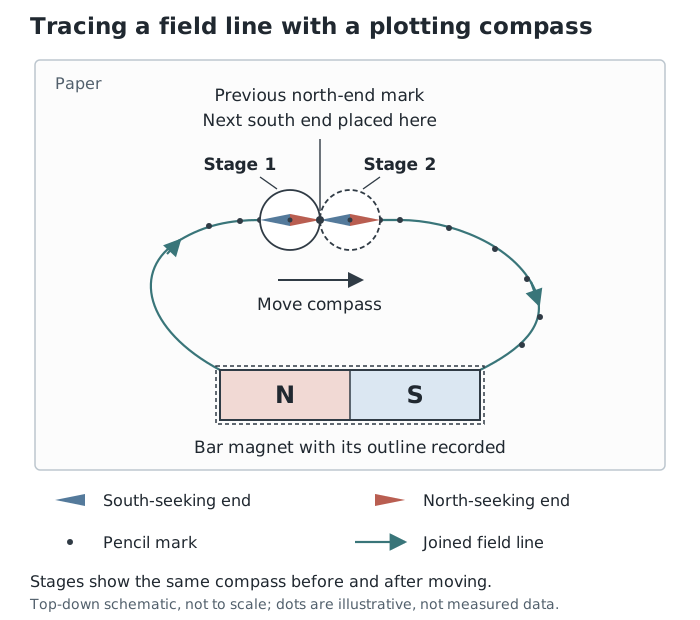
Move the compass along its previous north-end mark, record the next direction, and join the points to trace a field line.
The needle lies along the field line at each position. Near a pole, different traced lines crowd together; farther away, they spread apart. This connects the measured directions to the field pattern and its relative strength.
Away from nearby magnets and magnetic objects, a freely turning compass needle still settles in a particular direction. Its north-seeking end points roughly towards geographic north. The needle is responding to the Earth's magnetic field.
You can demonstrate this with plotting compasses on paper away from magnets, iron objects and electrical equipment. Mark the direction of the north-seeking end at several positions. Across a small area, the needles point in approximately the same direction because the Earth's field is approximately uniform on that scale. Turn a compass away from that direction and release it: the needle returns to alignment with the field.
This behaviour provides evidence that the Earth has a magnetic field associated with a magnetic core. A compass is itself a small magnet, so its repeated alignment shows that a magnetic influence exists even when no nearby bar magnet is present. It does not mean that the core is a solid permanent bar magnet.
The north-seeking pole of a compass is attracted towards the Arctic region. Since unlike poles attract, that region behaves as a magnetic south pole, despite being near geographic north. Geographic directions and magnetic pole types must therefore be distinguished.
Get unlimited access to all revision notes, key terms, and exam tips.
Attraction alone does not prove that an object is a magnet: an unmagnetised magnetic material is also attracted. Repulsion by a known magnet is evidence that the object is itself a magnet.
When drawing magnetic fields, include arrows from north to south outside the magnet. Field lines must not cross.
Show a uniform field using straight, parallel, equally spaced lines with arrows pointing in the same direction.
In a compass investigation, use the north-seeking end of the needle to mark the field direction.
Magnetic field
A region where a magnet or magnetic material experiences a magnetic force.
Magnetic pole
One of the two regions of a magnet, called north and south, where its magnetic effect is strongest.
Magnetic material
A material that is attracted to a magnet and can become magnetised, such as iron, steel, cobalt or nickel.
Permanent magnet
A magnet that retains its magnetism and produces its own magnetic field without needing an external magnetic field.
Induced magnet
A magnetic material that becomes magnetised when placed in another magnetic field. A temporary induced magnet loses most or all of its magnetism when that field is removed.
Uniform magnetic field
A magnetic field with the same strength and direction at every point.
Plotting compass
A small compass whose freely turning magnetic needle shows the direction of the magnetic field at its position.
Put your knowledge into practice — try past paper questions for Combined Science
Magnetic field
A region where a magnet or magnetic material experiences a magnetic force.
Magnetic pole
One of the two regions of a magnet, called north and south, where its magnetic effect is strongest.
Magnetic material
A material that is attracted to a magnet and can become magnetised, such as iron, steel, cobalt or nickel.
Permanent magnet
A magnet that retains its magnetism and produces its own magnetic field without needing an external magnetic field.
Induced magnet
A magnetic material that becomes magnetised when placed in another magnetic field. A temporary induced magnet loses most or all of its magnetism when that field is removed.
Uniform magnetic field
A magnetic field with the same strength and direction at every point.
Plotting compass
A small compass whose freely turning magnetic needle shows the direction of the magnetic field at its position.
Get unlimited access to all revision notes, key terms, and exam tips.