Loading…


Loading…
Loading…
Loading…
Edexcel GCSE Combined Science · 1SC0
Edexcel 1SC0 · Domestic electricity and power Check the specification (PDF) (opens in a new tab)
A voltage, or potential difference, drives the movement of charge around a complete circuit. Whether its polarity stays the same or reverses determines whether it produces direct or alternating current.
A direct voltage has a fixed polarity: its positive and negative terminals do not exchange roles. A cell provides an approximately steady direct voltage. In a circuit powered by a cell or battery, charge moves in one direction only. This is direct current, or d.c.
An alternating voltage repeatedly reverses polarity. The direction in which it drives charge therefore reverses too, producing alternating current, or a.c. Charge moves back and forth rather than continuously travelling in one direction.
A voltage–time graph makes this difference visible. A steady direct voltage is a horizontal line on one side of zero. An alternating voltage repeatedly crosses zero, taking positive and negative values. The signs show opposite polarities, not whether electricity is present or absent.
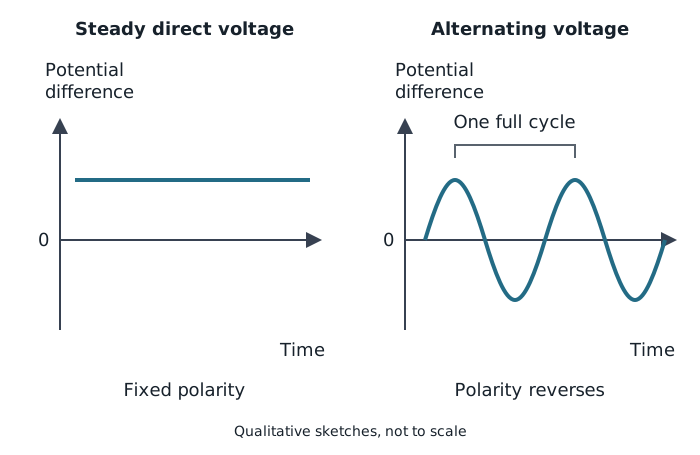
A steady direct voltage stays on one side of zero; an alternating voltage repeatedly reverses polarity.
The electricity supplied to UK homes is a.c., with a frequency of 50 Hz and a potential difference of about 230 V.
Frequency is the number of complete cycles each second. At 50 Hz, the pattern repeats 50 times every second: during each complete cycle, the current flows one way and then the other. The quoted 230 V describes the mains supply; it does not mean that the alternating voltage remains at a constant value.
The live wire carries the alternating potential difference from the supply to the appliance. The neutral wire completes the circuit with the live wire, allowing current to flow through the appliance. Both are involved in its normal operation.
The earth wire has a different job: safety. In an earthed appliance with a metal case, it connects the case to earth. It normally carries no current, but provides a path for current if a fault makes the case live.
In a modern UK three-core cable, the insulation colours identify the wires:
| Wire | Insulation colour | Potential relative to earth |
|---|---|---|
| Live | Brown | Alternating; about 230 V mains value |
| Neutral | Blue | Approximately 0 V |
| Earth | Green and yellow stripes | 0 V |
Consequently, the potential difference is about 230 V between live and neutral, about 230 V between live and earth, and approximately 0 V between neutral and earth. Neutral is normally close to earth potential, but this is not a guarantee that it is safe to touch.
Imagine that damaged insulation allows a live wire inside a metal-cased appliance to touch its case. Without effective earthing, the case could become live. A person touching it while connected to earth could complete a circuit through their body.
The earth wire provides a low-resistance path from the metal case to earth. When the live wire touches the earthed case, a large fault current flows through the live wire and the earth path.
A fuse contains a thin wire. If the current becomes too large, the wire heats up and melts, breaking the circuit. In this fault, the large current causes the fuse in the live wire to melt, disconnecting the appliance from the live supply. Earthing and the fuse work together: the earth path allows the fault current to flow, and the fuse interrupts it.
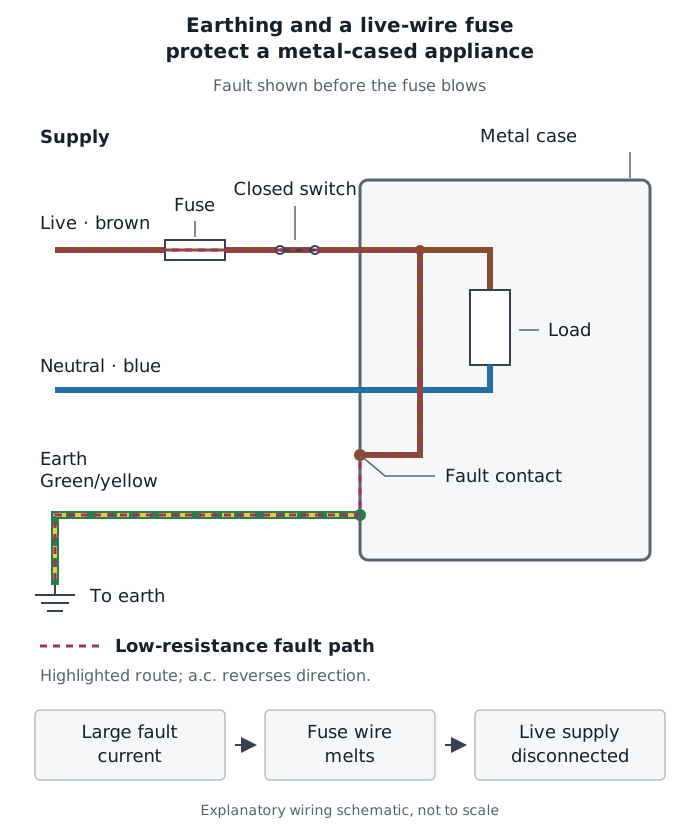
If live touches an earthed metal case, the low-resistance earth path allows a large fault current that blows the fuse.
A circuit breaker also disconnects the supply when the current becomes too large, but it uses an automatic switch rather than a wire that melts. Unlike a blown fuse, it can be reset and used again once the fault has been corrected. These devices also reduce the risk of overheating and fire caused by excessive current.
A switch in the live wire disconnects the appliance from the live supply when it is opened. A fuse in the live wire does the same when it blows.
If either were placed only in the neutral wire, opening the circuit would stop the normal current, but the appliance would remain connected to live. Parts inside could still be at a dangerous potential relative to earth. No current flowing through an appliance does not necessarily mean that it is safe.
There is a large potential difference between live and earth. An accidental low-resistance connection between them can produce a very large current, causing heating, burns or fire.
If a person provides the connection, current can pass through their body and cause a potentially fatal electric shock. A fuse is not a guarantee against this: a dangerous current through a person may be too small to blow it.
Even when an appliance is switched off, the live wiring on the supply side of its switch can remain dangerous. Mains electricity must not be used for classroom experiments or investigated by touching exposed wires.
Get unlimited access to all revision notes, key terms, and exam tips.
| Wire pair | Potential difference |
|---|---|
| Live–neutral | About 230 V |
| Live–earth | About 230 V |
| Neutral–earth | Approximately 0 V |
Get unlimited access to all revision notes, key terms, and exam tips.
Describe d.c. and a.c. in terms of charge movement: one direction only for d.c.; repeatedly changing direction for a.c.
50 Hz means 50 complete cycles each second, not just 50 individual reversals.
For an earthing explanation, link each step: live wire touches metal case → current flows through the low-resistance earth path → fuse melts or circuit breaker trips → live supply is disconnected.
Explain that a switch or fuse in the neutral wire could stop the current while leaving the appliance connected to the live supply.
Do not describe the neutral wire as always safe to touch, or assume that a fuse prevents every electric shock.
Direct voltage
A potential difference whose polarity remains the same: the positive and negative terminals do not exchange roles.
Alternating voltage
A potential difference whose polarity repeatedly reverses.
Direct current (d.c.)
An electric current in which charge moves in one direction only.
Alternating current (a.c.)
An electric current in which the movement of charge repeatedly changes direction.
Frequency
The number of complete cycles each second, measured in hertz (Hz).
Live wire
The mains wire that carries the alternating potential difference from the supply to an appliance.
Neutral wire
The mains wire that completes the circuit with the live wire and is normally close to earth potential.
Earth wire
A safety wire connecting an appliance’s metal case to earth, providing a low-resistance path for current if the case becomes live.
Fuse
A safety device containing a wire that heats up and melts when the current becomes too large, breaking the circuit.
Circuit breaker
An automatic safety switch that opens the circuit when the current becomes too large and can be reset after the fault is corrected.
Put your knowledge into practice — try past paper questions for Combined Science
Direct voltage
A potential difference whose polarity remains the same: the positive and negative terminals do not exchange roles.
Alternating voltage
A potential difference whose polarity repeatedly reverses.
Direct current (d.c.)
An electric current in which charge moves in one direction only.
Alternating current (a.c.)
An electric current in which the movement of charge repeatedly changes direction.
Frequency
The number of complete cycles each second, measured in hertz (Hz).
Live wire
The mains wire that carries the alternating potential difference from the supply to an appliance.
Neutral wire
The mains wire that completes the circuit with the live wire and is normally close to earth potential.
Earth wire
A safety wire connecting an appliance’s metal case to earth, providing a low-resistance path for current if the case becomes live.
Fuse
A safety device containing a wire that heats up and melts when the current becomes too large, breaking the circuit.
Circuit breaker
An automatic safety switch that opens the circuit when the current becomes too large and can be reset after the fault is corrected.