Loading…


Loading…
Loading…
Loading…
Edexcel GCSE Combined Science · 1SC0
Edexcel 1SC0 · Electromagnetic spectrum Check the specification (PDF) (opens in a new tab)
Light is one example of an electromagnetic wave. Radio waves, microwaves and X-rays belong to the same family, even though we cannot see them.
All electromagnetic waves are transverse: their oscillations are perpendicular to the direction in which energy travels. For example, if a wave transfers energy horizontally, its oscillations are at right angles to that direction, rather than backwards and forwards along it.
Electromagnetic waves can travel through a vacuum, a region containing no matter. They do not need a material medium to carry them. This allows radiation from the Sun to reach Earth through space. All electromagnetic waves travel at the same speed in a vacuum, regardless of their wavelength or frequency.
A source emits electromagnetic waves, which carry energy away from it. When an observer or another object absorbs the waves, energy is transferred to that absorber. An ‘observer’ need not be a person: it can be an object receiving the radiation.
For example, a hot heater emits infrared radiation. Your skin absorbs some of this radiation and warms up. The energy has travelled from the heater to your skin by electromagnetic waves.
In a microwave oven, microwaves emitted inside the oven are absorbed by water molecules in food. This transfers energy to the food, increasing its temperature.
Visible light also carries energy. Light emitted by the Sun can reach and be detected by your eyes, allowing you to see. Electromagnetic energy transfer does not always produce an obvious warming effect.
The electromagnetic spectrum is the complete, continuous range of electromagnetic waves. Its main groups, in order, are:
Radio waves → microwaves → infrared → visible light → ultraviolet → X-rays → gamma rays
These names divide up a continuous range; they are not seven isolated wavelengths with gaps between them.
Wavelength is the distance between corresponding points on consecutive waves, such as adjacent crests. Frequency is the number of complete oscillations each second. Because all electromagnetic waves have the same speed in a vacuum, a shorter wavelength corresponds to a higher frequency.
Moving from radio waves towards gamma rays, wavelength decreases and frequency increases. Radio waves have the longest wavelengths and lowest frequencies of these groups; gamma rays have the shortest wavelengths and highest frequencies.
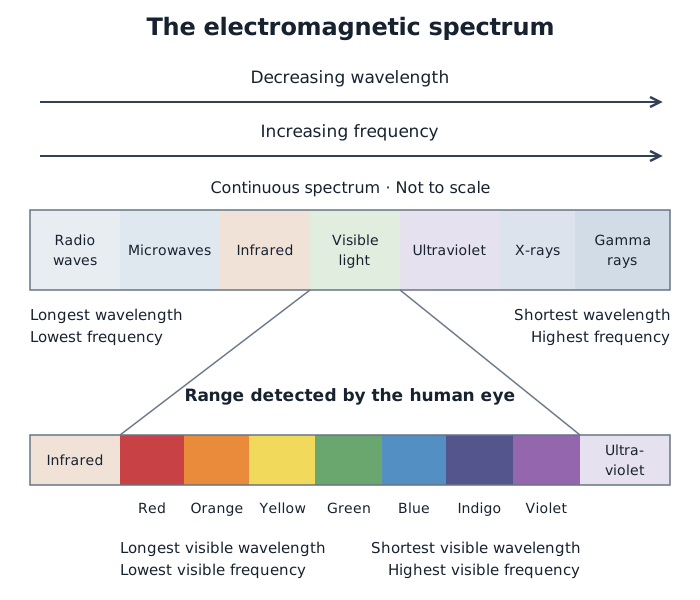
From radio waves to gamma rays, wavelength decreases and frequency increases. The human eye detects only the visible part. Not to scale.
Our eyes detect only a limited range of electromagnetic frequencies: visible light. Infrared and ultraviolet lie immediately outside this range, so neither is visible to the human eye.
Within visible light, the colours run in the order red, orange, yellow, green, blue, indigo, violet. Each colour corresponds to a narrow range of wavelengths and frequencies, with the colours blending continuously into one another.
Red is next to infrared and has the longest wavelength and lowest frequency of visible light. Violet is next to ultraviolet and has the shortest wavelength and highest frequency of visible light. The same wavelength–frequency pattern therefore applies both across the whole spectrum and within its visible part.
Get unlimited access to all revision notes, key terms, and exam tips.
Radio → microwaves → infrared → visible → ultraviolet → X-rays → gamma rays
In this direction: wavelength decreases; frequency increases. The spectrum is continuous, with no gaps between the named groups.
The human eye detects only a limited range of electromagnetic frequencies.
Red → orange → yellow → green → blue → indigo → violet
Get unlimited access to all revision notes, key terms, and exam tips.
Include ‘in a vacuum’ when stating that all electromagnetic waves travel at the same speed.
From radio waves to gamma rays, wavelength decreases but frequency increases.
For an energy-transfer example, identify the source, the electromagnetic wave and the object that absorbs its energy.
Learn the visible colours as well as the seven main spectrum groups: red, orange, yellow, green, blue, indigo, violet.
Electromagnetic wave
A transverse wave that transfers energy from a source to an observer or absorber and can travel through a vacuum.
Transverse wave
A wave whose oscillations are perpendicular to the direction of energy transfer.
Vacuum
A region containing no matter.
Wavelength
The distance between corresponding points on consecutive waves, such as two adjacent crests, measured in metres.
Frequency
The number of complete oscillations each second, measured in hertz (Hz).
Electromagnetic spectrum
The continuous range of electromagnetic radiation, from radio waves to gamma rays.
Visible light
The limited range of electromagnetic radiation that the human eye can detect, extending from red to violet.
Put your knowledge into practice — try past paper questions for Combined Science
Electromagnetic wave
A transverse wave that transfers energy from a source to an observer or absorber and can travel through a vacuum.
Transverse wave
A wave whose oscillations are perpendicular to the direction of energy transfer.
Vacuum
A region containing no matter.
Wavelength
The distance between corresponding points on consecutive waves, such as two adjacent crests, measured in metres.
Frequency
The number of complete oscillations each second, measured in hertz (Hz).
Electromagnetic spectrum
The continuous range of electromagnetic radiation, from radio waves to gamma rays.
Visible light
The limited range of electromagnetic radiation that the human eye can detect, extending from red to violet.