Loading…


Loading…
Loading…
Loading…
Edexcel GCSE Combined Science · 1SC0
Edexcel 1SC0 · Refraction and material interaction Check the specification (PDF) (opens in a new tab)
Water ripples move slowly enough to watch travelling across a tank. Sound travels through a metal rod so quickly that timing its journey with a handheld stopwatch is unsuitable. This core practical investigates how to measure wave speed, frequency and wavelength in a fluid and a solid, and why different equipment suits each measurement.
A fluid is a substance that can flow; here, the fluid is water. Wave speed is the distance a wave travels each second. Frequency is the number of complete waves passing a point each second, and wavelength is the distance between matching points on consecutive waves, such as neighbouring crests.
There are two ways to calculate wave speed:
Here, is speed in m/s, is distance in metres, is time in seconds, is frequency in hertz (Hz), and is wavelength in metres. The second equation works because each complete wave advances the pattern by one wavelength: the number of waves per second multiplied by the length of each wave gives distance per second.
Use a ripple tank, a motor-driven straight dipper, a ruler and a stopwatch. A digital camera, if available, helps with measuring wavelength. Place the dipper near a short side of the tank and fasten the ruler along a long side, with its markings visible above the water. Adjust the motor until the wavelength is about half the tank's length, so that two waves can be seen.
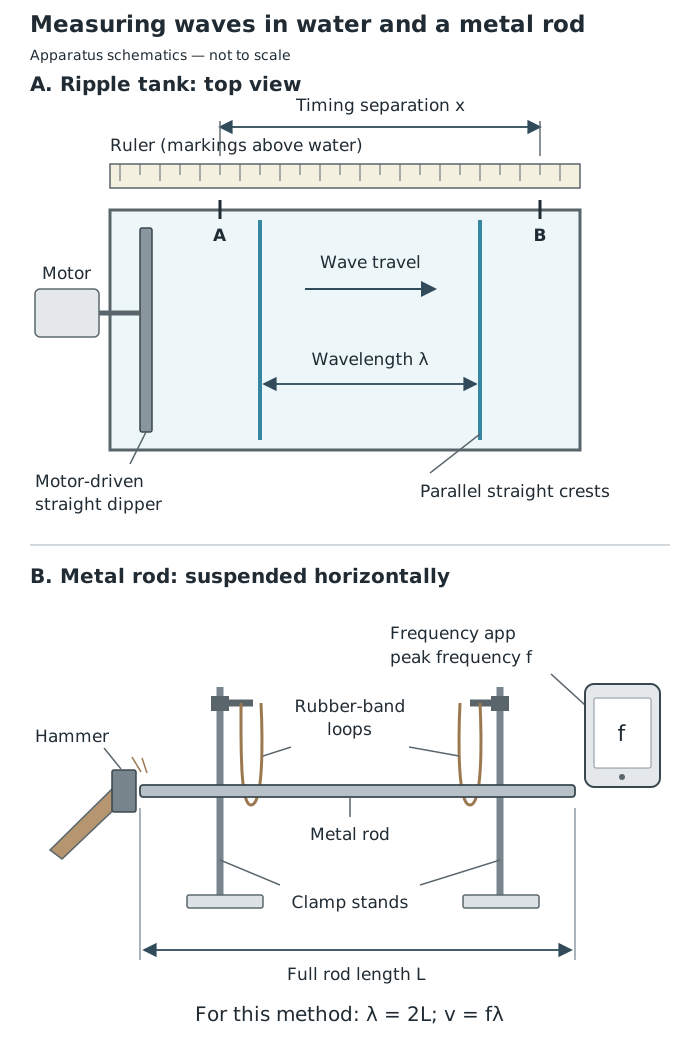
Water ripples can be observed and timed directly. For the rod, measure frequency and length, then calculate wave speed.
Measure the wave properties in three ways:
Use your measured frequency and wavelength to calculate a second estimate of speed using . These are two methods of measuring the same wave speed, so compare their results. They may differ because locating moving crests and starting or stopping a stopwatch introduce measurement uncertainty.
Mop up spilled water straight away, and keep water away from electrical equipment.
A stopwatch may display hundredths of a second, but this does not mean a person can start and stop it that accurately. Resolution is the smallest change an instrument can distinguish; human reaction time can still limit a measurement made with a high-resolution instrument.
For direct speed measurements, use the greatest practical separation between the two marks. A longer journey gives a longer timing interval, reducing the relative effect of reaction time. Repeat the timing and calculate a mean to reduce the effect of random variation.
For wavelength, a clear photograph is useful because the waves no longer move while you read the ruler. If several complete wavelengths fit in view, measure their total length and divide by the number of wavelength intervals. Count the gaps between crests, not simply the number of crests.
Keep water depth and the motor setting unchanged while comparing the two speed methods. Water-wave speed depends on depth and wavelength, so groups using different depths or frequency settings need not obtain the same result. Sloping absorbing edges, often called beaches, help prevent reflected waves from confusing the pattern.
Use a long metal rod, two clamps and stands, rubber bands, a hammer, a metre rule and a smartphone with a frequency app. Suspend the rod horizontally from the stands using the rubber bands, allowing it to vibrate.
Strike one end with the hammer. Hold the smartphone near the rod and record the peak frequency detected by the app. This measures the frequency of the sound produced by the vibrating rod without requiring you to count its rapid vibrations yourself.
Measure the rod's length, , using the metre rule. For the vibration used in this method, the wavelength is twice the rod's length:
Use this wavelength and the measured frequency in to calculate the speed of sound in the rod. This length–wavelength relationship is provided for the method; it is not a general rule for every vibration of every solid object.
A ruler is suitable for measuring the rod's length because the rod is stationary and its ends are identifiable. A frequency app is suitable for detecting vibrations too rapid to count by eye. By contrast, a handheld stopwatch cannot resolve the extremely short time sound takes to travel along a classroom-sized rod. Measuring the distance accurately would not overcome that timing problem.
Evaluation means explaining how well equipment performs its particular job, not simply saying that it is easy to use. Summarise both parts of the investigation using these headings:
| What was measured? | Which material was this measured for? | How was it measured? | Why was this method chosen? |
|---|---|---|---|
| Frequency | Water | Count waves formed in 10 s; divide by 10 | Slow ripples can be counted, and a longer interval reduces relative counting and timing errors |
| Wavelength | Water | Measure crest separation with a ruler, using a photograph if available | The ruler supplies a length scale; the photograph freezes the moving pattern |
| Speed | Water | Measure a crest's travel distance and time; also calculate | Ripples are slow enough to time, and the second method provides a comparison |
| Frequency | Metal rod | Record the peak frequency with a smartphone app | The vibrations are too rapid to count manually |
| Wavelength | Metal rod | Measure rod length and use for this method | The rod's stationary length is easier to measure than the wavelength directly |
| Speed | Metal rod | Calculate | Direct travel-time measurement is too fast for a handheld stopwatch |
For the rod, compare the quality of the length and frequency measurements rather than assuming one must be better. Consider how precisely the ends can be read, how much repeated readings vary, and whether background noise makes the frequency peak unclear. An app's many displayed digits do not by themselves establish accuracy.
Compare your two water-speed estimates and results from other groups. A useful conclusion identifies which equipment was suitable, what limited each measurement, and which practical change would improve it.
Get unlimited access to all revision notes, key terms, and exam tips.
Judge suitability using resolution, repeatability and difficulties identifying the measured feature. Explain the limitation and a specific improvement. A digital display does not guarantee accuracy.
Get unlimited access to all revision notes, key terms, and exam tips.
Link each equipment choice to the measurement: a ruler measures distance, a stopwatch measures time, and a frequency app measures frequency.
For frequency, divide the number of complete waves by the counting time. For wavelength, measure crest to crest, not crest to trough.
Convert distances to metres before calculating wave speed in m/s.
Explain improvements specifically: a longer timing interval reduces the relative effect of reaction time; a photograph makes moving crests easier to locate.
Do not assume a digital reading is automatically accurate. Consider resolution, repeatability and whether the app has identified the correct frequency peak.
The relationship between wavelength and rod length is supplied for this method; you are not expected to recall it as a general fact about solid objects.
Wave speed
The distance travelled by a wave per second, measured in metres per second (m/s).
Frequency
The number of complete waves passing a point each second, measured in hertz (Hz).
Wavelength
The distance between matching points on consecutive waves, such as one crest and the next, measured in metres (m).
Fluid
A substance that can flow, such as a liquid or a gas.
Ripple tank
A shallow tank of water used to produce and observe waves on the water surface.
Resolution
The smallest change in a quantity that a measuring instrument can distinguish.
Put your knowledge into practice — try past paper questions for Combined Science
Wave speed
The distance travelled by a wave per second, measured in metres per second (m/s).
Frequency
The number of complete waves passing a point each second, measured in hertz (Hz).
Wavelength
The distance between matching points on consecutive waves, such as one crest and the next, measured in metres (m).
Fluid
A substance that can flow, such as a liquid or a gas.
Ripple tank
A shallow tank of water used to produce and observe waves on the water surface.
Resolution
The smallest change in a quantity that a measuring instrument can distinguish.