Loading…


Loading…
Loading…
Loading…
Edexcel GCSE Combined Science · 1SC0
Edexcel 1SC0 · Electromagnetic spectrum Check the specification (PDF) (opens in a new tab)
Visible light is an electromagnetic wave, so a glass-block investigation lets us observe how electromagnetic waves interact with matter. The air and glass are different media: substances through which the wave travels.
A wave can be transmitted, passing through a substance, or absorbed, transferring energy to it. At a boundary, some of the wave may be reflected back into the original medium. A transmitted wave may also be refracted: its direction changes because it travels at a different speed in the new medium. These processes are not mutually exclusive. A glass window can transmit much of the visible light while also reflecting some of it.
A ray is a line representing the direction in which light travels. Arrowheads show its direction. To describe how it bends, draw a normal at the point where it meets a boundary. This line is perpendicular to the surface. Measure the angle of incidence, , between the incoming ray and the normal, and the angle of refraction, , between the transmitted ray and the normal.
Light travels more slowly in glass than in air. When it enters glass at an angle, it bends towards the normal, so . When it leaves glass for air, it speeds up and bends away from the normal, so at that boundary.
The opposite faces of a rectangular block are parallel. The bending at the second face reverses the change in direction at the first, so the emerging ray is parallel to the original incoming ray, but usually displaced sideways. If the ray enters along the normal, it changes speed but does not change direction at either face.
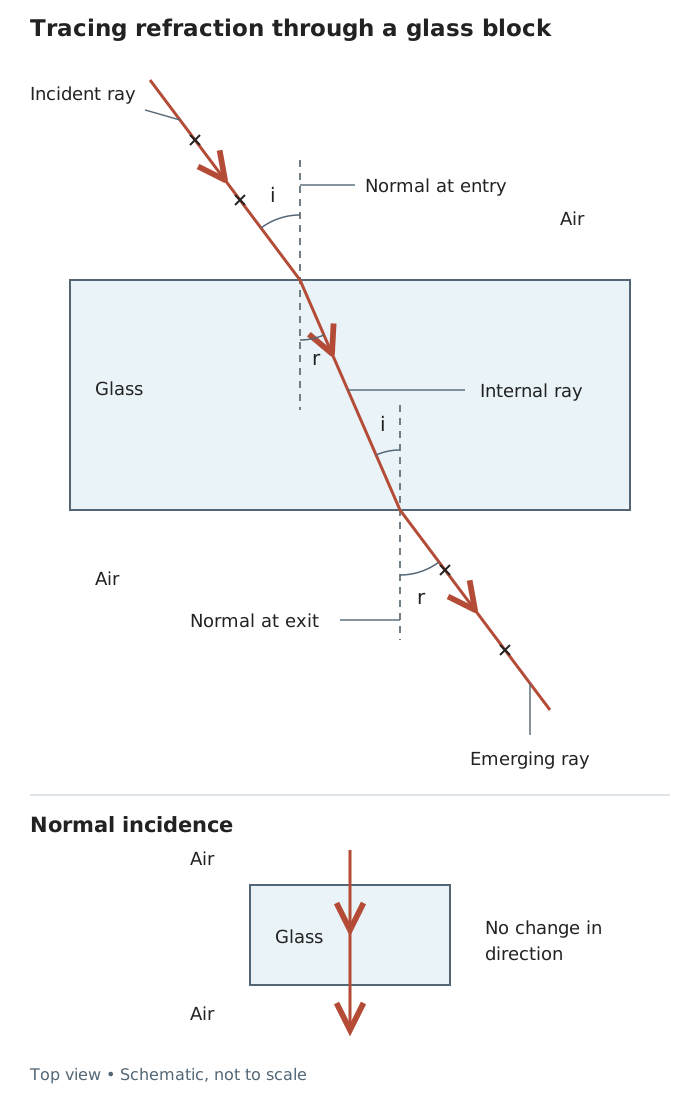
Measure angles from the normal at each face. The ray bends towards the normal on entering glass and away from it on leaving.
The aim is to investigate light travelling from air into glass and from glass into air. Use a ray box with a single slit, low-voltage power supply, rectangular glass block, plain paper, ruler and protractor. The slit produces one narrow ray whose path can be marked accurately. Ray boxes can become hot enough to cause burns, so avoid touching hot parts.
Keep the material and block the same while changing the entry angle. This allows you to investigate how angle of refraction depends on angle of incidence, rather than mixing the effects of angle and material.
Record four angles for each trial, keeping the entry and exit measurements in separate pairs:
| Air to glass: / ° | Air to glass: / ° | Glass to air: / ° | Glass to air: / ° |
|---|
Plot a scatter graph with angle of incidence on the horizontal axis and angle of refraction on the vertical axis, both in degrees. Plot the air-to-glass and glass-to-air results on the same axes, distinguish the two sets, and draw a separate smooth curve of best fit for each. Each curve should follow the overall trend rather than joining successive measurements with straight segments.
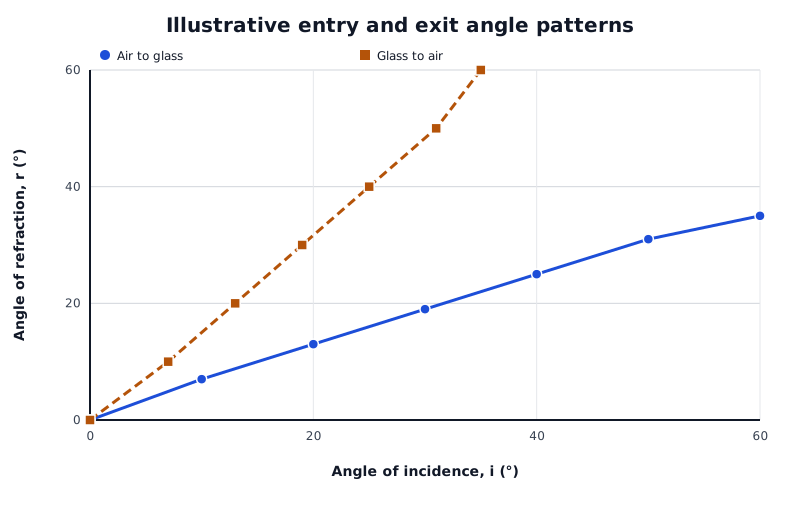
Straight joins guide the eye; they are not smooth curves of best fit. Entry bends towards the normal, while exit bends away.
Data for Illustrative entry and exit angle patterns
| Series | Angle of incidence, i (°) | Angle of refraction, r (°) |
|---|---|---|
| Air to glass | 0 | 0 |
| Air to glass | 10 | 7 |
| Air to glass | 20 | 13 |
| Air to glass | 30 | 19 |
| Air to glass | 40 | 25 |
| Air to glass | 50 | 31 |
| Air to glass | 60 | 35 |
| Glass to air | 0 | 0 |
| Glass to air | 7 | 10 |
| Glass to air | 13 | 20 |
| Glass to air | 19 | 30 |
| Glass to air | 25 | 40 |
| Glass to air | 31 | 50 |
| Glass to air | 35 | 60 |
The graph shows the pattern to look for. Its straight joins are only guides to the pattern, not examples of smooth best-fit curves. In both directions, increasing the angle of incidence increases the angle of refraction: there is a positive correlation. For air to glass, the refracted angle is smaller than the incident angle; for glass to air, it is larger. For example, the air-to-glass point represents bending towards the normal. The corresponding exit measurement is approximately , representing bending away from it.
Use your ray traces as well as the graph: the incoming and emerging rays should be parallel. Together, these observations support the conclusion that light changes direction at the boundaries because it travels at different speeds in air and glass.
To evaluate accuracy, consider how precisely you could locate the ray centres and read the angles. A narrow ray, small crosses, well-separated marks and thin ruler lines make the path easier to reconstruct. Centre the protractor on the boundary point and align its zero with the normal. Repeating measurements helps reveal inconsistent readings.
A substance does not necessarily interact with all electromagnetic wavelengths in the same way. It may transmit one range, absorb another and reflect another. For example, glass transmits visible light but can absorb ultraviolet radiation. The amount absorbed depends on the type of glass and the wavelength, so being transparent to visible light does not mean being transparent to every electromagnetic wave.
Refraction also depends on wavelength. Different wavelengths can travel at different speeds in the same material and therefore bend by different amounts. A glass prism separates white light into its constituent colours by this process, called dispersion. Violet light is refracted more than red light, spreading the colours into a spectrum.
Get unlimited access to all revision notes, key terms, and exam tips.
Single-slit ray box and power supply; rectangular glass block; paper, ruler and protractor.
Trace block → mark incoming and emerging rays → remove block and join marks → join entry to exit → draw both normals → measure both pairs of angles → repeat at different angles and at normal incidence.
Measure angles from the normal, not from the surface. A ray meeting the surface at right angles has an angle of incidence of 0°.
At the exit face, the incident ray is the ray inside the glass: label and measure the angles using the normal at that face.
For the core practical graph, put angle of incidence on the horizontal axis and angle of refraction on the vertical axis. Plot both directions on the same axes and draw separate smooth curves of best fit.
Explain refraction using a change in wave speed. A speed change does not necessarily change direction: a ray travelling along the normal remains straight.
For wavelength-dependent interactions, identify both the substance and the radiation. Do not assume a material behaves identically across the electromagnetic spectrum.
Medium
A substance through which a wave travels, such as air, water or glass.
Transmission
The passage of a wave through a substance.
Absorption
The transfer of energy from a wave to the substance it encounters.
Reflection
The return of a wave into its original medium after meeting a boundary.
Refraction
A change in the direction of a wave as it passes between substances because its speed changes. There is no change in direction when it crosses along the normal.
Normal
An imaginary line drawn at right angles to a surface at the point where a ray meets it.
Angle of incidence
The angle between an incoming ray and the normal at a boundary.
Angle of refraction
The angle between a transmitted, refracted ray and the normal at a boundary.
Dispersion
The separation of light into its constituent colours because different wavelengths travel at different speeds in a material and are refracted by different amounts.
Put your knowledge into practice — try past paper questions for Combined Science
Medium
A substance through which a wave travels, such as air, water or glass.
Transmission
The passage of a wave through a substance.
Absorption
The transfer of energy from a wave to the substance it encounters.
Reflection
The return of a wave into its original medium after meeting a boundary.
Refraction
A change in the direction of a wave as it passes between substances because its speed changes. There is no change in direction when it crosses along the normal.
Normal
An imaginary line drawn at right angles to a surface at the point where a ray meets it.
Angle of incidence
The angle between an incoming ray and the normal at a boundary.
Angle of refraction
The angle between a transmitted, refracted ray and the normal at a boundary.
Dispersion
The separation of light into its constituent colours because different wavelengths travel at different speeds in a material and are refracted by different amounts.
Record separate pairs for air to glass and glass to air. Plot horizontally and vertically in degrees, with both datasets and separate smooth curves of best fit. Both show positive correlation.
Accuracy: narrow ray, small well-separated marks, thin lines, correct protractor alignment. Safety: ray box may become hot enough to burn.
Get unlimited access to all revision notes, key terms, and exam tips.