Loading…


Loading…
Loading…
Loading…
Edexcel GCSE Combined Science · 1SC0
Edexcel 1SC0 · Work and energy transfers Check the specification (PDF) (opens in a new tab)
A system is an object or group of objects that we choose to study. For a kettle, we might study the heating element, water and casing. Objects outside that chosen system are its surroundings. Choosing the system helps us keep track of where energy is stored and where it goes.
Energy is measured in joules (J). Objects and systems can store energy in different ways:
| Energy store | When it is relevant |
|---|---|
| Kinetic | An object is moving. |
| Gravitational potential | An object is raised in a gravitational field; this store belongs to the interacting object–Earth system. |
| Elastic potential | An object is stretched, compressed or bent. |
| Chemical | Substances, such as fuels, food and batteries, can transfer energy through chemical reactions. |
| Thermal | Energy is associated with the particles within an object. Heating an object increases this store. |
| Magnetic | Magnets or magnetic materials interact. |
| Electrostatic | Electrically charged objects interact. |
| Nuclear | Energy can be released from atomic nuclei during nuclear reactions. |
An object can have more than one store at once. A moving, raised object has both kinetic and gravitational potential energy. For the same object in the same state, a higher temperature means more energy in its thermal store; temperature alone does not let us compare the total thermal energy of different objects.
When a system changes, energy is transferred. A falling apple gains speed: energy in the gravitational potential store of the apple–Earth system decreases while energy in the apple’s kinetic store increases. If air resistance is negligible, almost all of the decrease in gravitational potential energy becomes an increase in kinetic energy.
The store tells us where energy is held. The transfer pathway tells us how energy moves between stores:
These pathways are processes, not stores. For example, an electric kettle does not contain an ‘electrical energy store’: electrical working increases the thermal energy of its element.
An energy flow diagram uses boxes to identify stores and labelled arrows to identify transfer pathways. To construct one, identify the starting store or energy supply, the stores that increase, and how energy reaches them. Include unwanted transfers as well as the intended one.
For a kettle, electrical working heats the element. The element then heats the water, which is the intended result. However, the casing and surrounding air also become warmer.
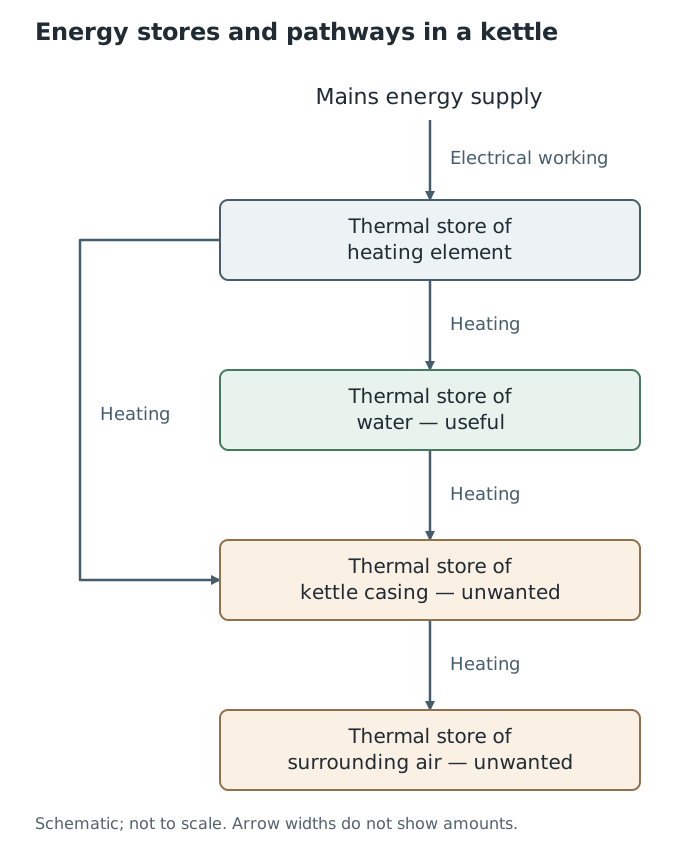
Electrical working increases the element’s thermal energy; heating transfers energy to the water, casing and surroundings.
Read the diagram by following each arrow from its starting point to its destination. The arrow label explains the process; the box label identifies where the energy is stored. This lets you distinguish the useful increase in the water’s thermal store from unwanted increases in other thermal stores.
Conservation of energy means that energy cannot be created or destroyed. It can only be transferred between stores. In a closed system, transfers produce no net change in the system’s total energy:
Individual stores can still change. As an apple falls, its kinetic energy increases while gravitational potential energy decreases. Conservation does not mean that every store stays constant.
The system boundary matters. A hot mug loses energy as it warms the surrounding air. If we study only the mug, its thermal energy decreases. If we include the mug and everything receiving that energy, the decrease is balanced by increases elsewhere. Energy leaving one object has not disappeared.
In real system changes, some energy is inevitably dissipated: it spreads out into less useful stores, usually thermal stores of the surroundings. The energy still exists, but it becomes difficult to collect and use for the original purpose.
Friction and air resistance cause this during movement. When a bicycle’s chain and gears rub together, energy is transferred mechanically into their thermal stores. They warm up and then transfer energy by heating to the surroundings. Not all the rider’s energy transfer therefore contributes to moving the bicycle.
Electrical equipment also warms up. In a kettle, increasing the water’s thermal energy is useful, but warming the casing and room is generally unwanted. In a filament lamp, the hot filament emits useful visible light, but much of the energy warms the surroundings instead.
‘Useful’ and ‘wasted’ describe whether a transfer helps achieve the intended task. Neither term changes the conservation rule: useful energy and wasted energy must both be included in the energy account.
A Sankey diagram represents energy transfers using arrows whose widths are proportional to the amounts of energy. The input arrow splits into outputs: the useful output usually continues straight ahead, while wasted outputs branch away.
To draw one, choose a scale for the widths, draw the input arrow, and split it into output arrows using the same scale. The output widths must add up to the input width because energy is conserved:
The following kettle diagram represents an electrical input of 1000 J. Of this, 800 J increases the water’s thermal energy and 200 J increases the thermal energy of the casing and surroundings.
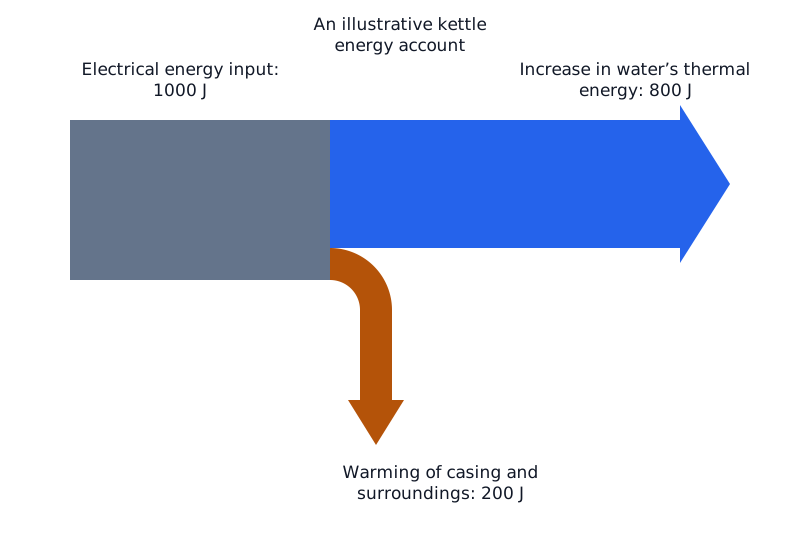
For example, 1000 J of electrical input becomes 800 J of useful water heating and 200 J of unwanted warming. Arrow widths show these proportions.
Electrical energy input: 1000 J. Increase in water’s thermal energy: 800 J. Warming of casing and surroundings: 200 J. Wasted energy = 1000 − 800 = 200 J. Efficiency = 800 ÷ 1000 × 100% = 80%. Arrow shaft widths are proportional to energy.
The useful arrow is four times as wide as the wasted arrow because 800 J is four times 200 J. The two output amounts total 1000 J, matching the input. If the input and useful output are known, the wasted transfer is found by subtracting the useful output from the input.
Get unlimited access to all revision notes, key terms, and exam tips.
Stores: kinetic, gravitational potential, elastic potential, chemical, thermal, magnetic, electrostatic and nuclear.
Transfer pathways: mechanical working, electrical working, heating and radiation. Stores hold energy; pathways describe its transfer. Energy is measured in joules (J).
Energy cannot be created or destroyed. In a closed system, total energy stays constant although individual stores change.
Real system changes spread some energy into less useful stores, usually thermal stores of the surroundings. Friction, air resistance and electrical resistance cause unwanted warming. Wasted energy is not destroyed.
Flow diagram: boxes identify stores; arrows identify pathways.
Sankey diagram: arrow widths show energy amounts. Output widths add up to the input width.
Get unlimited access to all revision notes, key terms, and exam tips.
Name the initial and final energy stores, then state the transfer pathway between them.
Electrical working, heating and radiation are transfer pathways, not energy stores. Avoid describing a ‘light store’ or ‘sound store’.
Do not say that wasted energy is destroyed. State where it goes, usually into thermal stores of objects and the surroundings.
In a Sankey diagram, arrow widths represent amounts of energy, not the speed of transfer. The output widths must add up to the input width.
Whether a transfer is useful depends on the purpose of the device: heating water is useful in a kettle, but heating a motor is usually unwanted.
System
An object or group of objects chosen for study.
Energy store
A way in which energy is held by an object or a system, such as a kinetic, chemical or thermal store.
Energy transfer pathway
A process by which energy moves between stores, such as mechanical working, electrical working, heating or radiation.
Closed system
A system in which energy transfers produce no net change in the total energy.
Conservation of energy
The principle that energy cannot be created or destroyed; it can only be transferred between stores.
Dissipation
The spreading out of energy into less useful stores, usually thermal stores of the surroundings.
Sankey diagram
A diagram in which arrow widths are proportional to the amounts of energy transferred, with branches showing different outputs.
Joule
The unit of energy, represented by the symbol J.
Put your knowledge into practice — try past paper questions for Combined Science
System
An object or group of objects chosen for study.
Energy store
A way in which energy is held by an object or a system, such as a kinetic, chemical or thermal store.
Energy transfer pathway
A process by which energy moves between stores, such as mechanical working, electrical working, heating or radiation.
Closed system
A system in which energy transfers produce no net change in the total energy.
Conservation of energy
The principle that energy cannot be created or destroyed; it can only be transferred between stores.
Dissipation
The spreading out of energy into less useful stores, usually thermal stores of the surroundings.
Sankey diagram
A diagram in which arrow widths are proportional to the amounts of energy transferred, with branches showing different outputs.
Joule
The unit of energy, represented by the symbol J.