Loading…


Loading…
Loading…
Loading…
Edexcel GCSE Combined Science · 1SC0
Edexcel 1SC0 · Work and energy transfers Check the specification (PDF) (opens in a new tab)
In physics, work is done when a force moves an object through a distance in the direction of that force. A person lifting a bucket and a motor pulling a rollercoaster uphill both do work. The force transfers energy mechanically, changing how energy is stored.
Work done and energy transferred are equal, and both are measured in joules (J). Applying a force is not enough on its own: if you push against a wall and it does not move, you do no work on the wall, even though your muscles may become tired.
For a constant force:
Here, is work done or energy transferred in joules, is force in newtons (N), and is distance moved in the direction of the force in metres (m). A larger force or a greater distance means more energy is transferred. A force of 1 N acting through 1 m transfers 1 J.
For example, pushing a shopping trolley with a constant force of 250 N through 20 m in the direction of the push transfers:
This tells us how much energy the push transfers; it does not mean that all of that energy must become kinetic energy. Some may be transferred by work against friction.
To measure work, you need to measure both the force and the distance over which it acts. A newton meter measures force; a ruler or tape measure measures distance.
Attach a newton meter to an object and pull it along a horizontal surface. Keep the meter horizontal and pull steadily so that its reading remains approximately constant. Record the force in newtons. Mark the object's starting and finishing positions and measure the distance between them in metres, along the direction of the pull. Multiply the measured force by this distance to find the work done by the pulling force.
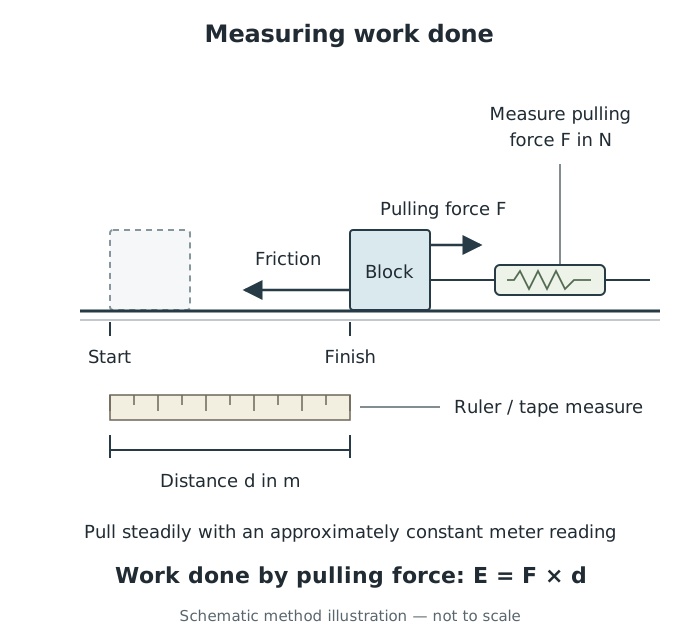
Measure the pulling force and the distance moved in its direction to calculate the work done.
Moving the object at a steady speed does not mean that no work is done. The pulling force still transfers energy, while friction transfers energy to thermal stores rather than allowing the object to gain kinetic energy.
Gravitational potential energy is energy stored because of an object's position in a gravitational field. Raising an object transfers energy to its gravitational potential store; lowering it reduces this store.
The change is calculated using:
The symbol means ‘change in’. Here, is mass in kilograms (kg), is gravitational field strength in newtons per kilogram (N/kg), and is the change in vertical height in metres. The energy change is in joules.
This equation connects directly to work done. An object's weight is . When it is lifted at a steady speed, the upward lifting force equals its weight. Multiplying that force by the vertical distance gives : the work done against gravity equals the gain in gravitational potential energy.
A bucket containing water has a total mass of 12 kg and is raised vertically by 15 m. With :
The bucket gains 1800 J in its gravitational potential store. The lifting force does 1800 J of work if the bucket's speed does not change and other transfers can be neglected. For a fixed mass and gravitational field strength, doubling the height gained doubles the energy gained.
Kinetic energy is the energy an object has because it is moving. Its value depends on both mass and speed:
Here, is in joules, is mass in kilograms, and is speed in metres per second (m/s).
At the same speed, doubling an object's mass doubles its kinetic energy. Speed has a stronger effect because it is squared: doubling the speed gives four times the kinetic energy, while tripling it gives nine times the kinetic energy.
A force can increase or decrease an object's kinetic energy. A forward force can make an object speed up; braking forces reduce its kinetic energy and transfer energy to thermal stores of the brakes and surroundings.
For a car stopped by a braking force of 500 N over 23 m, the amount of work done by the brakes is:
If braking accounts for the whole decrease, the car loses 11 500 J from its kinetic store. The energy is transferred, not destroyed.
When an object falls, gravity does work and energy is transferred from its gravitational potential store to its kinetic store. If it starts from rest and air resistance is negligible, the kinetic energy gained equals the gravitational potential energy lost:
The same connection applies to a rollercoaster descending a track when friction and air resistance are ignored. If resistive forces matter, some energy is transferred to thermal stores, so the kinetic energy gained is smaller than the gravitational potential energy lost.
Get unlimited access to all revision notes, key terms, and exam tips.
Convert mass to kilograms, distance or height to metres, and speed to metres per second before substituting.
Use the distance moved in the direction of the force. For gravitational potential energy, use the change in vertical height, not the length of a slope.
In the kinetic energy equation, square the speed before multiplying by half the mass.
Use the gravitational field strength given in the question; its unit is N/kg.
Only equate gravitational potential energy lost with kinetic energy gained when other energy transfers can be neglected.
Work done
Energy transferred by a force when an object moves through a distance in the direction of that force. It is measured in joules (J).
Joule
The SI unit of energy and work done. One joule is the work done by a force of one newton moving an object one metre in the direction of the force.
Gravitational potential energy
Energy stored because of an object's position in a gravitational field, measured relative to a chosen height.
Gravitational field strength
The force per kilogram acting on a mass in a gravitational field, measured in newtons per kilogram (N/kg).
Kinetic energy
The energy an object has because it is moving. It depends on its mass and the square of its speed.
Put your knowledge into practice — try past paper questions for Combined Science
Work done
Energy transferred by a force when an object moves through a distance in the direction of that force. It is measured in joules (J).
Joule
The SI unit of energy and work done. One joule is the work done by a force of one newton moving an object one metre in the direction of the force.
Gravitational potential energy
Energy stored because of an object's position in a gravitational field, measured relative to a chosen height.
Gravitational field strength
The force per kilogram acting on a mass in a gravitational field, measured in newtons per kilogram (N/kg).
Kinetic energy
The energy an object has because it is moving. It depends on its mass and the square of its speed.
Get unlimited access to all revision notes, key terms, and exam tips.