Loading…


Loading…
Loading…
Loading…
Edexcel GCSE Combined Science · 1SC0
Edexcel 1SC0 · Half-life and radiation hazards Check the specification (PDF) (opens in a new tab)
Ionising radiation has enough energy to remove electrons from atoms. When it passes through living tissue, this ionisation can damage molecules that cells need to function.
There are two important possible consequences. Radiation can damage or kill cells, causing tissue damage. If enough cells are affected, the tissue may no longer work properly. Large exposures can cause injuries such as skin burns.
Radiation can also damage DNA, the genetic material that carries a cell's instructions. A cell may repair this damage, but an incorrect repair can leave a mutation: a change in its DNA. The cell may die, or it may survive with altered instructions. If these changes lead to uncontrolled cell division, a cancerous tumour may develop. Exposure therefore increases risk; it does not mean that every exposed cell will become cancerous.
The ability of radiation to destroy cells can be useful in treating cancer, but healthy cells can be damaged too. This is why exposure must be carefully controlled.
Radiation dose measures exposure in terms of its potential biological harm. It is measured in sieverts (Sv). Safety precautions aim to keep the dose as low as possible.
Three approaches reduce irradiation:
These precautions work together. In a school experiment, a source should remain in its shielded container until needed, be moved using tongs and be returned promptly after use.
Gloves and suitable protective clothing serve a different purpose: they help keep radioactive material off the skin and clothing. They should not be confused with shielding against penetrating radiation.
A medical procedure may offer an important benefit, but the patient's radiation dose must still be limited. Exposure should be no greater than needed for the procedure. When radiation is directed at a particular area, careful targeting and appropriate shielding help protect healthy tissue.
For an investigation using a radioactive tracer, the isotope should have a half-life short enough for its activity to fall quickly after the test. However, its half-life must also be long enough for the tracer to reach the area being investigated and remain detectable while measurements are made. Choosing the shortest possible half-life without considering the investigation would not necessarily work.
Medical personnel may carry out many procedures, so repeated exposure can build up over time. They leave the room or work behind shielding during exposures where possible, increasing their distance from the source and reducing the radiation reaching them. A dosimeter, often worn as a badge, monitors their accumulated dose. It records exposure; it does not itself shield the wearer.
The key distinction is what reaches the person or object.
Irradiation occurs when radiation reaches an object from a source. For example, radiation from nearby radioactive dust may irradiate someone's skin even though no dust lands on them. Irradiation does not make the skin radioactive. Once the source is removed or the radiation is blocked, that exposure stops, although any damage already caused may remain.
Contamination occurs when radioactive material itself gets onto or inside something. Radioactive dust settling on skin contaminates it. The dust continues emitting radiation while it remains there, so the contaminated skin is also being irradiated. Radioactive material may enter the body by being inhaled or swallowed, exposing internal tissues as it decays.
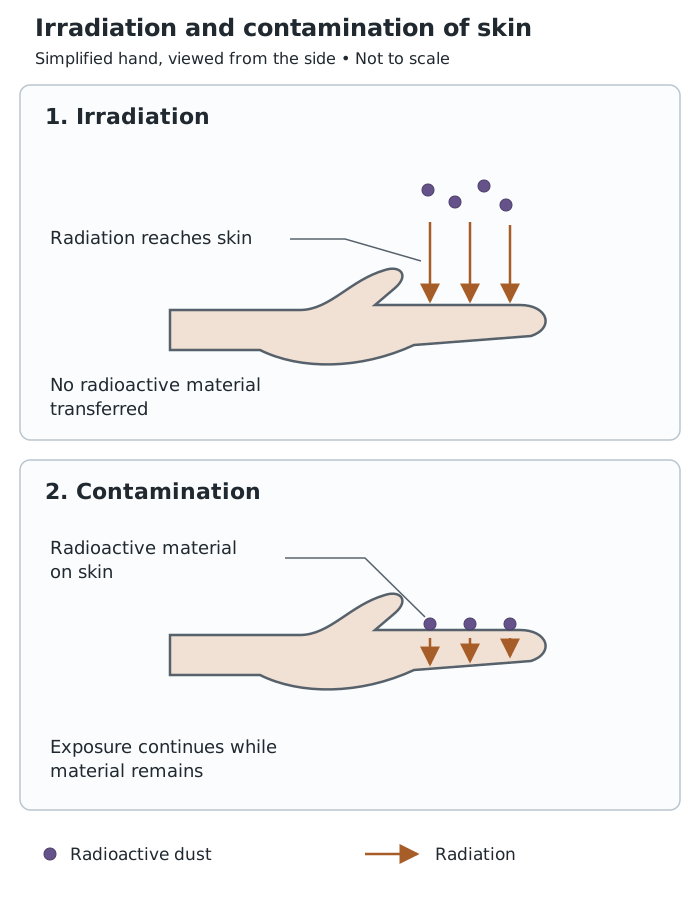
Irradiation transfers radiation to the skin; contamination puts radioactive material on it, creating a continuing source of irradiation.
Both irradiation and contamination can damage tissue or cause mutations. Contamination can produce prolonged exposure because the source remains on or inside the person. Internal contamination is particularly concerning because the source is close to internal tissues and may be difficult to remove. Contamination can also spread when radioactive material is transferred elsewhere.
However, a strong external source can deliver a dangerous dose without causing contamination. The hazard depends on the radiation emitted, the dose received and how long exposure continues—not just the label given to the exposure.
For irradiation, the main protections are time, distance and shielding. Preventing contamination means preventing radioactive material from reaching the body: gloves and protective clothing protect surfaces, while suitable sealed protective equipment can prevent radioactive dust from being inhaled. Removing contamination removes the material responsible for continuing exposure.
Get unlimited access to all revision notes, key terms, and exam tips.
| Irradiation | Contamination |
|---|---|
| Radiation reaches a person or object. | Radioactive material gets on or inside it. |
| Does not make the object radioactive. | The radioactive material present emits radiation. |
| Exposure stops when the source is removed or blocked. | Exposure can continue until the material is removed or its activity falls. |
Both can cause harm. Contamination may cause prolonged internal exposure and can spread; external irradiation can also deliver a dangerous dose.
Get unlimited access to all revision notes, key terms, and exam tips.
Link each precaution to its purpose: less time, greater distance and shielding reduce irradiation; gloves and protective clothing help prevent contamination.
Irradiation does not make an object radioactive. Contamination means radioactive material is present on or inside it.
Exposure stops when an external source is removed, but damage already caused may remain.
A short half-life reduces how long a tracer remains radioactive; it does not mean the tracer is harmless initially.
Compare hazards using the dose and duration of exposure, not simply by saying that contamination is always more dangerous.
Ionising radiation
Radiation that has enough energy to remove electrons from atoms, forming ions.
Tissue damage
Damage to a group of living cells, which can impair how a tissue works.
Mutation
A change in DNA, the genetic material in a cell.
Radiation dose
A measure of a person's exposure to radiation, taking account of its potential biological harm. Radiation dose is measured in sieverts (Sv).
Radioactive contamination
The unwanted presence of radioactive material on or inside an object or person.
Irradiation
Exposure of an object or person to radiation from a source, without necessarily transferring radioactive material.
Dosimeter
A device worn by someone working with radiation to monitor their accumulated radiation dose.
Radioactive tracer
A radioactive substance introduced into the body so that its radiation can be detected to investigate what is happening inside the body.
Put your knowledge into practice — try past paper questions for Combined Science
Ionising radiation
Radiation that has enough energy to remove electrons from atoms, forming ions.
Tissue damage
Damage to a group of living cells, which can impair how a tissue works.
Mutation
A change in DNA, the genetic material in a cell.
Radiation dose
A measure of a person's exposure to radiation, taking account of its potential biological harm. Radiation dose is measured in sieverts (Sv).
Radioactive contamination
The unwanted presence of radioactive material on or inside an object or person.
Irradiation
Exposure of an object or person to radiation from a source, without necessarily transferring radioactive material.
Dosimeter
A device worn by someone working with radiation to monitor their accumulated radiation dose.
Radioactive tracer
A radioactive substance introduced into the body so that its radiation can be detected to investigate what is happening inside the body.