Loading…


Loading…
Loading…
Loading…
Edexcel GCSE Combined Science · 1SC0
Edexcel 1SC0 · Density and thermal properties Check the specification (PDF) (opens in a new tab)
Matter is made of tiny particles: atoms or molecules. A simple kinetic theory model explains the properties of solids, liquids and gases by considering how these particles are arranged and how they move. The particles are always moving, even in a solid.
In a solid, particles are closely packed and vibrate about fixed positions. They cannot move freely past one another, so a solid keeps a definite shape and volume.
In a liquid, particles are still close together, but their arrangement is irregular and they can move past one another. This allows a liquid to flow and take the shape of its container. It has a definite volume: pouring it into a wider container changes its shape, not the amount of space it occupies.
In a gas, particles are far apart and move randomly in all directions. They spread throughout the available space, so a gas has neither a definite shape nor a fixed volume. Gases are easily compressed because the large gaps between particles can be reduced. Solids and liquids are much harder to compress because their particles are already close together.
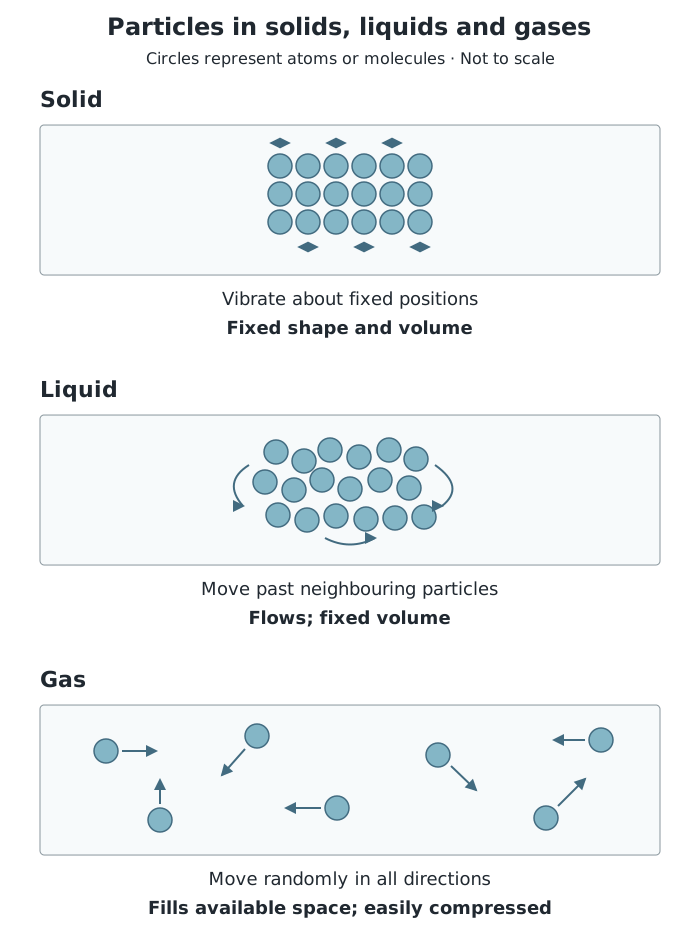
Particle arrangement and movement explain the different shapes, volumes and compressibility of solids, liquids and gases.
The circles in a particle diagram represent atoms or molecules, not visible pieces of the substance. When a gas is compressed, the gaps between particles become smaller; the particles themselves do not shrink.
Density is mass per unit volume. It tells us how much mass is packed into a particular amount of space. Two objects can occupy the same volume but have different masses because their densities differ.
Here, is density in kilograms per cubic metre (kg/m³), is mass in kilograms (kg), and is volume in cubic metres (m³). Mass is measured using a balance; volume is the space occupied by the object or substance.
To calculate density, divide the measured mass by the measured volume. The equation can also be rearranged to find an unknown mass or volume:
Laboratory measurements often use grams and cubic centimetres. These give density in g/cm³ if used directly. To obtain kg/m³, convert the mass and volume first: and . A measuring cylinder may be marked in millilitres; .
For the same substance, density depends on how closely its particles are packed. Solids and liquids usually have similar densities because their particles are close together in both states. A liquid is usually slightly less dense than the corresponding solid because its particles are generally a little further apart.
Water is an important exception: ice is less dense than liquid water. Its particles have a more open arrangement, so the same mass occupies a larger volume when frozen.
Gases have much lower densities because their particles are widely separated. A given mass occupies a much larger volume as a gas than as a solid or liquid. Since density is mass divided by volume, that larger volume gives a lower density.
Every density investigation needs two measurements: mass and volume. For a regularly shaped solid, its dimensions can be used to calculate its volume.
Measuring all three dimensions matters: a single length does not tell you the block's volume. Use a measuring instrument appropriate to the object's size and read its scale carefully.
An irregular object does not have a simple shape whose volume can easily be calculated from dimensions. Instead, measure the volume of water it displaces. This method is suitable for an object that sinks and does not dissolve in or react with water.
Measure the dry object's mass using a balance. Fill a displacement can with water until water runs from the spout, then wait until the flow stops. Place an empty measuring cylinder beneath the spout. Carefully lower the object until it is completely submerged, and collect all the displaced water.
The volume collected is the volume of the object: the submerged object has taken up space previously occupied by that water. Read the measuring cylinder at eye level, using the bottom of the water's curved surface, or meniscus. Use this volume and the object's mass to calculate density.
Avoid splashing and trapped air bubbles, which would affect the volume measurement. Repeat the measurement after resetting the water level and calculate a mean volume.
For a liquid, a measuring cylinder provides its volume, but the balance reading includes the container's mass.
Repeat the measurements and use mean values to reduce the effect of random variation. Handle glassware carefully and keep liquid away from the balance when filling containers.
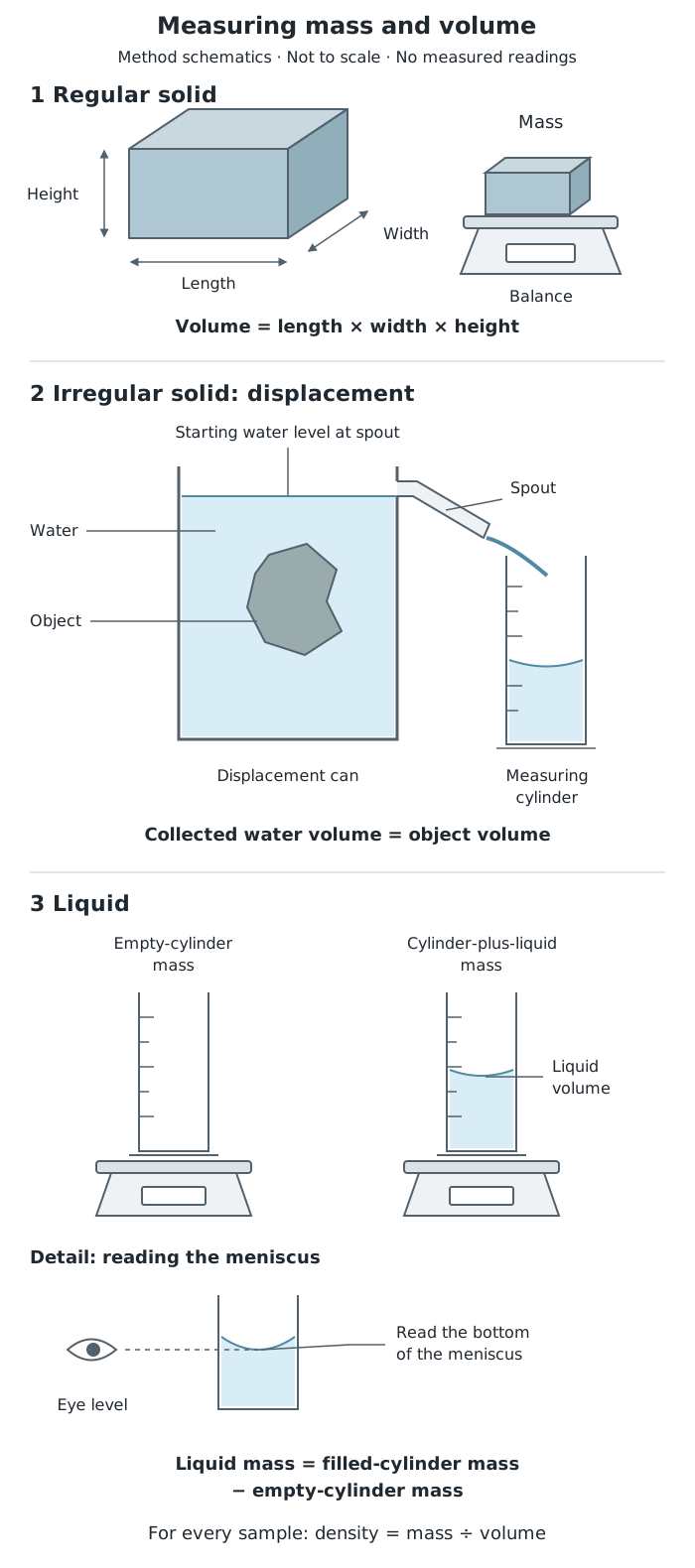
All three methods measure mass and volume; the way volume is found depends on the sample.
The names of the changes describe their starting and finishing states:
| Change | From → to |
|---|---|
| Melting | Solid → liquid |
| Freezing | Liquid → solid |
| Evaporation or boiling | Liquid → gas |
| Condensation | Gas → liquid |
| Sublimation | Solid → gas |
Evaporation occurs at a liquid's surface and can happen below its boiling point. Boiling occurs throughout the liquid at its boiling point, with bubbles of gas forming within it.
During each change of state, particles change their arrangement and movement, but no particles are created or destroyed. Mass is conserved, even though volume and density may change. For example, if 20 g of liquid completely evaporates, it produces 20 g of gas.
A container left open may appear to lose mass during evaporation because gas escapes into the surroundings. The total mass of the remaining liquid and the escaped gas is still the original mass.
Changes of state are physical changes: the substance remains the same, and reversing the change restores its original properties. Water that freezes into ice can be melted back into liquid water.
A chemical change produces different substances. Simply reversing a change of state does not undo that chemical reaction. Reversibility alone is not a rule for identifying every chemical change; the formation of different substances is the key distinction.
Get unlimited access to all revision notes, key terms, and exam tips.
| State | Arrangement and movement | Shape and volume |
|---|---|---|
| Solid | Closely packed; vibrate about fixed positions | Fixed shape and volume |
| Liquid | Close together; move past one another | Container's shape; fixed volume |
| Gas | Far apart; move randomly | Fill available space |
Gases compress easily because there are large gaps between particles.
For density in kg/m³, use mass in kg and volume in m³. Divide grams by 1000 and cubic centimetres by 1 000 000.
Describe both particle arrangement and particle movement when comparing states of matter. Solid particles vibrate; they are not motionless.
For a liquid, subtract the mass of the empty container from the mass of the container plus liquid.
In a displacement measurement, completely submerge the object without splashing or trapping air bubbles.
Mass is conserved during a change of state even if volume and density change. An open container can lose mass because gas escapes.
Do not claim that all chemical changes are irreversible. The important distinction is that chemical changes produce different substances.
Kinetic theory
A model that describes matter as particles in constant motion and explains its properties through their movement and arrangement.
Density
The mass per unit volume of a substance: . Its SI unit is kg/m³.
Mass
The amount of matter in an object, measured in kilograms. It is different from weight, which is a force.
Volume
The space occupied by an object or substance, measured in cubic metres.
Physical change
A change in which no new substance is formed. Reversing a change of state restores the material's original properties.
Chemical change
A change in which different substances are formed.
Conservation of mass
The principle that total mass remains unchanged. During a change of state, no particles are created or destroyed.
Sublimation
A change directly from solid to gas, without passing through the liquid state.
Put your knowledge into practice — try past paper questions for Combined Science
Kinetic theory
A model that describes matter as particles in constant motion and explains its properties through their movement and arrangement.
Density
The mass per unit volume of a substance: . Its SI unit is kg/m³.
Mass
The amount of matter in an object, measured in kilograms. It is different from weight, which is a force.
Volume
The space occupied by an object or substance, measured in cubic metres.
Physical change
A change in which no new substance is formed. Reversing a change of state restores the material's original properties.
Chemical change
A change in which different substances are formed.
Conservation of mass
The principle that total mass remains unchanged. During a change of state, no particles are created or destroyed.
Sublimation
A change directly from solid to gas, without passing through the liquid state.
Use kg, m³ and kg/m³. .
Mass is conserved: particles are not created or destroyed. Volume and density can change.
Changes of state are physical: reversing them restores original properties. Chemical changes form different substances.
Get unlimited access to all revision notes, key terms, and exam tips.