Loading…


Loading…
Loading…
Loading…
Edexcel GCSE Combined Science · 1SC0
Edexcel 1SC0 · Current, voltage, and resistance Check the specification (PDF) (opens in a new tab)
Current is the rate of flow of electric charge. A source of potential difference transfers energy to charge, allowing a current to flow around a closed circuit. Resistance measures how much a component opposes that flow.
For the same potential difference, increasing resistance reduces current; decreasing resistance increases current. The qualification matters: changing both the resistance and the potential difference could produce a different result.
A fixed resistor provides a set resistance. A variable resistor allows the resistance to be adjusted. In a common wire-based variable resistor, moving a sliding contact changes the length of resistance wire included in the circuit. A longer length has greater resistance; a shorter length has less.
When a variable resistor is connected in series with a lamp, increasing its resistance increases the circuit’s total resistance. With the supply potential difference unchanged, the current falls and the lamp becomes dimmer. Reducing the resistance allows a larger current and makes the lamp brighter.
The quantities are related by:
Here, is potential difference in volts (V), is current in amperes (A), and is resistance in ohms (Ω). A resistance of means that a potential difference of produces a current of .
Rearrange the equation according to the quantity you need:
Calculating current
For example, a resistor has a potential difference of 6 V across it and a resistance of 3 Ω. Calculate the current through it.
The result tells us how much charge flows each second. If the resistance were doubled while the potential difference stayed the same, the current would halve.
Calculating potential difference
For example, a 10 Ω resistor carries a current of 0.4 A. Calculate the potential difference across it.
This is the potential difference needed across that resistor to produce the stated current.
Calculating resistance
For example, a resistor has a potential difference of 6 V across it and carries a current of 0.5 A. Calculate its resistance.
This resistance describes how strongly the component opposes current at those values of potential difference and current. For a fixed resistor at constant temperature, resistance stays constant, so current is directly proportional to potential difference. Other components do not necessarily have constant resistance.
In series, there is only one path: charge must pass through both resistors, one after the other. Adding a second resistor adds further opposition to the flow of charge, so the net resistance increases.
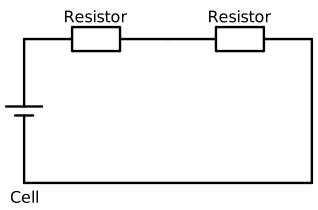
Two resistors in one current path: charge must pass through both, so their resistances add.
The resistances add:
The same current passes through both resistors, while the supply potential difference is shared between them. With an unchanged supply, the greater net resistance means a smaller current.
In parallel, each resistor is on a separate branch. Both branches have the same potential difference across them, and each provides a path for charge.
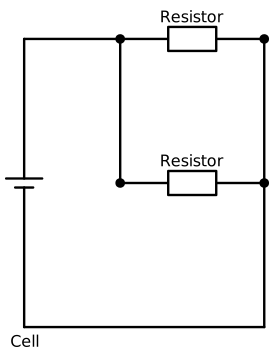
Each resistor provides a separate path. The additional branch increases total current at the same supply potential difference.
Adding the second branch allows an additional current to flow. The total current from the supply is the sum of the branch currents, so it increases even though the supply potential difference has not changed. Since , a larger total current at the same potential difference means a smaller net resistance.
The combination has a resistance lower than either resistor alone. The individual resistors have not changed: it is the extra path that reduces the resistance of the combination.
Get unlimited access to all revision notes, key terms, and exam tips.
At constant potential difference:
A variable resistor adjusts resistance by changing the length of resistance wire in use: longer wire → greater resistance.
: volts (V); : amperes (A); : ohms (Ω).
Series: charge passes through both resistors. Resistances add, so net resistance increases:
Parallel: an extra branch provides another path for charge. At the same supply potential difference, total current increases, so net resistance decreases below either individual resistance.
Get unlimited access to all revision notes, key terms, and exam tips.
When explaining how resistance changes current, state that the supply potential difference is unchanged.
Use volts (V), amperes (A) and ohms (Ω). Convert milliamperes to amperes before substituting into V = IR.
Use the potential difference across, and the current through, the same component when calculating its resistance.
Explain parallel resistance using extra paths for charge and increased total current, not by adding the resistances.
Resistance
A measure of how much a component opposes the flow of electric charge, measured in ohms (Ω).
Variable resistor
A resistor whose resistance can be adjusted to control the current in a circuit.
Net resistance
The resistance of a single resistor that would draw the same total current as a combination of resistors at the same potential difference.
Series circuit
An arrangement in which components are connected one after another in a single current path.
Parallel circuit
An arrangement in which components are connected on separate branches between the same two junctions.
Put your knowledge into practice — try past paper questions for Combined Science
Resistance
A measure of how much a component opposes the flow of electric charge, measured in ohms (Ω).
Variable resistor
A resistor whose resistance can be adjusted to control the current in a circuit.
Net resistance
The resistance of a single resistor that would draw the same total current as a combination of resistors at the same potential difference.
Series circuit
An arrangement in which components are connected one after another in a single current path.
Parallel circuit
An arrangement in which components are connected on separate branches between the same two junctions.