Loading…


Loading…
Loading…
Loading…
Edexcel GCSE Combined Science · 1SC0
Edexcel 1SC0 · Current, voltage, and resistance Check the specification (PDF) (opens in a new tab)
A cell has a positive terminal and a negative terminal. It establishes a potential difference, also called voltage, between these terminals. Components connected in the circuit can therefore have a potential difference across them.
Potential difference tells us how much energy is transferred for each coulomb of charge that passes. Charge is measured in coulombs (C) and energy in joules (J). A potential difference of 6 V across a lamp means that 6 J of energy is transferred in the lamp for every 1 C of charge passing through it.
This gives the meaning of the unit volt:
A larger potential difference means more energy transferred per coulomb. It does not, by itself, tell us the total energy transferred: that also depends on how much charge passes.
A voltmeter measures potential difference between two points. To measure the potential difference across a resistor, connect one voltmeter lead to each side of the resistor. The voltmeter is then in parallel with it: both are connected between the same two circuit points.
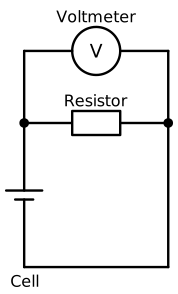
The voltmeter connects to both ends of the resistor, so it measures the potential difference across it.
In a circuit diagram, the voltmeter symbol is a circle containing V. Follow its two connections in the diagram: they join the circuit on opposite sides of the resistor. This is what measuring voltage across a component means. The voltmeter is not inserted into the main path through the resistor.
Because voltage is energy transferred per coulomb, multiplying the charge moved by the potential difference gives the total energy transferred:
Here, is energy transferred in joules (J), is charge moved in coulombs (C), and is potential difference in volts (V).
For example, a lamp operates at a potential difference of 6 V, and 4200 C of charge passes through it. The energy transferred is:
Each coulomb transfers 6 J, so all 4200 C together transfer 25 200 J in the lamp.
The same relationship can be rearranged depending on the unknown quantity:
Dividing energy by charge gives the energy transferred per coulomb—the potential difference. Dividing energy by potential difference gives the charge that must have passed to transfer that amount of energy.
Get unlimited access to all revision notes, key terms, and exam tips.
: joules (J); : coulombs (C); : volts (V).
Higher voltage means more energy transferred per coulomb; total energy also depends on charge moved.
Get unlimited access to all revision notes, key terms, and exam tips.
Define potential difference as energy transferred per unit charge, not simply as energy transferred.
Draw a voltmeter in parallel across the component being measured, not in series.
Use charge in coulombs and potential difference in volts in E = Q × V; the energy transferred is then in joules.
V represents both the quantity potential difference in an equation and the unit volt after a numerical value.
Potential difference
The energy transferred per unit charge passed between two points in a circuit: . It is also called voltage.
Volt
The unit of potential difference. One volt means one joule of energy is transferred per coulomb of charge: .
Voltmeter
An instrument that measures potential difference between two points, connected in parallel across the component being measured.
Coulomb
The unit of electric charge, with symbol C.
Put your knowledge into practice — try past paper questions for Combined Science
Potential difference
The energy transferred per unit charge passed between two points in a circuit: . It is also called voltage.
Volt
The unit of potential difference. One volt means one joule of energy is transferred per coulomb of charge: .
Voltmeter
An instrument that measures potential difference between two points, connected in parallel across the component being measured.
Coulomb
The unit of electric charge, with symbol C.