Loading…


Loading…
Loading…
Loading…
Edexcel GCSE Combined Science · 1SC0
Edexcel 1SC0 · Calculations involving masses Calculations involving masses Check the specification (PDF) (opens in a new tab)
Calculate the relative formula mass of a compound using relative atomic masses.
Calculate the percentage by mass of a specific element within a compound using relative atomic masses.
Calculate the empirical formulae of simple compounds using reacting masses or percentage composition data.
Deduce the empirical formula of a compound from its molecular formula, and vice versa, using its relative molecular mass.
Describe an experimental procedure to determine the empirical formula of a simple compound, such as magnesium oxide.
Explain the law of conservation of mass in both closed systems (e.g., a precipitation reaction) and non-enclosed systems (e.g., a reaction releasing or absorbing a gas).
Calculate the masses of reactants and products from balanced chemical equations when given the mass of a single substance.
Calculate the concentration of solutions in grams per cubic decimeter (g dm^-3).
Understand that one mole of particles is defined as the Avogadro constant number of particles (6.02 × 10^23) and is equivalent to a mass of the relative particle mass in grams.
Calculate the number of moles of particles in a given mass of a substance, and vice versa.
Calculate the number of particles in a given number of moles or a given mass of a substance, and vice versa.
Explain why the mass of a product in a chemical reaction is limited and controlled by the mass of the reactant that is not in excess.
Deduce the stoichiometry of a chemical reaction using the measured masses of the reactants and products.
Higher tier. Atoms, molecules and ions are too small and numerous to count individually in an ordinary sample. Chemists therefore measure the amount of substance in moles, with the unit symbol mol.
A dozen means 12 objects. In the same way, one mole means specified particles. This number per mole is the Avogadro constant, .
The particles must be specified because different substances contain different kinds of particle:
Equal amounts in moles contain equal numbers of the stated particles. They do not necessarily have equal masses, because different particles have different masses.
One mole of particles has a mass equal to their relative particle mass in grams. This connects a microscopic particle count to something that can be measured with a balance.
For atoms, use the relative atomic mass, . Carbon has , so one mole of carbon atoms has a mass of 12 g. Helium has , so one mole of helium atoms has a mass of 4 g. Both samples contain the same number of atoms.
For molecules or formula units, use the relative molecular or formula mass, . For water, using and :
One mole of water molecules therefore has a mass of 18 g. The molar mass, , is the mass per mole: for water it is 18 g mol⁻¹. Notice the distinction: relative mass has no unit, whereas molar mass has units of g mol⁻¹.
To find the amount in moles, divide the sample’s mass by the mass of one mole:
Here, is the amount in mol, is the mass in g and is the molar mass in g mol⁻¹.
For example, a 9.0 g sample of water, with molar mass 18 g mol⁻¹, contains:
This makes sense: 9.0 g is half the mass of one mole of water, so it contains half a mole of water molecules.
To work in the opposite direction, multiply the amount by the molar mass:
For example, 0.25 mol of water has a mass of .
Each mole contains the Avogadro constant number of particles. To find the number of particles, , multiply:
For example, 0.20 mol of sodium atoms contains sodium atoms.
To find the amount in moles from a particle count, divide:
A sample containing water molecules therefore contains of water molecules. Its particle count is half the number in one mole.
Moles provide the bridge between a mass and a particle count. First convert to moles, then convert to the quantity required.
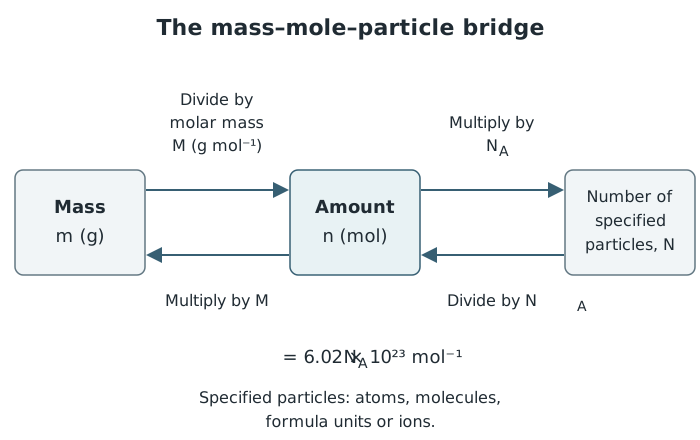
Moles connect a measurable mass to a particle count. Follow the arrows in the direction of the conversion.
For mass to particles, divide by molar mass, then multiply by the Avogadro constant:
The 9.0 g water sample above contains 0.50 mol of water molecules, so it contains water molecules.
For particles to mass, divide by the Avogadro constant, then multiply by molar mass:
For example, water molecules represent 0.20 mol. With a molar mass of 18 g mol⁻¹, their mass is .
The chemical formula tells you how many atoms of each element are present in each molecule. A mole of molecules is not necessarily a mole of atoms.
Each H₂ molecule contains two hydrogen atoms, so one mole of H₂ molecules contains two moles of hydrogen atoms. Likewise, each H₂O molecule contains two hydrogen atoms and one oxygen atom.
The 9.0 g water sample contains water molecules. It therefore contains hydrogen atoms, but only oxygen atoms. The formula subscripts connect the number of molecules to the number of atoms within them.
Get unlimited access to all revision notes, key terms, and exam tips.
With mass in g, amount in mol and particle count :
Go through moles:
Use for atoms and for molecules or formula units. To count atoms within molecules, multiply the molecule count by the relevant formula subscript.
Get unlimited access to all revision notes, key terms, and exam tips.
Identify what is being counted: atoms, molecules, formula units or ions. State the particle type in your answer.
Use mass in grams when the molar mass is in g mol⁻¹. Convert kilograms or milligrams first.
Use the relative atomic masses given in the question or periodic table, and show your substitutions and working.
Enter 6.02 × 10²³ using your calculator’s scientific-notation key. Keep unrounded intermediate values until the final answer.
If asked for atoms within molecules, use the formula subscripts: each H₂O molecule contains two hydrogen atoms, not one.
Mole
The unit of amount of substance, symbol mol. One mole contains specified particles.
Avogadro constant
The number of particles per mole, represented by . For these GCSE calculations, use .
Molar mass
The mass of one mole of a substance, measured in g mol⁻¹. Its numerical value equals the appropriate relative particle mass.
Relative particle mass
A mass compared with a standard based on carbon-12, with no unit. Use relative atomic mass for atoms and relative molecular or formula mass for molecules or formula units.
Formula unit
The simplest whole-number ratio of ions represented by the formula of an ionic compound. For example, one NaCl formula unit represents one sodium ion for every chloride ion; it is not a separate molecule.
Put your knowledge into practice — try past paper questions for Combined Science
Mole
The unit of amount of substance, symbol mol. One mole contains specified particles.
Avogadro constant
The number of particles per mole, represented by . For these GCSE calculations, use .
Molar mass
The mass of one mole of a substance, measured in g mol⁻¹. Its numerical value equals the appropriate relative particle mass.
Relative particle mass
A mass compared with a standard based on carbon-12, with no unit. Use relative atomic mass for atoms and relative molecular or formula mass for molecules or formula units.
Formula unit
The simplest whole-number ratio of ions represented by the formula of an ionic compound. For example, one NaCl formula unit represents one sodium ion for every chloride ion; it is not a separate molecule.