Loading…


Loading…
Loading…
Loading…
Edexcel GCSE Combined Science · 1SC0
Edexcel 1SC0 · Calculations involving masses Calculations involving masses Check the specification (PDF) (opens in a new tab)
Calculate the relative formula mass of a compound using relative atomic masses.
Calculate the percentage by mass of a specific element within a compound using relative atomic masses.
Calculate the empirical formulae of simple compounds using reacting masses or percentage composition data.
Deduce the empirical formula of a compound from its molecular formula, and vice versa, using its relative molecular mass.
Describe an experimental procedure to determine the empirical formula of a simple compound, such as magnesium oxide.
Explain the law of conservation of mass in both closed systems (e.g., a precipitation reaction) and non-enclosed systems (e.g., a reaction releasing or absorbing a gas).
Calculate the masses of reactants and products from balanced chemical equations when given the mass of a single substance.
Calculate the concentration of solutions in grams per cubic decimeter (g dm^-3).
Understand that one mole of particles is defined as the Avogadro constant number of particles (6.02 × 10^23) and is equivalent to a mass of the relative particle mass in grams.
Calculate the number of moles of particles in a given mass of a substance, and vice versa.
Calculate the number of particles in a given number of moles or a given mass of a substance, and vice versa.
Explain why the mass of a product in a chemical reaction is limited and controlled by the mass of the reactant that is not in excess.
Deduce the stoichiometry of a chemical reaction using the measured masses of the reactants and products.
In a chemical reaction, atoms are rearranged into new substances. They are not created or destroyed. Because the same atoms are present before and after the reaction, the total mass of the reactants equals the total mass of the products. This is the law of conservation of mass.
A balanced chemical equation expresses this rearrangement: it contains the same number of atoms of each element on both sides. The products may look very different from the reactants, but changing chemical properties does not mean that matter has disappeared.
A closed system prevents substances from entering or leaving. If you weigh a closed reaction flask and all its contents before and after a reaction, its total mass stays the same.
For example, mixing calcium chloride solution with sodium sulfate solution forms an insoluble solid, calcium sulfate. A reaction that forms an insoluble solid from solutions is called a precipitation reaction:
The solid precipitate is a new substance, not extra matter. In a closed flask, the precipitate, remaining solution and flask together have the same mass as the flask and its contents before mixing.
An open flask allows gases to cross the boundary between the flask and the surrounding air. The balance measures only the flask and what remains inside it, not everything involved in the reaction.
Calcium carbonate reacts with hydrochloric acid to produce carbon dioxide gas:
In an open flask, carbon dioxide escapes, so the measured mass decreases. If the escaped gas were included, the total mass would still be unchanged.
The opposite happens when a reaction takes in a gas from the air. For example, magnesium gains mass as it reacts with oxygen to form magnesium oxide. The extra mass comes from oxygen that was initially outside the container. Including that oxygen in the starting mass shows that mass is conserved.
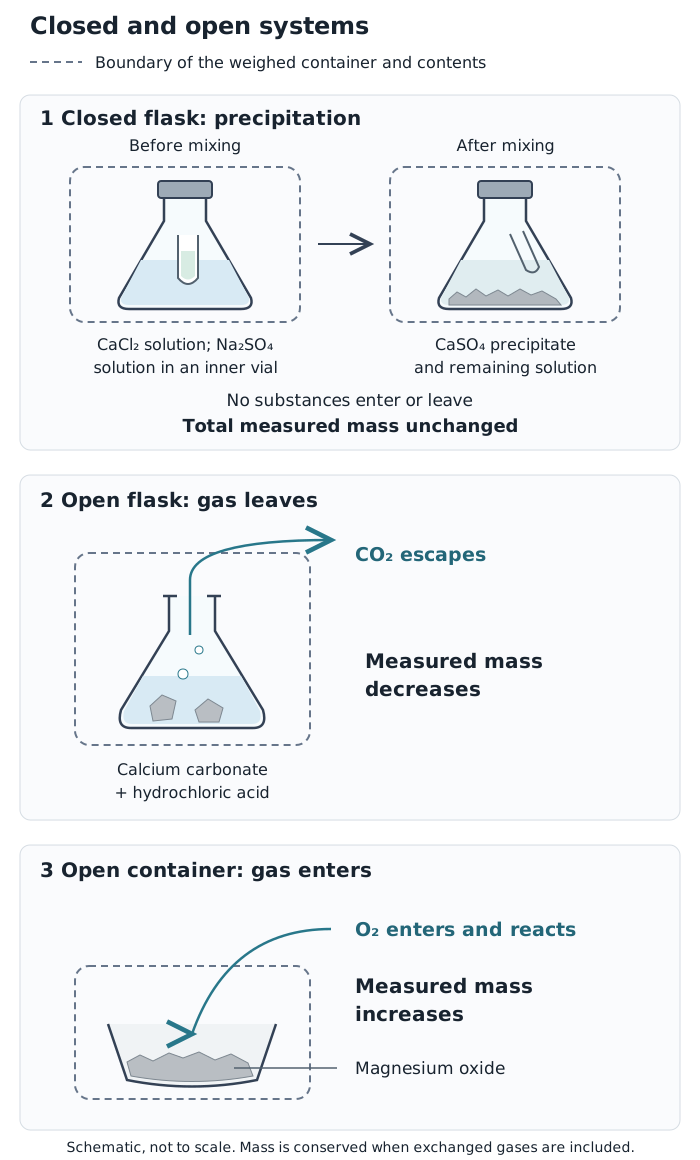
Mass is conserved in every reaction. An open container’s measured mass can change because gas crosses its boundary.
A balanced equation tells us the relative numbers of particles reacting. Different particles have different masses, so the coefficients are not directly a mass ratio.
To find the mass ratio, multiply each substance’s relative formula mass, , by its coefficient. Relative formula mass is the sum of the relative atomic masses in a formula and has no unit. The resulting ratio can be used with grams, tonnes or another consistent mass unit.
Consider magnesium burning in oxygen:
Using and , the relative masses are:
| Substance | Coefficient × relative formula mass | Parts by mass |
|---|---|---|
| Mg | 48 | |
| O₂ | 32 | |
| MgO | 80 |
Thus, 48 g of magnesium reacts with 32 g of oxygen to form 80 g of magnesium oxide. Notice that : the mass relationship also demonstrates conservation of mass.
If 6.0 g of magnesium burns completely with enough oxygen, scale the magnesium-to-magnesium-oxide ratio:
The product is heavier than the magnesium because it also contains oxygen.
The same approach works when finding a reactant mass from a product mass: put the coefficient-weighted relative mass of the substance you want on top of the fraction, and that of the known substance underneath. For aluminium oxide decomposition, , the aluminium oxide-to-aluminium mass ratio is . Therefore, 51 tonnes of aluminium oxide can produce tonnes of aluminium.
Reactants must combine in the proportions set by the balanced equation. If one reactant is supplied in excess, there is more of it than the other reactant can use.
The reactant that is not in excess is the limiting reactant. Once it has all reacted, no more product can form, even if another reactant remains. Its starting mass therefore controls the maximum mass of product.
In the magnesium example, 6.0 g of magnesium needs 4.0 g of oxygen to make 10.0 g of magnesium oxide. Supplying more oxygen does not produce more magnesium oxide once all the magnesium has reacted: the surplus oxygen remains unused. This is why a reacting-mass calculation based on magnesium assumes that enough oxygen is available and the magnesium reacts completely.
Stoichiometry describes the relative amounts of substances in a reaction. You can deduce the coefficients of an equation from reacting masses, but first you must convert those masses into amounts in moles.
The molar mass, , is the mass of one mole in ; its numerical value equals the relative formula mass. Use:
Here, is the amount in mol and is the mass in g. Divide all the calculated amounts by the smallest to find their ratio. If necessary, multiply every term by the same number to obtain the smallest whole-number ratio.
For example, 64 g of methanol reacts with 96 g of oxygen to produce 88 g of carbon dioxide and 72 g of water. Using , and :
| Substance | Mass / g | Molar mass / g mol⁻¹ | Amount / mol |
|---|---|---|---|
| CH₃OH | 64 | 32 | |
| O₂ | 96 | 32 | |
| CO₂ | 88 | 44 | |
| H₂O | 72 | 18 |
The amounts have the ratio . Dividing by the smallest gives ; multiplying every term by two restores the smallest whole-number ratio. These numbers become the coefficients:
Check the result by counting atoms: both sides contain two carbon atoms, eight hydrogen atoms and eight oxygen atoms. On the left, the oxygen count is ; on the right, it is . The total masses also match: g.
Get unlimited access to all revision notes, key terms, and exam tips.
Atoms are rearranged, not created or destroyed: total reactant mass = total product mass.
Including the gas restores the full mass balance.
Here, is the equation coefficient. Use consistent mass units and assume sufficient other reactants for complete reaction.
The reactant not in excess runs out first and controls the maximum product mass. Excess reactant remains; adding more of it alone cannot make more product.
Convert each reacting mass to moles → divide by the smallest → multiply all terms if needed for whole numbers → use the smallest whole-number ratio as coefficients → check atom balance.
Get unlimited access to all revision notes, key terms, and exam tips.
An apparent mass change in an open flask is explained by gas entering or leaving, not by mass being created or destroyed.
Multiply each relative formula mass by its coefficient before comparing reacting masses. Coefficients alone are not mass ratios.
Keep mass units consistent and use the unrounded ratio in your calculation.
For limiting-reactant questions, use the mass that actually reacts, not any excess left over.
When deducing coefficients, convert masses to moles first. Multiply every term in the ratio by the same number to obtain the smallest whole-number ratio.
Conservation of mass
The principle that the total mass of the reactants equals the total mass of the products in a chemical reaction; matter is not created or destroyed.
Closed system
A system in which substances cannot enter or leave.
Precipitation reaction
A reaction in which solutions react to form an insoluble solid called a precipitate.
Coefficient
A number placed before a chemical formula in an equation, showing the relative number of particles or amount in moles of that substance.
Limiting reactant
The reactant that is used up first and therefore controls the maximum mass of product formed.
Reactant in excess
A reactant supplied in a greater amount than is needed to react completely with the limiting reactant, so some remains.
Stoichiometry
The relative amounts of reactants and products in a reaction, expressed by the coefficients in its balanced equation.
Put your knowledge into practice — try past paper questions for Combined Science
Conservation of mass
The principle that the total mass of the reactants equals the total mass of the products in a chemical reaction; matter is not created or destroyed.
Closed system
A system in which substances cannot enter or leave.
Precipitation reaction
A reaction in which solutions react to form an insoluble solid called a precipitate.
Coefficient
A number placed before a chemical formula in an equation, showing the relative number of particles or amount in moles of that substance.
Limiting reactant
The reactant that is used up first and therefore controls the maximum mass of product formed.
Reactant in excess
A reactant supplied in a greater amount than is needed to react completely with the limiting reactant, so some remains.
Stoichiometry
The relative amounts of reactants and products in a reaction, expressed by the coefficients in its balanced equation.