Loading…


Loading…
Loading…
Loading…
Edexcel GCSE Combined Science · 1SC0
Edexcel 1SC0 · Calculations involving masses Calculations involving masses Check the specification (PDF) (opens in a new tab)
Calculate the relative formula mass of a compound using relative atomic masses.
Calculate the percentage by mass of a specific element within a compound using relative atomic masses.
Calculate the empirical formulae of simple compounds using reacting masses or percentage composition data.
Deduce the empirical formula of a compound from its molecular formula, and vice versa, using its relative molecular mass.
Describe an experimental procedure to determine the empirical formula of a simple compound, such as magnesium oxide.
Explain the law of conservation of mass in both closed systems (e.g., a precipitation reaction) and non-enclosed systems (e.g., a reaction releasing or absorbing a gas).
Calculate the masses of reactants and products from balanced chemical equations when given the mass of a single substance.
Calculate the concentration of solutions in grams per cubic decimeter (g dm^-3).
Understand that one mole of particles is defined as the Avogadro constant number of particles (6.02 × 10^23) and is equivalent to a mass of the relative particle mass in grams.
Calculate the number of moles of particles in a given mass of a substance, and vice versa.
Calculate the number of particles in a given number of moles or a given mass of a substance, and vice versa.
Explain why the mass of a product in a chemical reaction is limited and controlled by the mass of the reactant that is not in excess.
Deduce the stoichiometry of a chemical reaction using the measured masses of the reactants and products.
A chemical formula describes numbers of atoms, not their masses. An empirical formula gives the simplest whole-number ratio of atoms of each element in a compound. For example, MgO means that magnesium and oxygen atoms are present in a ratio of 1:1. A subscript of 1 is not written.
A molecular formula gives the actual number of atoms of each element in one molecule. Hydrogen peroxide has the molecular formula H₂O₂: each molecule contains two hydrogen atoms and two oxygen atoms. Its empirical formula is HO, because 2:2 simplifies to 1:1.
To turn a molecular formula into an empirical formula, divide all its subscripts by their highest common factor. Sometimes there is no common factor, so the two formulae are identical: methane is CH₄ in both cases. Ionic compounds such as magnesium oxide form lattices rather than separate molecules; their formulae express the simplest ratio of ions.
Different elements have different masses per atom. Equal masses of two elements therefore do not usually contain equal numbers of atoms. Relative atomic mass, , allows us to account for this difference.
For each element, calculate:
Use masses in the same unit. Divide each result by the smallest result to find the simplest ratio, then write that ratio as subscripts in the formula.
For example, a compound contains 10 g of hydrogen and 80 g of oxygen. Using and :
| Step | Hydrogen | Oxygen |
|---|---|---|
| Mass / g | 10 | 80 |
| Mass divided by | ||
| Divide by the smallest result, 5 | 2 | 1 |
The atom ratio is H:O = 2:1, so the empirical formula is H₂O. The original mass ratio, 1:8, would not give the correct formula.
The final ratio must contain whole numbers. If dividing by the smallest result gives 1:1.5, multiply both numbers by 2 to obtain 2:3. This preserves the ratio rather than changing it by rounding 1.5 to an integer.
Percentage by mass tells you how much of each element is present in every 100 g of a compound. You can therefore assume a 100 g sample and use the percentages as masses in grams. This does not change the atom ratio: a larger or smaller sample of the same compound has the same composition.
For example, a compound contains 27.29% carbon and 72.71% oxygen by mass. A 100 g sample would contain 27.29 g of carbon and 72.71 g of oxygen. Using and :
The empirical formula is CO₂. Percentage data and reacting-mass data lead to the same calculation method.
An empirical formula alone cannot tell you how many atoms are in a molecule. For example, CH₂O and C₆H₁₂O₆ both have the simplest ratio C:H:O = 1:2:1. To identify the molecular formula, you also need the compound’s relative molecular mass, .
First add the relative atomic masses represented by the empirical formula. Then calculate the whole-number multiplier:
For a compound with empirical formula CH₂O and , using values of C = 12, H = 1 and O = 16:
The multiplier is . Multiply every subscript in CH₂O by 6 to give C₆H₁₂O₆. Each molecule has six times the numbers of atoms represented by the empirical formula, but the same ratio.
Magnesium reacts with oxygen from the air when heated. By measuring the magnesium mass and the mass gained during the reaction, you can find the masses of both elements in the oxide.
Use a balance, magnesium ribbon, a crucible with a lid, a Bunsen burner, suitable crucible support and tongs.
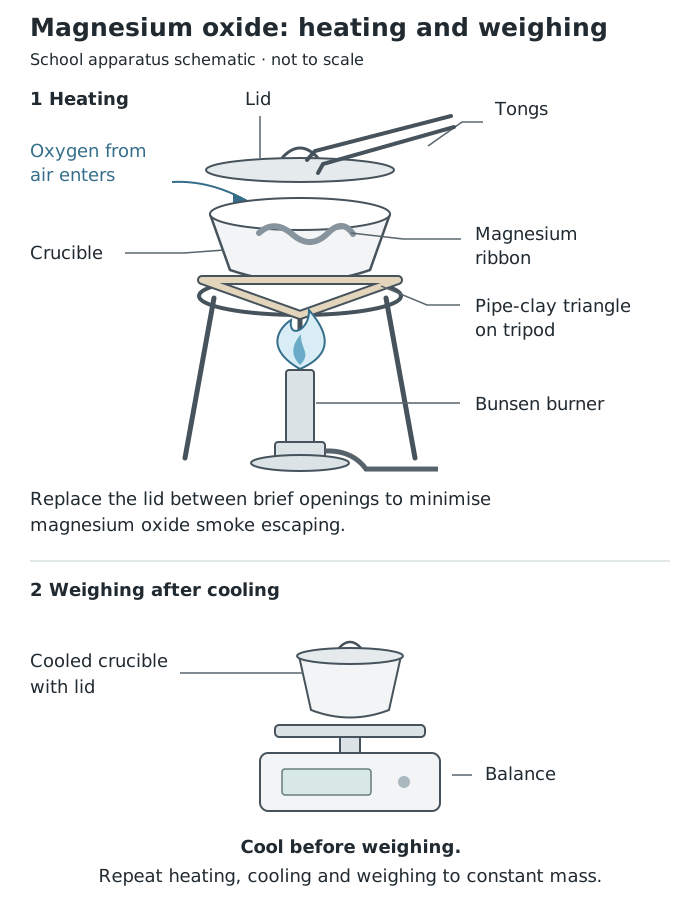
Heating admits oxygen to react with magnesium; the lid helps retain the product. Repeated heating, cooling and weighing checks that the reaction is complete.
The lid helps retain the product, but must not prevent oxygen entering. Losing product or leaving magnesium unreacted would make the measured mass gain too small.
Consider these recorded masses:
| Measurement | Mass / g |
|---|---|
| Crucible and lid | 24.83 |
| Crucible, lid and magnesium | 25.07 |
| Crucible, lid and magnesium oxide after heating | 25.23 |
The magnesium mass is . The oxygen mass is the gain in mass: .
Using and , divide each element’s mass by its relative atomic mass:
The empirical formula is therefore MgO. The elements have different masses in the product, but equal relative numbers of atoms.
Get unlimited access to all revision notes, key terms, and exam tips.
For percentages, assume 100 g: each percentage becomes that element’s mass in grams.
Multiply every empirical-formula subscript by this factor.
Get unlimited access to all revision notes, key terms, and exam tips.
Use the masses of the elements that actually combine, not the total mass of a reactant supplied in excess.
Divide each element’s mass by its own relative atomic mass before simplifying the ratio.
Keep extra digits during calculations. A ratio close to 1:2 may be rounded to 1:2, but 1:1.5 must be multiplied throughout by 2 to give 2:3.
In the magnesium experiment, the final contents are magnesium oxide. The oxygen mass is the gain in mass, not the whole mass of the oxide.
When finding a molecular formula, multiply every empirical-formula subscript by the same whole-number factor, including unwritten subscripts of 1.
Empirical formula
A formula showing the simplest whole-number ratio of atoms of each element in a compound.
Molecular formula
A formula showing the actual number of atoms of each element in one molecule.
Relative atomic mass
The weighted mean mass of an atom of an element relative to one-twelfth of the mass of a carbon-12 atom. It has no unit.
Relative molecular mass
The sum of the relative atomic masses of all the atoms in one molecule, written as . It has no unit.
Constant mass
A mass that no longer changes after repeated heating, cooling and weighing; in the magnesium oxide experiment, this indicates that the reaction is complete.
Put your knowledge into practice — try past paper questions for Combined Science
Empirical formula
A formula showing the simplest whole-number ratio of atoms of each element in a compound.
Molecular formula
A formula showing the actual number of atoms of each element in one molecule.
Relative atomic mass
The weighted mean mass of an atom of an element relative to one-twelfth of the mass of a carbon-12 atom. It has no unit.
Relative molecular mass
The sum of the relative atomic masses of all the atoms in one molecule, written as . It has no unit.
Constant mass
A mass that no longer changes after repeated heating, cooling and weighing; in the magnesium oxide experiment, this indicates that the reaction is complete.