Loading…


Loading…
Loading…
Loading…
Edexcel GCSE Combined Science · 1SC0
Edexcel 1SC0 · Evolution and Classification Check the specification (PDF) (opens in a new tab)
Human evolution is the change in the human lineage over many generations. Humans did not evolve from chimpanzees living today: humans and chimpanzees share an earlier common ancestor. Fossils and stone tools help scientists reconstruct changes that took place over millions of years.
A fossil is a preserved remain or trace of a past organism. Fossil skeletons provide evidence about body structure, while tools provide evidence about behaviour. Dating these discoveries allows scientists to compare older and younger evidence rather than simply noticing that specimens look different.
Different parts of a skeleton answer different questions. The space inside the skull, called its cranial capacity, helps scientists estimate brain size. The shapes of feet and leg bones, together with the relative lengths of arms and legs, provide evidence about how an individual moved.
Bipedalism means walking on two legs. A skeleton can show adaptations for upright walking while retaining features useful for climbing. Human-like features did not all appear at once.
Ardi, an Ardipithecus ramidus fossil from Ethiopia, lived 4.4 million years ago. She had a small brain, about 350 cm³, similar in size to a chimpanzee’s brain. Her long arms and relatively short legs were more ape-like than those of modern humans.
Ardi’s grasping big toe was suited to holding branches, suggesting that she climbed trees. However, her leg structure also provides evidence that she could walk upright. This combination is significant: an early member of the human lineage could show some adaptation to bipedalism without having a modern human body.
Lucy, an Australopithecus afarensis fossil also found in Ethiopia, lived 3.2 million years ago. Her brain was slightly larger than Ardi’s, at about 430 cm³, but was still small compared with a modern human brain.
Lucy’s skeleton provides evidence of more efficient upright walking than Ardi’s. Evidence from her species includes arched feet without an ape-like grasping big toe, making the feet better suited to walking than gripping branches. Her arm and leg proportions were between those of apes and modern humans.
Lucy is important because she shows that effective upright walking developed before the much larger brains seen in later humans. Walking upright and increased brain size were not a single simultaneous change.
Richard Leakey led fossil-searching expeditions in Kenya. His team’s discoveries included Turkana Boy, a Homo erectus skeleton dating from 1.6 million years ago.
This skeleton had relatively short arms and long legs, with feet and legs well adapted to upright walking. Its brain was much larger than Lucy’s, at around 1,000 cm³, although still smaller than that of a typical modern human.
Comparing Ardi, Lucy and Turkana Boy reveals a broad pattern: increasingly human-like adaptations for walking on two legs and an increase in brain size. The fossils provide dated physical evidence of change. They should not be treated as proof that these three particular individuals formed a direct parent-to-descendant sequence; the fossil record is incomplete.
A stone tool is an artefact: an object deliberately made or modified by a human or human ancestor. Unlike a skeleton, it gives evidence about what its maker could do.
Early tools, from around 2.5 million years ago, included simple sharp flakes made by striking stones together. These could cut or scrape meat from bones. By around 1.6 million years ago, toolmakers were producing more carefully shaped hand axes, useful for tasks such as chopping and preparing food.
Later tools included sharper, more specialised points and blades, followed by finely worked arrowheads. Making these required more controlled shaping and planning than producing a simple flake. The general development towards more sophisticated tools provides evidence of changing skills and behaviour in the human lineage. Tool shape alone, however, does not give an exact age or directly measure the maker’s brain size.
Stone tools are often buried as sediment or volcanic ash accumulates. In an undisturbed sequence, lower layers were deposited before those above them. A tool in a lower layer is therefore usually older than one in a higher layer. This is relative dating: it establishes an order without necessarily giving an age in years.
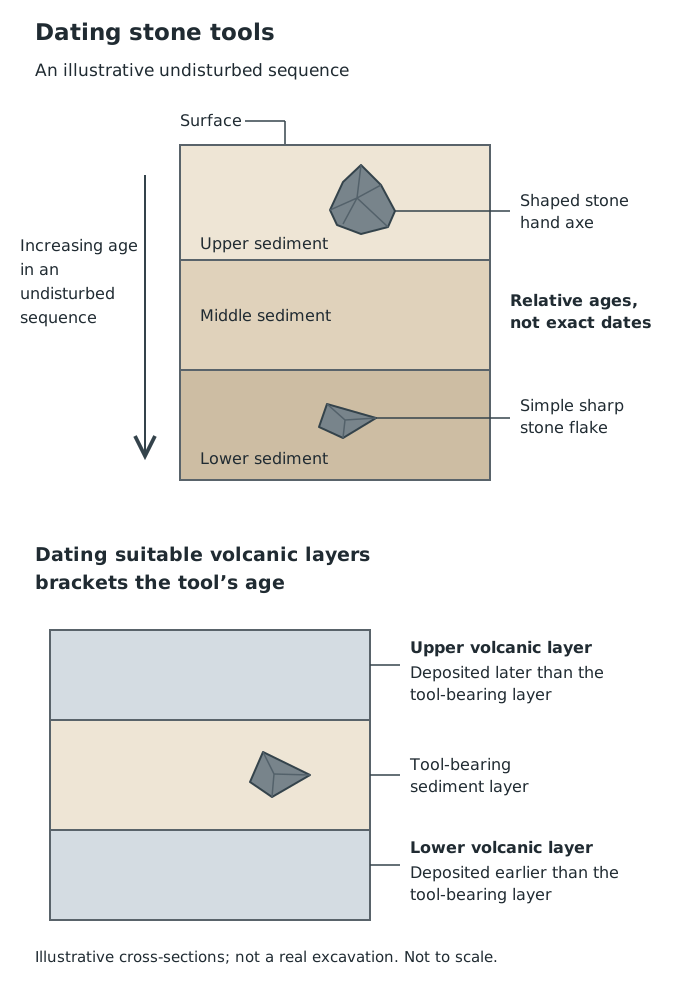
Layers show how a tool’s surroundings establish its relative age or bracket its age between dated layers.
For example, a simple flake below a shaped hand axe would support the conclusion that the flake was deposited earlier, provided the layers had not been disturbed. Scientists need to consider whether erosion or later movement has displaced an object before trusting its position.
Scientists can also use radiometric dating of suitable surrounding rock or volcanic layers. Radioactive isotopes decay over time, allowing the age of the material to be estimated. A tool between two dated layers can then be assigned an age range: younger than the layer below and older than the layer above.
For more recent finds, associated material that was once living, such as a wooden handle, may be dated using radiocarbon dating. The wood contains carbon; the stone does not contain the once-living carbon needed for this method. Radiocarbon dating is not suitable for dating the millions-of-years-old fossils discussed here.
Together, skeletal features, tool development and dates from the surrounding environment provide complementary evidence: what earlier humans were like, what they could do and when they lived.
Get unlimited access to all revision notes, key terms, and exam tips.
Overall pattern: greater adaptation to bipedalism and increased brain size. Upright walking developed before a large brain.
Simple sharp flakes → shaped hand axes → more specialised, finely worked points and blades.
Increasing sophistication provides evidence of changing toolmaking skills and behaviour.
Learn the fossil ages precisely: Ardi 4.4 million years, Lucy 3.2 million years and Richard Leakey’s fossil discovery 1.6 million years.
Link a skeletal feature to what it suggests: longer legs and human-like feet provide evidence of adaptation to upright walking.
Distinguish the age of a fossil from the date it was discovered.
Explain how the surroundings date a stone tool. Radiocarbon dating cannot directly date the stone itself, and deeper layers are usually older only where the sequence has not been disturbed.
Fossil
Preserved remains or traces of an organism that lived in the past.
Bipedalism
Walking on two legs.
Cranial capacity
The internal volume of a skull’s braincase, used to estimate brain size.
Artefact
An object made or modified by humans or their ancestors, such as a stone tool.
Relative dating
Dating that establishes whether an object is older or younger than another, rather than giving its age in years.
Radiometric dating
Estimating age using the radioactive decay of isotopes in suitable materials.
Radiocarbon dating
A dating method that uses radioactive carbon-14 in material that was once living.
Put your knowledge into practice — try past paper questions for Combined Science
Fossil
Preserved remains or traces of an organism that lived in the past.
Bipedalism
Walking on two legs.
Cranial capacity
The internal volume of a skull’s braincase, used to estimate brain size.
Artefact
An object made or modified by humans or their ancestors, such as a stone tool.
Relative dating
Dating that establishes whether an object is older or younger than another, rather than giving its age in years.
Radiometric dating
Estimating age using the radioactive decay of isotopes in suitable materials.
Radiocarbon dating
A dating method that uses radioactive carbon-14 in material that was once living.
Get unlimited access to all revision notes, key terms, and exam tips.