Loading…


Loading…
Loading…
Loading…
Edexcel GCSE Combined Science · 1SC0
Edexcel 1SC0 · Evolution and Classification Check the specification (PDF) (opens in a new tab)
Evolution is a change in the inherited characteristics of a population over generations. For example, a characteristic that was once rare may become common. This is a change across generations, rather than a change in one organism during its lifetime.
Charles Darwin proposed that natural selection could explain how evolution happens. His ideas drew on observations during a round-the-world expedition, years of experimentation, and his knowledge of geology and fossils. He published his explanation in On the Origin of Species in 1859.
The central connection in Darwin’s theory is between inherited differences, survival and reproduction: individuals with characteristics better suited to their environment are more likely to leave offspring.
Individuals within a population are not all identical. They show variation in characteristics such as colour or resistance to disease. Some differences are inherited because individuals have different genetic information. Random mutations can produce new genetic variants, although not every mutation changes an organism’s phenotype or gives it an advantage.
The environment affects which characteristics are advantageous. Organisms compete for resources, and factors such as predators or disease can reduce their chances of surviving. These factors act as selection pressures. An inherited characteristic that helps an organism in those conditions gives it a better chance of surviving and reproducing.
When these individuals reproduce, they can pass the genetic information responsible for the advantageous characteristic to their offspring. They therefore contribute more offspring to the next generation than less well-adapted individuals. Over many generations, the advantageous characteristic becomes more common: the population evolves.
This process is sometimes called ‘survival of the fittest’. Here, fitness means being well suited to the environment and successfully reproducing. A characteristic is not automatically advantageous in every environment.
Antibiotics are medicines that kill bacteria or prevent them from reproducing. They target bacterial structures or processes and are not effective against viruses. For example, penicillin interferes with the building of bacterial cell walls, so susceptible bacterial cells may rupture as they grow.
Bacteria within a population can differ genetically. A random mutation may give a bacterium resistance to a particular antibiotic. This means it can survive treatment that would kill susceptible bacteria or stop them reproducing.
Resistance is an advantage when that antibiotic is present. The antibiotic acts as the selection pressure; it does not deliberately produce the useful mutation.
Before treatment, a bacterial population may contain a small number of resistant bacteria among many susceptible bacteria. When exposed to the antibiotic, susceptible bacteria are killed or prevented from reproducing, while resistant bacteria survive.
The survivors now face less competition for nutrients. They reproduce asexually by dividing, passing their genetic information—including the variant responsible for resistance—to their offspring. As these descendants multiply, resistant bacteria make up an increasing proportion of the population.
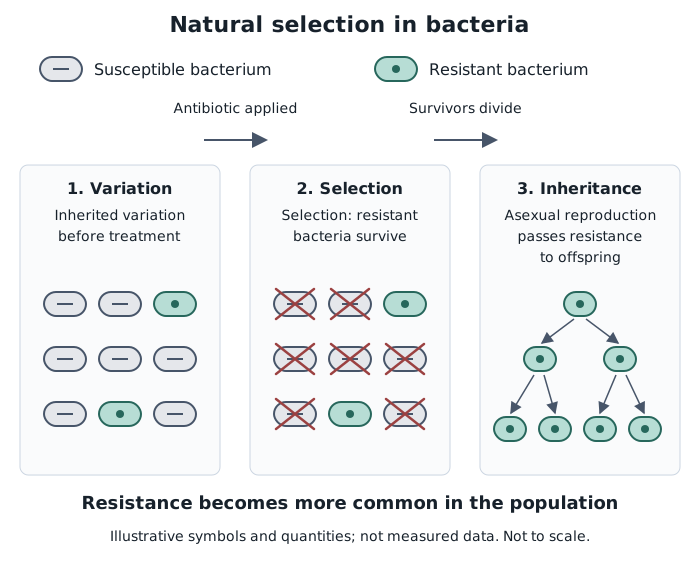
An antibiotic selects resistant bacteria, whose descendants make resistance more common in the population.
The important change is not simply that more bacteria exist. It is that resistance becomes more common within the population. If these bacteria cause disease, an infection dominated by resistant bacteria is harder to control using that antibiotic.
Antibiotic resistance shows the sequence predicted by natural selection: genetic variation exists, a selection pressure favours some variants, survivors reproduce, and their offspring inherit the advantageous variant. The population’s inherited characteristics then change over generations.
Bacteria reproduce quickly, so many generations can occur in a short time. This allows evolutionary changes to become apparent much more rapidly than in organisms with long generation times. The emergence of antibiotic-resistant populations therefore provides evidence for Darwin’s explanation of evolution by natural selection.
Get unlimited access to all revision notes, key terms, and exam tips.
Inherited variation → selection pressure → better survival and reproduction → inheritance → advantageous characteristics become more common.
Resistance demonstrates inherited variation, natural selection and population change. Rapid bacterial reproduction makes changes observable over many generations in a short time.
Get unlimited access to all revision notes, key terms, and exam tips.
Explain the whole chain: inherited variation → survival advantage → reproduction → inheritance → increased frequency over generations.
Mutations occur randomly; bacteria do not develop resistance because they need it. The antibiotic selects bacteria that are already resistant.
It is the bacteria that become resistant, not the patient or the antibiotic.
‘Fittest’ means best suited to the particular environment, not necessarily strongest or fastest.
Evolution
A change in the inherited characteristics of a population over generations.
Natural selection
The process in which organisms with advantageous inherited characteristics are more likely to survive, reproduce and pass those characteristics to offspring.
Population
A group of organisms of the same species living in an area.
Phenotype
An organism’s observable characteristics, influenced by its genetic information and environment.
Mutation
A change in the base sequence of DNA, which can produce genetic variation.
Selection pressure
An environmental factor that affects which organisms are more likely to survive and reproduce.
Antibiotic
A medicine that kills bacteria or prevents them from reproducing; it does not treat viral infections.
Antibiotic resistance
An inherited ability of bacteria to survive an antibiotic that would kill susceptible bacteria or prevent their reproduction.
Asexual reproduction
Reproduction involving one parent, producing genetically identical offspring unless mutations occur.
Put your knowledge into practice — try past paper questions for Combined Science
Evolution
A change in the inherited characteristics of a population over generations.
Natural selection
The process in which organisms with advantageous inherited characteristics are more likely to survive, reproduce and pass those characteristics to offspring.
Population
A group of organisms of the same species living in an area.
Phenotype
An organism’s observable characteristics, influenced by its genetic information and environment.
Mutation
A change in the base sequence of DNA, which can produce genetic variation.
Selection pressure
An environmental factor that affects which organisms are more likely to survive and reproduce.
Antibiotic
A medicine that kills bacteria or prevents them from reproducing; it does not treat viral infections.
Antibiotic resistance
An inherited ability of bacteria to survive an antibiotic that would kill susceptible bacteria or prevent their reproduction.
Asexual reproduction
Reproduction involving one parent, producing genetically identical offspring unless mutations occur.