Loading…


Loading…
Loading…
Loading…
Edexcel GCSE Combined Science · 1SC0
Edexcel 1SC0 · Evolution and Classification Check the specification (PDF) (opens in a new tab)
Biological classification organises living organisms into groups. Traditionally, scientists compared observable characteristics, such as overall shape, body structures and cell structure. Organisms sharing important features were placed together.
The traditional five-kingdom method divided life into prokaryotes, protists, fungi, plants and animals. The prokaryote kingdom grouped single-celled organisms whose cells lack a nucleus. The other four kingdoms contain eukaryotes: organisms whose cells have a nucleus. Familiar examples include algae among the protists, mushrooms among the fungi, grasses among the plants and mammals among the animals.
These structural comparisons are useful, but they do not always reveal how closely organisms are related. In particular, sharing a simple cell structure does not necessarily mean that organisms belong to one closely related group.
As technology developed, scientists became able to compare the base sequences in organisms’ DNA and RNA. A base sequence is the order of the chemical bases in these molecules. Comparing equivalent sequences across organisms provides evidence about their evolutionary relationships.
Generally, the more similar the sequences, the more closely related the organisms are, and the more recently they shared a common ancestor. For example, a mammal’s DNA sequences are generally more similar to those of other mammals than to those of birds or fish.
Genetic analysis therefore adds evidence that cannot be obtained simply by looking at organisms or examining their cells. Classification can be revised when this evidence reveals relationships that were previously hidden.
Genetic comparisons revealed major differences between two groups that had both been placed in the prokaryote kingdom. Although both groups lack a nucleus, the evidence showed that they were less closely related than scientists had previously thought.
This supported separating them into Bacteria and Archaea. Along with the eukaryotes, they form the three-domain system proposed by Carl Woese in 1990:
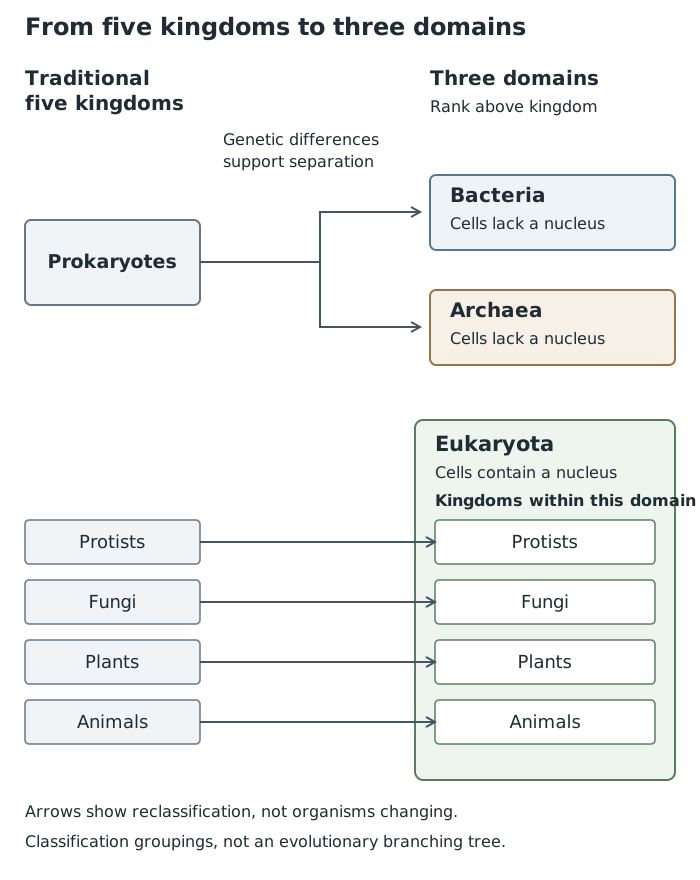
Genetic evidence supported splitting the old prokaryote group into two domains. The four eukaryotic kingdoms sit within Eukaryota.
A domain is a broader classification group than a kingdom. In the three-domain system, the four eukaryotic kingdoms are grouped within Eukaryota, while organisms formerly grouped together as prokaryotes are separated into Bacteria and Archaea.
The change is therefore not simply replacing five group names with three names at the same level. It introduces a higher level of classification that better reflects the relationships revealed by genetic evidence. It also shows how scientific models can change when new methods provide new evidence.
Get unlimited access to all revision notes, key terms, and exam tips.
Traditional kingdoms: prokaryotes, protists, fungi, plants and animals.
Three domains:
Domain is above kingdom. Genetic evidence supported separating prokaryotes into Bacteria and Archaea, while grouping the four eukaryotic kingdoms within Eukaryota.
Get unlimited access to all revision notes, key terms, and exam tips.
Link the evidence to the change: genetic analysis revealed important differences between organisms previously grouped together as prokaryotes, supporting their separation into Archaea and Bacteria.
A domain is above a kingdom. The three-domain system does not mean that plants, animals, fungi and protists have stopped being separate kingdoms.
Both Archaea and Bacteria lack a nucleus; this shared feature does not mean that they belong to the same domain.
Classification
The organisation of living organisms into groups based on shared characteristics and evolutionary relationships.
Genetic analysis
The comparison of genetic material, such as DNA or RNA base sequences, to investigate similarities, differences and relationships between organisms.
Domain
The highest level of biological classification in the three-domain system, above kingdom.
Kingdom
A major group in biological classification, below domain in the three-domain system.
Prokaryote
A single-celled organism whose cell has no nucleus.
Eukaryote
An organism whose cells contain a nucleus.
Common ancestor
An ancestral organism from which two or more groups of organisms evolved.
Put your knowledge into practice — try past paper questions for Combined Science
Classification
The organisation of living organisms into groups based on shared characteristics and evolutionary relationships.
Genetic analysis
The comparison of genetic material, such as DNA or RNA base sequences, to investigate similarities, differences and relationships between organisms.
Domain
The highest level of biological classification in the three-domain system, above kingdom.
Kingdom
A major group in biological classification, below domain in the three-domain system.
Prokaryote
A single-celled organism whose cell has no nucleus.
Eukaryote
An organism whose cells contain a nucleus.
Common ancestor
An ancestral organism from which two or more groups of organisms evolved.