

Loading…
Loading…
Loading…
AQA GCSE Media Studies · 8572
AQA 8572 Check the specification (PDF) (opens in a new tab)
A media product communicates through much more than its dialogue or written text. Images, sounds, colours, objects and the arrangement of material can all carry meaning. Together, these features form media language. A newspaper front page, for example, communicates through the relationship between its photograph, headline and accompanying text, not through any one element alone.
Producers use codes: systems of signs and shared rules that help audiences make sense of a product. A convention is an established practice that audiences recognise, such as placing a headline alongside a news photograph. These shared understandings help producers communicate, but audiences may still interpret a product differently.
Semiotics is the study of signs and how they communicate meaning. A sign is anything that conveys meaning or stands for something else. It might be a word, an image, a sound, an object or a gesture.
Semiotic analysis starts by distinguishing two levels of meaning:
In the OMO advert, a middle-aged woman is shown hanging out washing. That is a denotation. Interpreting the scene as connecting women with domestic responsibility moves into connotation: it considers the ideas suggested by the image rather than simply identifying its contents.
The same sign can suggest different things. Red might connote love, danger, anger or passion. Its meaning depends on what surrounds it, the product's purpose and the audience's cultural knowledge. Interpretations can also change over time, so an older advert may communicate differently to an audience today than to its original audience.
Words work as signs too. Galaxy's slogan, ‘why have cotton when you can have silk?’, names two fabrics, but it is advertising chocolate. The audience must recognise the comparison: silk suggests smoothness and luxury, positioning Galaxy as a more desirable choice. The meaning comes from shared associations, not from a literal claim that the chocolate contains fabric.
A sign can be understood as having a signifier, its perceivable form, and a signified, the idea associated with it. The word ‘silk’ is a signifier; luxury is one possible signified in this advertising context.
A symbol represents an idea, object or relationship through its associated meaning. Symbolism therefore involves interpretation. An object can do more than identify what is present: it can suggest values, beliefs or attitudes.
An icon, in the cultural or social sense used here, is a recognisable representation with lasting significance or influence. The TARDIS is an icon of Doctor Who: its appearance has come to represent the series. Its police-box form also connects it to the programme's historical context, when police boxes were familiar features of 1960s society and associated with law and order.
These terms can overlap. Something can be culturally iconic while also symbolising particular ideas. Neither label means that every audience member will give it exactly the same meaning.
An image may support several interpretations. Anchorage occurs when another element, often a headline or caption, narrows those possibilities and guides the audience towards an intended meaning.
The 2028 newspaper examples show how this works. The Daily Mirror uses negative wording, including ‘two-faced’ and ‘politicians who let the country down’, in the standfirst accompanying an image of Robert Jenrick and Nigel Farage. A standfirst is the short introductory text beneath a headline. Here, it encourages readers to interpret the people pictured negatively. The Times uses the same image with a less overtly judgemental caption, guiding its interpretation differently.
The photograph alone does not account for this difference. Meaning is created through the combination of image and words. Anchorage encourages a reading; it does not guarantee that every reader will accept it.
A simple way to describe communication is the linear model: a sender transmits a message to a receiver.
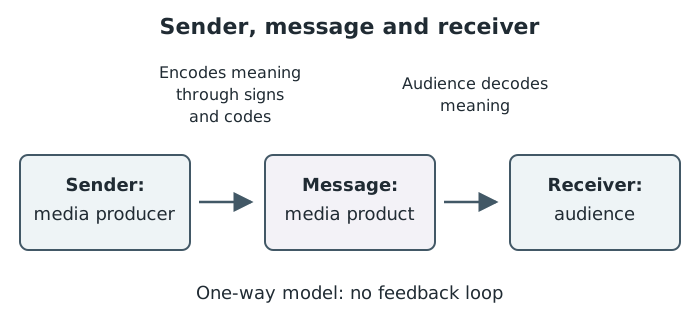
The linear model connects production choices with audience interpretation, but does not include feedback.
The sender is the producer or creator. The BBC, for example, can be understood as the sender of Doctor Who. The message is the media product, such as an episode, and the receiver is its audience. The product reaches the audience through a channel appropriate to its form.
The producer encodes meaning by choosing signs and arranging them. The audience decodes the product by interpreting those signs. These processes connect production choices with audience understanding, but intended and interpreted meanings are not necessarily identical.
The linear model describes a one-way process without feedback. It is therefore limited when applied to interactive media. Audience responses to Marcus Rashford's online presence, for example, matter to its success: communication is not simply a producer sending material to silent receivers. Calling the receiver passive in this model means there is no direct response built into the model, not that interpreting a product requires no thought.
Media products do not present everything that happened or everything a producer could have included. Their meaning is shaped through three connected processes:
These choices create narratives, portray aspects of reality and construct points of view. They also communicate values: ideas about what is important, desirable or acceptable.
Suppose a report about a school event selects photographs of smiling pupils, combines them with enthusiastic quotations and leaves out complaints about the organisation. Its choices construct a positive account. Including the complaints and combining them with photographs of queues could produce a different impression of the same event. Selection is unavoidable, but its consequences matter.
Construction does not automatically mean that a product is false. It means that audiences encounter an account shaped by producers rather than an unfiltered copy of reality. Even factual products involve decisions about what to show and how to present it.
Fiction constructs a world too. Doctor Who presents a reality in which time travel is possible. Its selected details and their arrangement make that world understandable to the audience. A narrative can also be suggested by a single image: the woman hanging washing in the OMO advert implies a domestic situation without requiring a sequence of scenes.
A product's mode of address is the way it communicates with its audience.
Direct address explicitly addresses the audience. A presenter speaking to camera, a person looking towards the viewer from a magazine cover, or an advert saying ‘you’ to its reader can create a sense of personal contact. Depending on the context, this may feel welcoming, persuasive or challenging.
Indirect address allows the audience to observe or overhear communication within the product's world without being addressed directly. In Doctor Who, ‘An Unearthly Child’, Ian and Barbara's conversation in the car is an example: they communicate with each other while viewers are invisible onlookers. This maintains the sense of a self-contained fictional world.
The crucial distinction is who is being addressed. A character can say ‘you’ to another character without addressing the audience. Indirect address can still involve and engage viewers; it simply does so without explicitly acknowledging them.
Register is the style of language chosen for a situation, purpose or audience, including its level of formality. Formal vocabulary may suggest authority or seriousness, while informal language may suggest familiarity and approachability.
For example, ‘Please ensure that your application is submitted’ and ‘Make sure you send it in’ give similar instructions but establish different tones. Both address the reader directly. Register and mode of address are therefore separate choices: direct address is not necessarily informal.
When analysing a product, connect its details rather than treating them as isolated labels. Identify what is present, explain its possible associations, and consider how words, images or sounds work together. Then explain how these choices encourage a particular understanding of the product, its world or its values.
If asked to define a term, explain its meaning rather than giving only an example. For indirect address, make clear that the audience is not addressed directly.
Indirect address does not mean that characters avoid looking at each other. The distinction concerns their relationship with the audience.
Support connotations with specific details and context. A colour does not always have the same meaning.
Move beyond identifying a feature: explain how its selection or combination with other elements creates meaning.
When a question specifies an extract, use precise evidence from that extract rather than unrelated moments elsewhere in the product.
It can see this note and what your specification asks for.
Answers are free with an account.
1 free note left this week
Get more free notesYour answer sets when this note comes back for review, or marks it complete.
Was this note helpful?
Log in to tell us whether it helped, or to report a problem.
Last updated
Media language
The images, words, sounds and other features through which media products communicate meaning.
Semiotics
The study of signs and how they create and communicate meaning.
Sign
Something that conveys meaning or stands for something else, such as a word, image, sound, object or gesture.
Denotation
The literal meaning of a sign: what is directly shown, heard or written.
Connotation
An associated or suggested meaning of a sign, shaped by its use, cultural knowledge and context.
Code
A system of signs and shared rules through which meaning is communicated.
Anchorage
The use of one element, often words accompanying an image, to narrow possible interpretations and guide audiences towards an intended meaning.
Icon
A recognisable cultural or social representation with lasting significance or influence.
Symbol
Something understood as representing an idea, object or relationship through its associated meaning.
Linear model of communication
A one-way account of communication in which a sender transmits a message to a receiver, without a feedback loop.
Sender
The creator or producer of a message in a communication model.
Message
The media product communicated by a sender to a receiver; the term can also refer to the ideas it conveys.
Receiver
The audience that receives and interprets a message.
Encoding
The process of putting intended meanings into a media product through choices of signs and codes.
Decoding
The process through which an audience interprets the signs and codes in a media product.
Selection
Choosing which material or elements to include in a media product.
Combination
Connecting and arranging selected elements so that they create meaning together.
Exclusion
Leaving material or elements out of a media product.
Mode of address
The way a media product communicates with and establishes a relationship with its audience.
Direct address
Communication that explicitly addresses the audience, for example through speech to camera or words directed at the reader.
Indirect address
Communication within the world of a media product that the audience observes or overhears without being addressed directly.
Register
The style of language used for a particular situation, purpose or audience, including its level of formality.
Put your knowledge into practice — try past paper questions for Media Studies
Media language
The images, words, sounds and other features through which media products communicate meaning.
Semiotics
The study of signs and how they create and communicate meaning.
Sign
Something that conveys meaning or stands for something else, such as a word, image, sound, object or gesture.
Denotation
The literal meaning of a sign: what is directly shown, heard or written.
Connotation
An associated or suggested meaning of a sign, shaped by its use, cultural knowledge and context.
Code
A system of signs and shared rules through which meaning is communicated.
Anchorage
The use of one element, often words accompanying an image, to narrow possible interpretations and guide audiences towards an intended meaning.
Icon
A recognisable cultural or social representation with lasting significance or influence.
Symbol
Something understood as representing an idea, object or relationship through its associated meaning.
Linear model of communication
A one-way account of communication in which a sender transmits a message to a receiver, without a feedback loop.
Sender
The creator or producer of a message in a communication model.
Message
The media product communicated by a sender to a receiver; the term can also refer to the ideas it conveys.
Receiver
The audience that receives and interprets a message.
Encoding
The process of putting intended meanings into a media product through choices of signs and codes.
Decoding
The process through which an audience interprets the signs and codes in a media product.
Selection
Choosing which material or elements to include in a media product.
Combination
Connecting and arranging selected elements so that they create meaning together.
Exclusion
Leaving material or elements out of a media product.
Mode of address
The way a media product communicates with and establishes a relationship with its audience.
Direct address
Communication that explicitly addresses the audience, for example through speech to camera or words directed at the reader.
Indirect address
Communication within the world of a media product that the audience observes or overhears without being addressed directly.
Register
The style of language used for a particular situation, purpose or audience, including its level of formality.
Sender → message → receiver
Producers encode meaning; audiences decode it. The linear model is one-way and has no feedback loop, limiting its usefulness for interactive media.
Together, these construct narratives, views of reality, points of view, messages and values. Constructed does not necessarily mean false.
Specific detail → denotation → supported connotation → relationship with other elements → meaning or audience positioning.