

Loading…
Loading…
Loading…
AQA Level 2 Certificate Further Mathematics · 8365
AQA 8365 · 6.2 Check the specification (PDF) (opens in a new tab)
A geometrical proof explains why a statement must be true, using given information and established mathematical facts. Each becomes information you can use in the next step. The argument ends when you reach the statement you were asked to prove.
Measuring a diagram can suggest a result, but it cannot prove it. A drawing may not be to scale, and checking one particular shape does not establish a general relationship. Letters allow an argument to work without choosing particular angle sizes or lengths.
In , the middle letter, , is the vertex: the angle is between and . The notation denotes the length of the line segment joining and . Naming the exact angle or length makes each step unambiguous.
Useful reasons include angles on a straight line summing to , angles around a point summing to , vertically opposite angles being equal, and the angles of a triangle summing to . A quadrilateral has an angle sum of . Equal sides of an isosceles triangle have equal angles opposite them.
Parallel lines provide further connections: alternate angles are equal, corresponding angles are equal, and co-interior angles sum to . The parallel lines must be given or established before these facts can be used.
Circle theorems connect angles that may lie in different parts of a diagram. Look for the chord or arc linking them: angles in the same segment are equal, and the angle at the centre is twice the angle at the circumference subtended by the same arc. An angle in a semicircle is . Opposite angles of a cyclic quadrilateral sum to , while the alternate segment theorem connects a tangent–chord angle to an angle at the circumference.
These facts are tools for building an argument, not just rules for calculating missing numbers.
Start by separating what is given from what must be proved. Mark the given information on the diagram, then look for a triangle, parallel lines or another configuration that connects it to the target. You can plan backwards from the target, but the written proof should move forwards from established facts.
For example, let , and lie on one straight line, parallel to the line through and . Suppose and . We want to prove that .
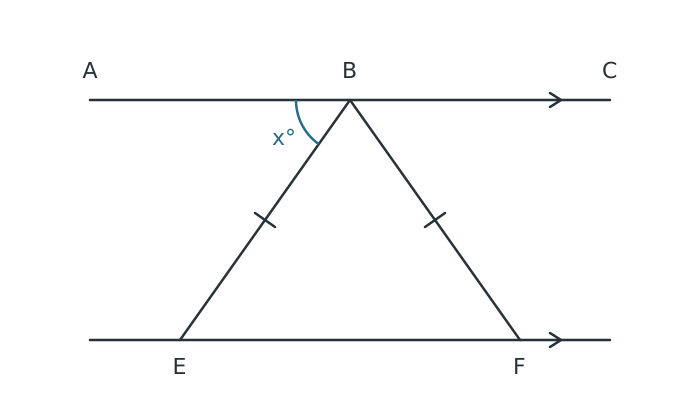
Parallel lines and equal sides provide the two base angles needed to prove the angle at B.
The target angle belongs to triangle . Finding its two other angles will therefore give us a route to the result.
| Statement | Reason |
|---|---|
| Alternate angles are equal because . | |
| , so the base angles of isosceles triangle are equal. | |
| Rearranging and simplifying. |
The proof works for every value of compatible with this configuration. No particular value of is needed.
A circle proof often needs more than one theorem, followed by an ordinary angle sum. Suppose is a cyclic quadrilateral, with tangent touching the circle at . Let , and . We want to prove .
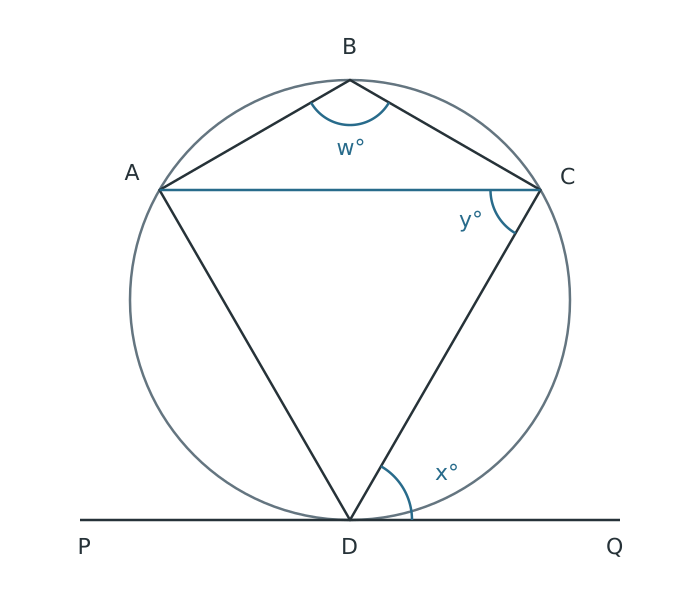
Triangle ADC combines the cyclic-quadrilateral theorem with the alternate segment theorem.
The target links three angles in different positions. Triangle brings them together: one of its angles is already , and the other two can be expressed using circle theorems.
| Statement | Reason |
|---|---|
| Opposite angles of cyclic quadrilateral sum to . | |
| Alternate segment theorem, using tangent and chord . | |
| Angles in triangle sum to . | |
| Subtracting and rearranging. |
The geometry establishes the equation; the algebra puts it into the requested form.
Another useful combination occurs when is a diameter and lies on the circumference. If the angles at and are and , then because it is an angle in a semicircle. The triangle angle sum gives , so dividing by proves . This establishes a relationship without determining and separately.
For equality statements, look for two triangles whose corresponding parts can be matched. Congruent triangles have equal corresponding sides and angles. To establish congruence, use SSS (three sides), SAS (two sides and the included angle), ASA (two angles and a corresponding side), or RHS (a right angle, hypotenuse and another side).
For example, let be a rectangle. To prove its diagonals are equal, compare triangles and :
The triangles are congruent by SAS, so their corresponding sides and are equal. These are the diagonals, which completes the proof.
Similarity can instead establish equal corresponding angles or ratios of corresponding lengths; it does not by itself establish equal lengths. Pythagoras' theorem, , can establish relationships between lengths in a right-angled triangle, where is the hypotenuse. Choose the tool that connects the information given to the conclusion required.
Given facts → justified deductions → required conclusion.
State the exact angle or length and give a reason for each geometrical step. In , is the vertex.
Combine these with angle sums, then simplify the resulting equation to reach the target relationship.
Give a mathematical reason for each geometrical step, including basic angle sums. A statement–reason table is a clear way to present a proof.
Use three-letter angle notation when several angles meet at a vertex: the middle letter identifies the vertex.
Do not assume that lines are parallel, lengths are equal or angles are right angles just because they look that way.
Check each theorem's conditions: for example, alternate angles require parallel lines, and Pythagoras' theorem requires a right-angled triangle.
Finish with the exact statement requested. Proving a relationship between unknowns does not necessarily require finding their individual values.
When using congruence, match corresponding vertices and state the congruence criterion.
It can see this note and what your specification asks for.
Answers are free with an account.
1 free note left this week
Get more free notesYour answer sets when this note comes back for review, or marks it complete.
Was this note helpful?
Log in to tell us whether it helped, or to report a problem.
Last updated
Geometrical proof
A logical argument establishing a geometrical statement from given information and known mathematical facts, with a reason for each deduction.
Theorem
A mathematical statement that has been proved and can be used to justify further deductions.
Deduction
A conclusion that follows logically from given information or previously established results.
Congruence
The property of having exactly the same shape and size. Corresponding sides and angles of congruent shapes are equal.
Similarity
The property of having the same shape: corresponding angles are equal and corresponding lengths are in a common ratio.
Cyclic quadrilateral
A quadrilateral whose four vertices lie on the circumference of one circle.
Alternate segment theorem
The theorem stating that the angle between a tangent and a chord equals the angle subtended by that chord at the circumference in the alternate segment.
Put your knowledge into practice — try past paper questions for Further Mathematics
Geometrical proof
A logical argument establishing a geometrical statement from given information and known mathematical facts, with a reason for each deduction.
Theorem
A mathematical statement that has been proved and can be used to justify further deductions.
Deduction
A conclusion that follows logically from given information or previously established results.
Congruence
The property of having exactly the same shape and size. Corresponding sides and angles of congruent shapes are equal.
Similarity
The property of having the same shape: corresponding angles are equal and corresponding lengths are in a common ratio.
Cyclic quadrilateral
A quadrilateral whose four vertices lie on the circumference of one circle.
Alternate segment theorem
The theorem stating that the angle between a tangent and a chord equals the angle subtended by that chord at the circumference in the alternate segment.
| Angles in a triangle sum to . |