

Loading…
Loading…
Loading…
AQA GCSE Combined Science: Synergy · 8465
AQA 8465 · 4.2.1.7 Check the specification (PDF) (opens in a new tab)
The body's organs need to work together. The endocrine system coordinates and controls body functions using chemical messages called hormones. It consists of glands that secrete, or release, hormones directly into the bloodstream.
Hormones are large molecules. The blood carries them around the body, but a particular hormone produces its effect at a target organ. This is the organ that responds to that hormone. Hormonal control therefore connects a gland in one part of the body with an organ elsewhere: the gland releases the message, the blood transports it and the target organ responds.
The nervous system also coordinates responses, but it carries electrical impulses along nerve cells. Compared with nervous responses, hormonal responses are generally slower to take effect but last longer. Hormonal control is therefore useful for regulating processes over time, although some hormones also help the body respond to emergencies.
The pituitary gland, located in the brain, is often called the master gland. It secretes several hormones, some of which act on other endocrine glands and stimulate them to release their own hormones.
This creates a chain of control: a pituitary hormone acts on another gland, which releases a hormone that affects the body. For example, the pituitary gland can stimulate the thyroid gland to release thyroxine.
Adrenaline is secreted by the adrenal glands, which lie just above the kidneys. Fear or stress can trigger its release, preparing the body for ‘flight or fight’: escaping from danger or confronting it.
Adrenaline increases heart rate and boosts the delivery of oxygen and glucose to the brain and muscles. Oxygen and glucose are needed for aerobic respiration, which releases energy. Increasing their delivery supports greater energy release for rapid action, such as running away. Adrenaline does not itself supply the energy; it helps cells obtain the substances needed to release it.
The thyroid gland, in the neck, secretes thyroxine. Thyroxine stimulates the basal metabolic rate: the rate of chemical reactions in the body when it is at rest. Even when you are sitting still, your cells are carrying out reactions needed to keep you alive.
Thyroxine also plays an important role in proper growth and development. Its release needs to be regulated so that the amount in the blood stays around a normal level.
Negative feedback means that a change triggers a response which tends to reverse that change. If a level falls, the response raises it; if it rises too far, the response lowers it. This stabilises the system rather than allowing the original change to become larger.
Thyroxine control involves TSH, or thyroid-stimulating hormone, secreted by the pituitary gland. TSH stimulates the thyroid gland to release thyroxine.
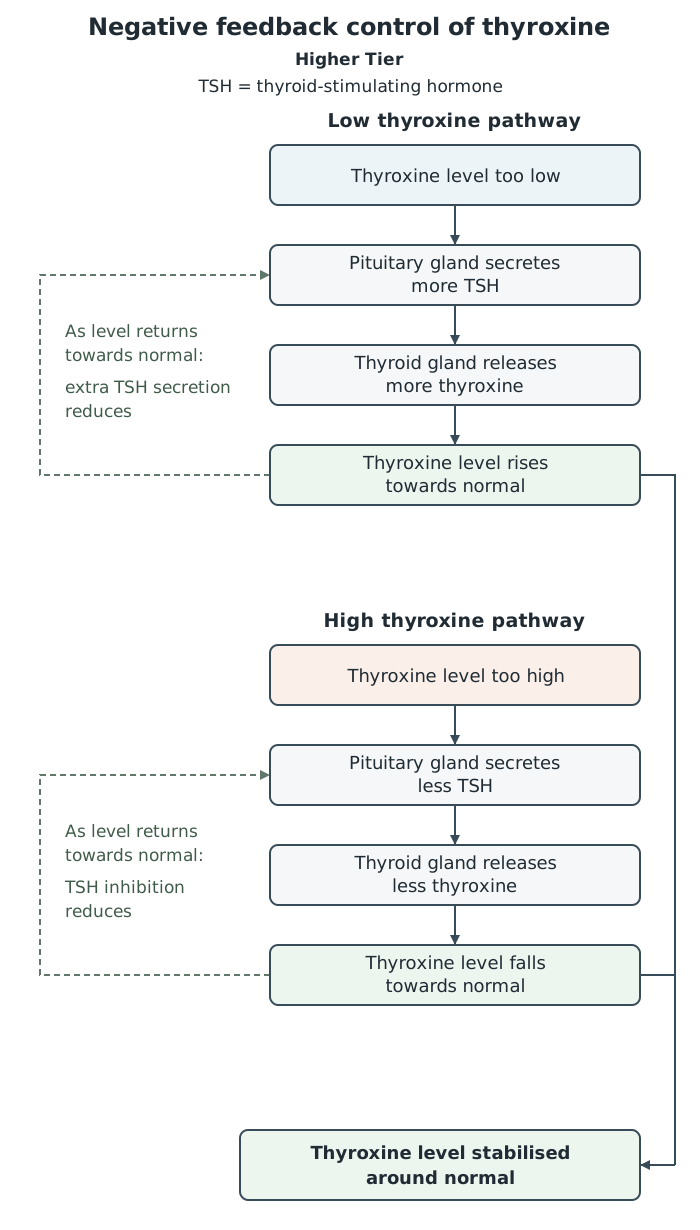
Both pathways reverse the initial change in thyroxine level, helping to keep it stable.
To interpret a negative feedback diagram, start with the change and follow the arrows through the response. In the low-thyroxine pathway, increased TSH leads to increased thyroxine release: the final rise opposes the initial fall. In the high-thyroxine pathway, reduced TSH leads to reduced thyroxine release: the final fall opposes the initial rise. In both cases, the outcome reverses the starting change. As thyroxine returns towards normal, the corrective response is reduced.
Distinguish the gland from its hormone: adrenal glands secrete adrenaline; the thyroid gland secretes thyroxine.
For adrenaline, link increased oxygen and glucose delivery to respiration and energy release, rather than saying that adrenaline supplies energy.
When explaining negative feedback, state the initial change, the response and how that response reverses the change. It corrects both high and low levels.
TSH is secreted by the pituitary gland, not the thyroid gland.
It can see this note and what your specification asks for.
Answers are free with an account.
1 free note left this week
Get more free notesYour answer sets when this note comes back for review, or marks it complete.
Was this note helpful?
Log in to tell us whether it helped, or to report a problem.
Last updated
Endocrine system
The system of glands that secrete hormones directly into the bloodstream to coordinate and control body functions.
Hormone
A chemical messenger carried in the blood to a target organ, where it produces an effect.
Target organ
An organ on which a particular hormone acts to produce an effect.
Pituitary gland
A gland in the brain that secretes several hormones, including hormones that stimulate other endocrine glands.
Adrenaline
A hormone secreted by the adrenal glands that increases oxygen and glucose delivery to the brain and muscles, preparing the body for flight or fight.
Thyroxine
A hormone secreted by the thyroid gland that stimulates the basal metabolic rate and supports growth and development.
Basal metabolic rate
The rate at which chemical reactions occur in the body when it is at rest.
TSH
Thyroid-stimulating hormone: a hormone secreted by the pituitary gland that stimulates the thyroid gland to release thyroxine.
Negative feedback
A control mechanism in which a change triggers a response that tends to reverse that change, stabilising the system.
Put your knowledge into practice — try past paper questions for Combined Science: Synergy
Endocrine system
The system of glands that secrete hormones directly into the bloodstream to coordinate and control body functions.
Hormone
A chemical messenger carried in the blood to a target organ, where it produces an effect.
Target organ
An organ on which a particular hormone acts to produce an effect.
Pituitary gland
A gland in the brain that secretes several hormones, including hormones that stimulate other endocrine glands.
Adrenaline
A hormone secreted by the adrenal glands that increases oxygen and glucose delivery to the brain and muscles, preparing the body for flight or fight.
Thyroxine
A hormone secreted by the thyroid gland that stimulates the basal metabolic rate and supports growth and development.
Basal metabolic rate
The rate at which chemical reactions occur in the body when it is at rest.
TSH
Thyroid-stimulating hormone: a hormone secreted by the pituitary gland that stimulates the thyroid gland to release thyroxine.
Negative feedback
A control mechanism in which a change triggers a response that tends to reverse that change, stabilising the system.