Loading…


Loading…
Loading…
Loading…
AQA GCSE Combined Science Trilogy · 8464
AQA 8464 · 6.6.2.1 Check the specification (PDF) (opens in a new tab)
Sunlight reaches Earth across the vacuum of space. Unlike sound, it does not need particles in a material to carry it. Light is an electromagnetic wave: a transverse wave that transfers energy from a source to an absorber.
In a transverse wave, the oscillations are at right angles to the direction in which energy travels. Electromagnetic waves do not carry matter from the source to the absorber. For example, the Sun does not send hot material to Earth to warm it; energy travels by electromagnetic radiation.
The source emits the waves, while the absorber takes in their energy. Absorbing this energy can produce a change, such as warming an object.
Visible light, radio waves and X-rays may seem very different, but they belong to the same family. All electromagnetic waves are transverse, can travel through a vacuum, and travel at the same velocity through a vacuum or air.
Together they form the electromagnetic spectrum. It is continuous: wavelengths and frequencies vary across it without gaps. The seven named groups describe different regions of this spectrum, rather than seven completely separate kinds of behaviour.
The groups are arranged using two wave properties. Wavelength is the distance between corresponding points on consecutive waves, such as neighbouring crests. Frequency is the number of complete waves passing a point each second.
The wave equation links these properties:
Here, is wave speed, is frequency and is wavelength. Because electromagnetic waves have the same speed in a vacuum or air, a shorter wavelength means a higher frequency. More closely spaced waves pass a point more often.
From longest to shortest wavelength, the order is:
Radio → microwave → infrared → visible light → ultraviolet → X-rays → gamma rays.
This is also the order from lowest to highest frequency. Radio waves therefore have the longest wavelengths and lowest frequencies, while gamma rays have the shortest wavelengths and highest frequencies.
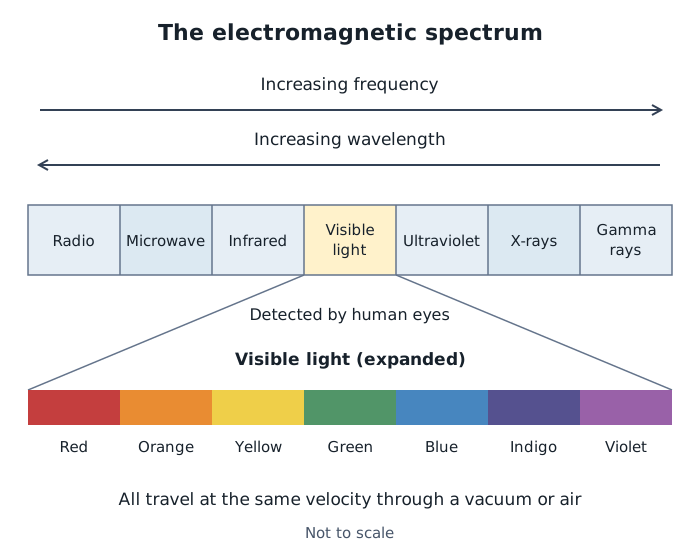
The electromagnetic spectrum is continuous. From radio waves to gamma rays, wavelength decreases and frequency increases; visible light occupies only a limited region.
Read the wavelength and frequency arrows in opposite directions. Moving towards gamma rays decreases wavelength but increases frequency; it does not increase the speed of the waves.
Our eyes detect only visible light, a limited region of the electromagnetic spectrum between infrared and ultraviolet. The other regions are still electromagnetic waves even though we cannot see them.
Within visible light, the colours run from red, orange, yellow, green, blue, indigo to violet as wavelength decreases. Red has the longest wavelength and lowest frequency in the visible range; violet has the shortest wavelength and highest frequency.
Being invisible does not mean a wave transfers no energy. Infrared and microwaves, for example, can warm objects without being detected by our eyes.
A useful way to explain electromagnetic energy transfer is to follow the chain source → electromagnetic waves → absorber → effect.
In a microwave oven, the microwave source emits microwaves. Water molecules in the food absorb energy carried by these waves. Energy is transferred to the food’s thermal energy store, increasing its temperature.
A hot object emits infrared radiation. When another object absorbs this radiation, energy is transferred to its thermal energy store and it warms up. No contact between the two objects is needed for this transfer.
The Sun emits electromagnetic waves that travel through space to Earth. Infrared radiation absorbed at Earth’s surface warms it. The Sun also emits visible light, which our eyes detect, and ultraviolet radiation, which can cause sunburn when absorbed by skin. These examples show that electromagnetic radiation transfers energy even across a vacuum.
Get unlimited access to all revision notes, key terms, and exam tips.
Long → short wavelength; low → high frequency:
Radio → microwave → infrared → visible light → ultraviolet → X-rays → gamma rays.
: at constant speed, shorter wavelength means higher frequency.
Recall the chain: source → waves → absorber → effect.
Microwaves absorbed by food and infrared absorbed by objects transfer energy to their thermal energy stores.
Check the direction requested when ordering the spectrum: increasing frequency is the same order as decreasing wavelength.
For an energy-transfer example, identify the source, the type of electromagnetic wave and the absorber, then describe the effect on the absorber.
A higher frequency does not mean a higher speed: all electromagnetic waves travel at the same velocity through a vacuum or air.
Visible light is part of the electromagnetic spectrum, not a separate type of wave outside it.
Electromagnetic wave
A transverse wave that transfers energy from a source to an absorber and can travel through a vacuum.
Transverse wave
A wave whose oscillations are at right angles to the direction of energy transfer.
Electromagnetic spectrum
The continuous range of electromagnetic waves, arranged by wavelength or frequency.
Wavelength
The distance between corresponding points on consecutive waves, such as from one crest to the next, measured in metres.
Frequency
The number of complete waves passing a point each second, measured in hertz (Hz).
Absorber
An object or material that takes in energy carried by waves.
Vacuum
A region containing no matter. Electromagnetic waves can travel through it without needing particles to carry them.
Visible light
The range of electromagnetic waves detectable by human eyes, extending from red to violet.
Put your knowledge into practice — try past paper questions for Combined Science Trilogy
Electromagnetic wave
A transverse wave that transfers energy from a source to an absorber and can travel through a vacuum.
Transverse wave
A wave whose oscillations are at right angles to the direction of energy transfer.
Electromagnetic spectrum
The continuous range of electromagnetic waves, arranged by wavelength or frequency.
Wavelength
The distance between corresponding points on consecutive waves, such as from one crest to the next, measured in metres.
Frequency
The number of complete waves passing a point each second, measured in hertz (Hz).
Absorber
An object or material that takes in energy carried by waves.
Vacuum
A region containing no matter. Electromagnetic waves can travel through it without needing particles to carry them.
Visible light
The range of electromagnetic waves detectable by human eyes, extending from red to violet.
Get unlimited access to all revision notes, key terms, and exam tips.