Loading…


Loading…
Loading…
Loading…
AQA GCSE Combined Science Trilogy · 8464
AQA 8464 · 6.6.2.2 Refraction and Wave Properties Check the specification (PDF) (opens in a new tab)
Electromagnetic waves can interact with a material in several ways. Transmission means that the wave passes through the material. Absorption transfers energy from the wave to the material. Reflection sends a wave back from a boundary. A transmitted wave may also undergo refraction: a change in direction caused by a change in wave speed.
These are not necessarily separate alternatives. At a window, for example, some visible light passes through the glass while some is reflected from its surface. Light entering the glass at an angle can also be refracted.
The interaction depends on both the material and the wavelength. A material that transmits one part of the electromagnetic spectrum may absorb or reflect another. For example, ordinary window glass transmits visible light but absorbs some ultraviolet wavelengths. Being transparent to visible light does not mean being transparent to every electromagnetic wave.
A ray is a line showing the direction in which a wave travels. Its arrowhead shows the direction of travel. Ray diagrams let us represent what happens where two media meet, such as the boundary between air and glass.
To describe a ray's direction at a boundary, draw a normal: an imaginary line at right angles to the boundary, passing through the point where the ray meets it. The angle of incidence is between the incoming ray and the normal. The angle of refraction is between the refracted ray and the normal.
For light travelling from air into glass, the refracted ray bends towards the normal, so its angle to the normal becomes smaller. For light travelling from glass into air, it bends away from the normal, so its angle to the normal becomes larger.
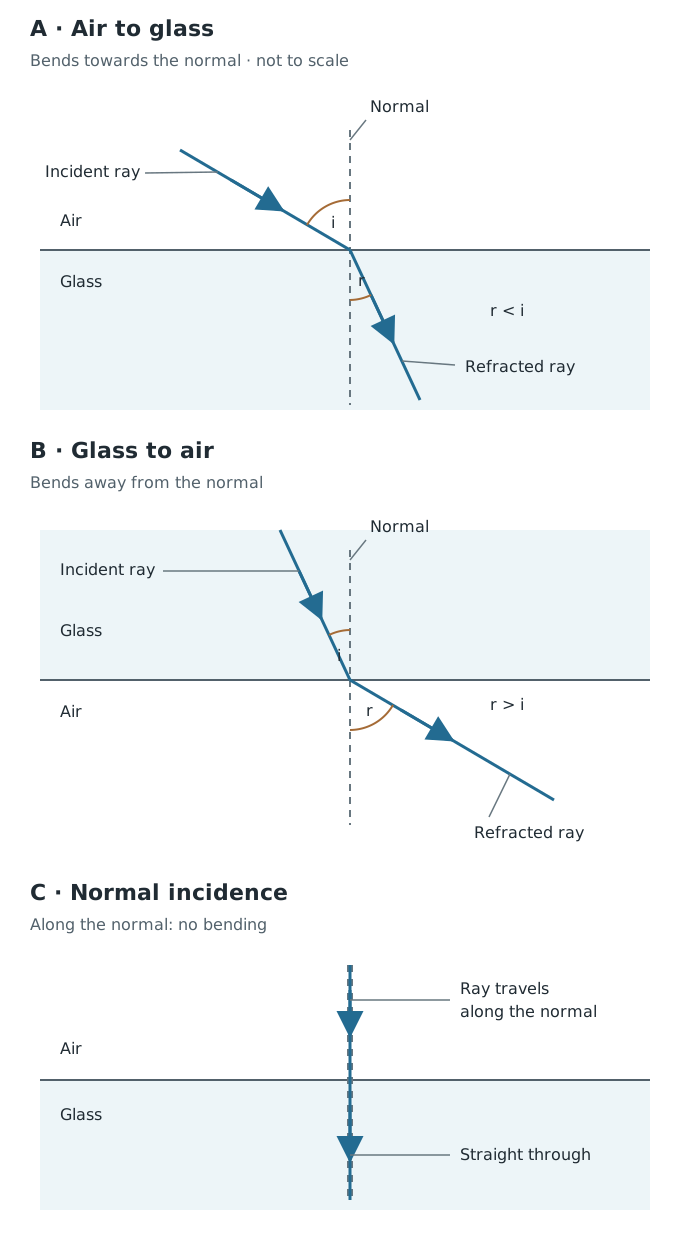
Light bends towards the normal entering glass from air, and away from the normal leaving glass for air. Along the normal, it does not bend.
For a ray entering glass from air:
For a ray leaving glass and entering air, use the same construction but draw the outgoing ray farther from the normal. If tracing a ray through a rectangular glass block, draw a separate normal at each boundary where the ray crosses.
A ray travelling along the normal continues straight through the boundary: it does not bend. This is an important exception to the idea that crossing a boundary always changes direction.
All electromagnetic waves have the same speed in a vacuum, but their speed in a material can be different. Visible light travels more slowly in glass than in air.
When a wave enters a medium where it travels more slowly, it bends towards the normal, provided it meets the boundary at an angle. When it enters a medium where it travels faster, it bends away from the normal. The speed change, rather than simply the name of the material, determines the bending direction.
The wave's frequency stays the same when it crosses the boundary. Its wavelength changes with its speed. Using , a lower speed at the same frequency means a shorter wavelength; a higher speed means a longer wavelength.
A wavefront joins points at the same stage of a wave's cycle, such as points along a crest. In a diagram of straight waves, successive wavefronts are parallel lines. The direction of travel is perpendicular to these lines, and the spacing between successive crests represents the wavelength.
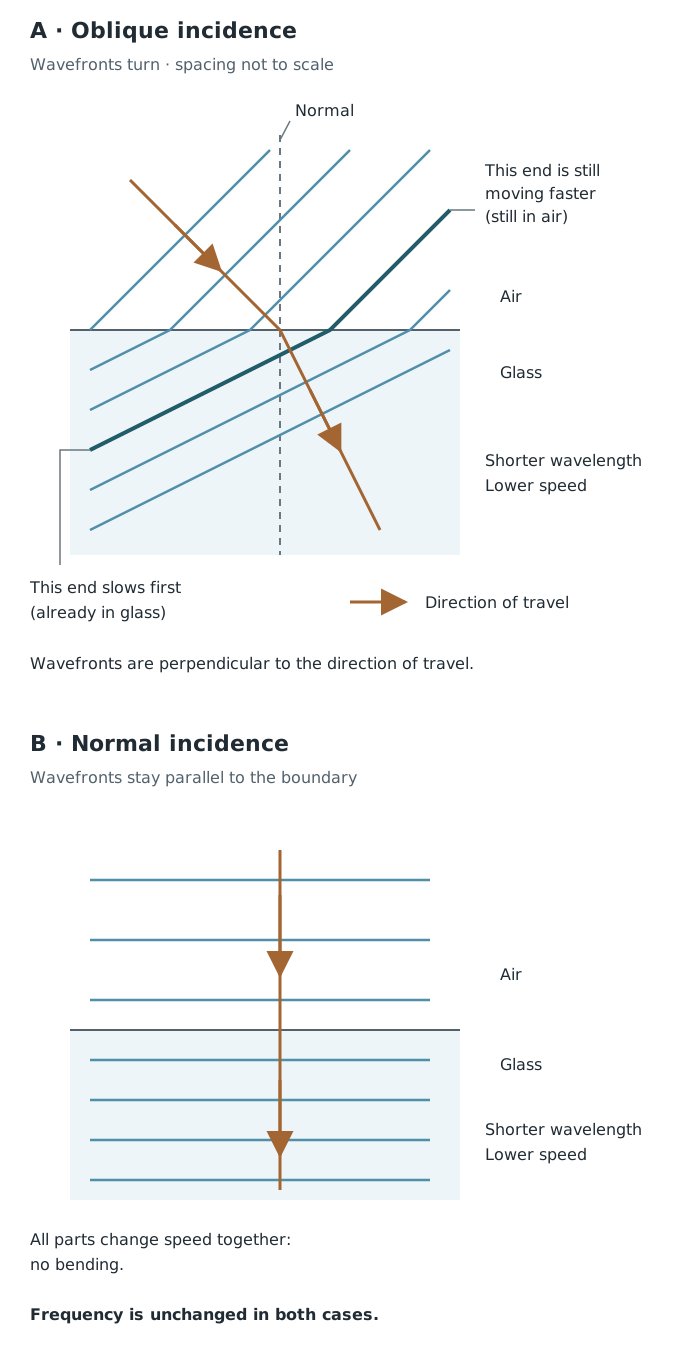
At an angle, one end of a wavefront slows before the other, turning the wavefront. At normal incidence, all parts slow together.
Consider a wave entering glass from air at an angle. One end of a wavefront reaches the glass first and slows down, while the other end is still travelling faster in air. During this interval, the end still in air travels farther. This turns the wavefront, changing the direction of travel towards the normal.
Once the wave is in the glass, the wavefronts are closer together because the wavelength is shorter. The frequency has not changed.
For travel from glass to air, one end speeds up before the other, producing bending away from the normal. At normal incidence, the wavefront is parallel to the boundary: all parts cross and change speed together. Its spacing changes, but its orientation does not, so there is no bending.
Get unlimited access to all revision notes, key terms, and exam tips.
Whether electromagnetic waves are absorbed, transmitted, reflected or refracted depends on wavelength and material. Different interactions can occur together.
Measure angles between each ray and the normal, not between the ray and the boundary.
Draw rays with a ruler, add arrowheads and place the change in direction exactly at the boundary.
Use the change in wave speed to decide the bending direction; entering a material does not always mean bending towards the normal.
For a wavefront explanation, state that one end changes speed before the other, then link this to the change in direction.
Refraction
The change in direction of a wave caused by a change in its speed when it passes between different media.
Medium
A substance or material through which a wave travels, such as air, water or glass.
Transmission
The passage of a wave through a material.
Absorption
The transfer of energy from a wave to a material.
Reflection
The return of a wave from a boundary into the medium it came from.
Normal
An imaginary line perpendicular to a boundary at the point where a ray meets it.
Angle of incidence
The angle between the incoming ray and the normal.
Angle of refraction
The angle between the transmitted, refracted ray and the normal.
Wavefront
A line joining points at the same stage of a wave's cycle, such as points along a crest.
Put your knowledge into practice — try past paper questions for Combined Science Trilogy
Refraction
The change in direction of a wave caused by a change in its speed when it passes between different media.
Medium
A substance or material through which a wave travels, such as air, water or glass.
Transmission
The passage of a wave through a material.
Absorption
The transfer of energy from a wave to a material.
Reflection
The return of a wave from a boundary into the medium it came from.
Normal
An imaginary line perpendicular to a boundary at the point where a ray meets it.
Angle of incidence
The angle between the incoming ray and the normal.
Angle of refraction
The angle between the transmitted, refracted ray and the normal.
Wavefront
A line joining points at the same stage of a wave's cycle, such as points along a crest.
Get unlimited access to all revision notes, key terms, and exam tips.