Loading…


Loading…
Loading…
Loading…
AQA GCSE Combined Science Trilogy · 8464
AQA 8464 · 6.6.1.2 Properties of Waves Check the specification (PDF) (opens in a new tab)
A wave travels through a material while the material itself vibrates. To measure wave speed, we can time a wave travelling a known distance, or measure its frequency and wavelength.
For a timed journey:
Here, is the distance travelled in metres and is the travel time in seconds. Alternatively:
Frequency is measured in hertz (Hz), wavelength in metres (m), and speed in metres per second (m/s). The most suitable apparatus depends on how quickly the wave moves and how clearly its pattern can be seen.
Sound travels too quickly for a person to time a short journey accurately with a stopwatch. Two microphones connected to an oscilloscope allow the arrival of the same sound at two positions to be timed electronically.
Place the microphones about 5 m apart and measure their separation with a tape measure. Arrange them along the direction in which the sound will travel. Bang two wooden blocks together just beyond the first microphone, so the sound passes the first microphone and then the second.
Set the oscilloscope to trigger when the first microphone detects the sound. Adjust its time base so that both microphone signals are visible. Identify the arrival of the same sound pulse on each trace and measure the time difference, using the horizontal time scale. This is the time taken for sound to travel the measured microphone separation.
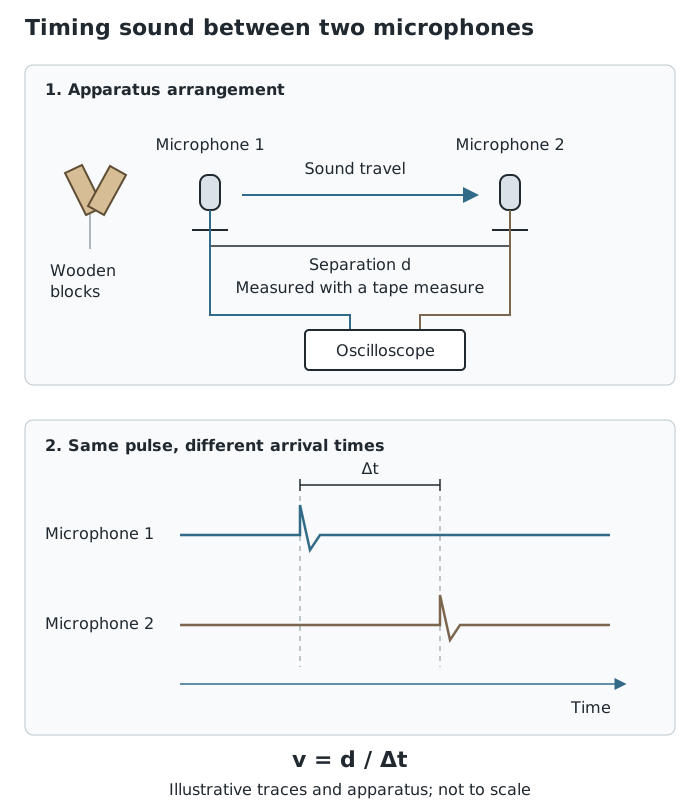
Measure the distance between microphones and the time taken for the same sound to travel between them.
Calculate speed by dividing the microphone separation by the time difference. Repeat the measurement several times and calculate a mean. Electronic timing avoids the reaction-time delay involved in starting and stopping a stopwatch.
A simpler outdoor method uses two people about 100 m apart, with the distance measured using a trundle wheel. One person bangs wooden blocks together above their head. The other starts a stopwatch when they see the blocks meet and stops it when they hear the sound. Light takes a negligible time to cover this distance compared with sound. Repeating and averaging helps with random variation, but reaction time remains a substantial limitation because the sound journey is short.
A ripple tank allows wavelength and frequency to be measured separately, then combined to calculate speed. Use a shallow layer of water, about , and a motor-driven wooden rod. When stationary, the rod should just touch the water surface. Its up-and-down vibration produces straight wavefronts.
Get unlimited access to all revision notes, key terms, and exam tips.
In a practical-method answer, name the apparatus, state exactly which distance and time are measured, and give the calculation.
Count wavelength intervals, not wavefronts: six consecutive crests span five wavelengths.
For a vibrating string, each loop is half a wavelength. Double the mean loop length to find the wavelength.
Convert wavelength measurements to metres before using v = fλ.
Explain improvements: measuring several wavelengths reduces the percentage uncertainty in length; automatic sound timing avoids human reaction-time error.
Wave speed
The speed at which a wave, and the energy it carries, travels through a medium, measured in metres per second (m/s).
Wavelength
The distance between equivalent points on adjacent waves, such as crest to crest, measured in metres (m).
Frequency
The number of complete waves passing a point each second, measured in hertz (Hz).
Ripple tank
A shallow, transparent-bottomed tank used to produce and observe water waves.
Wavefront
A line joining points at the same stage of a wave, such as a line of crests on a water surface.
Oscilloscope
An instrument that displays how an electrical signal changes with time; microphone signals can be used to measure sound arrival times.
Standing wave
A wave pattern with fixed positions of little or no movement and vibrating loops between them.
Put your knowledge into practice — try past paper questions for Combined Science Trilogy
Wave speed
The speed at which a wave, and the energy it carries, travels through a medium, measured in metres per second (m/s).
Wavelength
The distance between equivalent points on adjacent waves, such as crest to crest, measured in metres (m).
Frequency
The number of complete waves passing a point each second, measured in hertz (Hz).
Ripple tank
A shallow, transparent-bottomed tank used to produce and observe water waves.
Wavefront
A line joining points at the same stage of a wave, such as a line of crests on a water surface.
Oscilloscope
An instrument that displays how an electrical signal changes with time; microphone signals can be used to measure sound arrival times.
Standing wave
A wave pattern with fixed positions of little or no movement and vibrating loops between them.
A lamp above the transparent tank projects the wave pattern onto white card underneath. Adjust the lamp until the pattern is clear; dimmer room lighting can help. Look directly at the card from the side rather than down through the water.
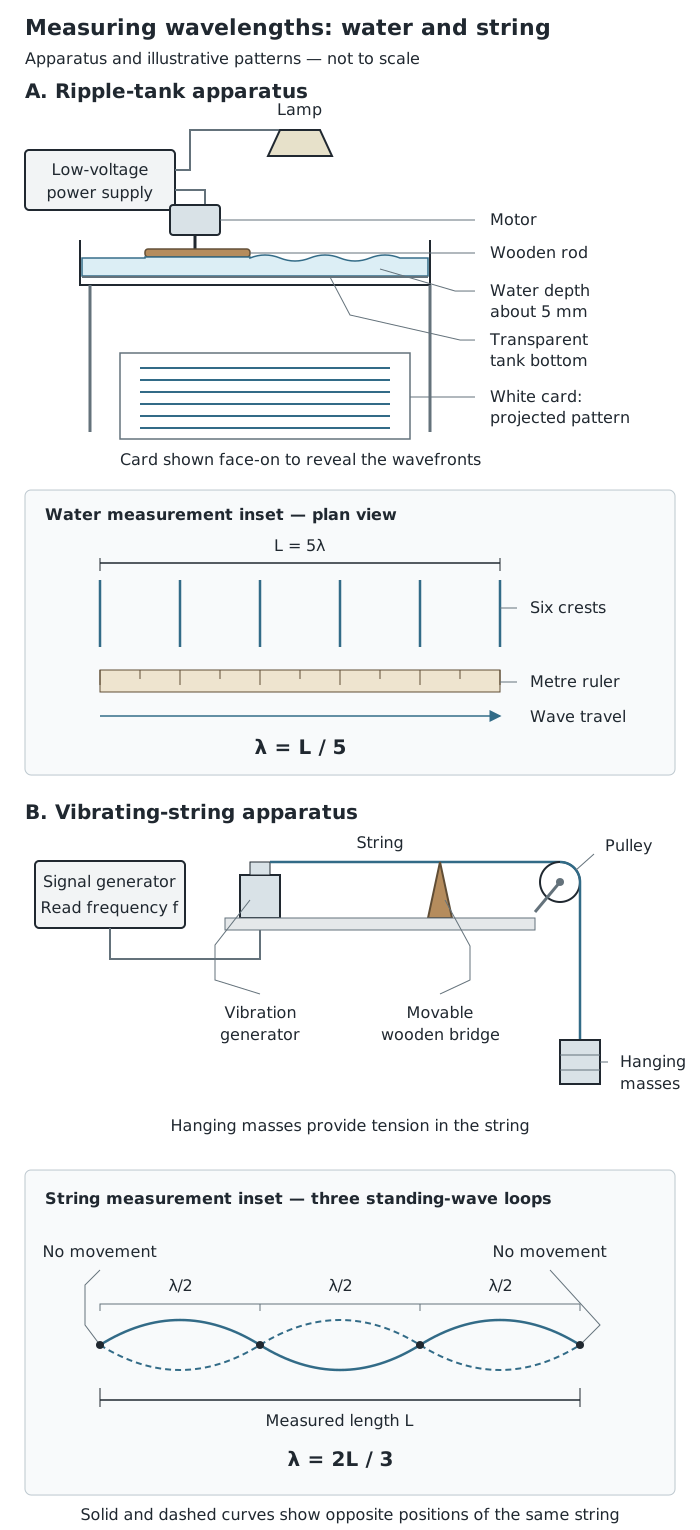
Water-wave crest intervals are whole wavelengths; each vibrating string loop is half a wavelength.
Observe the pattern before choosing how to measure it. If the waves pass slowly enough to count, a stopwatch is suitable for frequency. If they are too fast to follow, a video recording can make counting easier. A stroboscope can also make the pattern appear stationary when appropriately matched to the wave frequency, but it must only be used after checking that flashing light will not affect anyone present.
Place a metre ruler at right angles to the wavefronts, along the direction of wave travel. Measure from one crest to a later crest across several complete wavelength intervals. Divide this total distance by the number of intervals to obtain the mean wavelength. Measuring several intervals makes the uncertainty in locating the endpoints smaller relative to the total length measured.
To measure frequency, choose a fixed point in the pattern. Count the number of complete waves passing that point during a measured time, such as 10 seconds:
Repeat the count and calculate a mean. Keep the water depth and motor setting unchanged while measuring the frequency and wavelength for one result. Record both values, convert the wavelength to metres, and calculate .
For example, a ripple-tank result with a frequency of 4.545 Hz and wavelength of 0.025 m gives a speed of approximately 0.114 m/s. This is the speed of the travelling ripple pattern, not the speed at which an individual point on the water moves up and down.
A stretched string or elastic cord provides a solid material in which to observe waves. Connect a signal generator to a vibration generator attached to the string. Support the string over a wooden bridge and a pulley, with hanging masses providing tension. A metre ruler measures the vibrating length.
Adjust the signal-generator frequency until a clear pattern of vibrating loops appears. The vibrating length can also be adjusted by moving the bridge, or the tension changed by adding or removing masses. This is a standing-wave pattern: the loops vibrate, but their positions remain fixed. Similar patterns occur on the strings of musical instruments.
Each loop spans half a wavelength. Measure the length across several loops, divide by the number of loops, and multiply by two:
Read the frequency from the signal generator rather than trying to count the rapid vibrations. Use this frequency and the measured wavelength to calculate wave speed. Although the loop pattern stays in place, gives the speed of waves travelling along the string.
Repeat for another clear pattern. When comparing different frequencies, keep the same string and hanging masses so that its tension stays unchanged. Results of 10.0 Hz with a wavelength of 1.68 m, and 15.0 Hz with a wavelength of 1.12 m, both give 16.80 m/s: a higher frequency can be accompanied by a shorter wavelength without changing the speed.
Use a suitable low-voltage supply for the ripple tank and keep water away from electrical connections. For the string experiment, keep clear of hanging masses and use a soft surface underneath them in case they fall. Wear eye protection where a tensioned cord could snap.
Distance and wavelength: m · time: s · frequency: Hz · speed: m/s
Get unlimited access to all revision notes, key terms, and exam tips.