Loading…


Loading…
Loading…
Loading…
AQA GCSE Combined Science Trilogy · 8464
AQA 8464 · 4.2.2.1 Human digestive system Check the specification (PDF) (opens in a new tab)
Living organisms depend on chemical reactions. Some reactions build larger molecules from smaller ones; others break molecules down. Together, all the reactions in a cell or organism make up its metabolism. Digestion, photosynthesis and respiration all involve reactions catalysed by enzymes.
An enzyme is a protein that acts as a biological catalyst. A catalyst speeds up a chemical reaction without being used up. Enzymes are made by living cells, and many reactions would happen too slowly to support life without them.
An enzyme is not a reactant that must be replaced after every reaction. It remains unchanged by the reaction it catalyses and can act again on another substrate.
Enzyme proteins have a three-dimensional shape. Part of that shape forms an active site: the region where the substance being acted on, called the substrate, binds.
The active site has a shape complementary to its substrate. Complementary means that the shapes fit together, rather than being identical. This explains enzyme specificity: a substrate with an unsuitable shape cannot fit the active site, so the enzyme cannot catalyse its reaction.
The lock and key model represents this relationship. The enzyme is like a lock and its substrate is like the matching key. A particular key fits a particular lock, just as an appropriate substrate fits an enzyme's active site. This is a simplified model of molecular interactions, not a suggestion that enzymes are rigid metal objects.
Enzymes and substrates move randomly in solution. When a suitable substrate collides with the enzyme's active site and binds, an enzyme–substrate complex forms. The enzyme catalyses the reaction, converting the substrate into a product or products.
The products then leave the active site. The enzyme is unchanged and its active site is available for another substrate. A breakdown reaction can therefore be represented as a repeating sequence: substrate binds, products form, products leave, and the enzyme is reused.
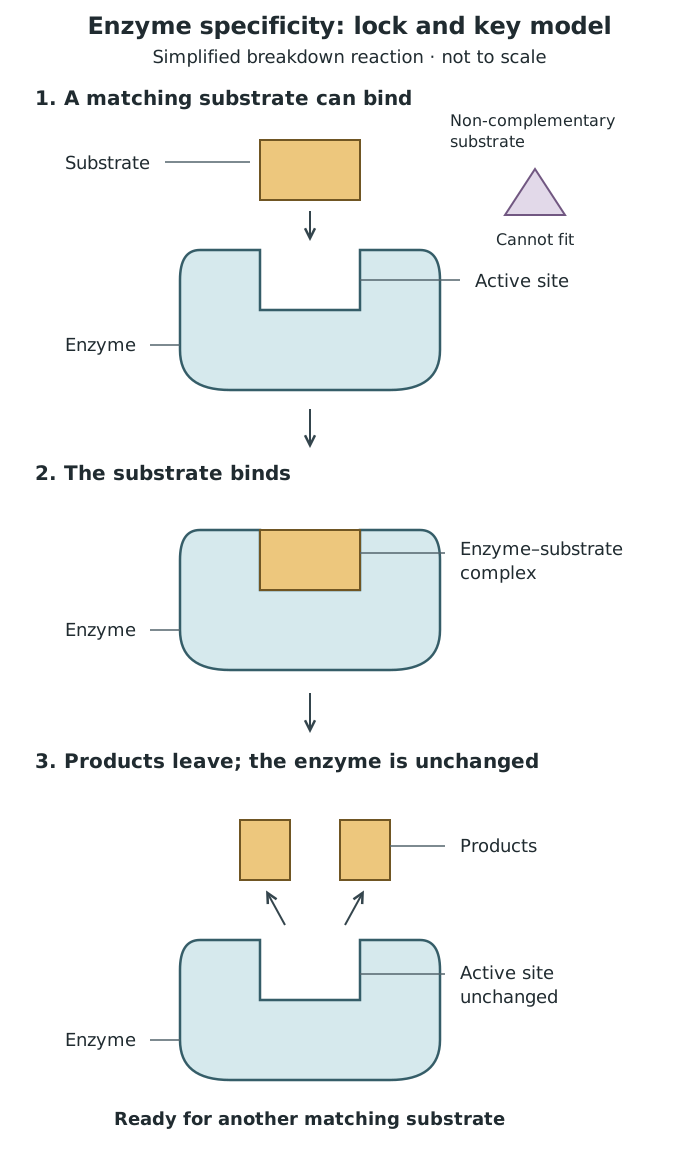
A simplified breakdown reaction: the matching substrate binds, products are released, and the enzyme can be reused.
At low temperatures, enzyme and substrate molecules have less kinetic energy and move more slowly. There are fewer successful collisions with active sites each second, so the reaction proceeds slowly.
As temperature rises towards the enzyme's optimum temperature, molecules gain kinetic energy and move faster. More successful collisions occur each second, increasing the reaction rate. The optimum is the temperature at which the reaction is fastest under the conditions being investigated. Many human enzymes work best at about 37°C; this is not a universal optimum for every enzyme.
At sufficiently high temperatures, bonds maintaining the enzyme's three-dimensional shape are disrupted. The active site changes shape and is no longer complementary to the substrate. Fewer enzyme–substrate complexes can form, so the reaction rate falls. This change is called denaturation.
Cooling and overheating therefore slow enzyme activity for different reasons. Cooling reduces molecular movement; overheating can change the active site's shape.
The pH scale describes how acidic or alkaline a solution is: below pH 7 is acidic, pH 7 is neutral and above pH 7 is alkaline. An enzyme's optimum pH is the pH at which it catalyses its reaction fastest under the conditions being investigated.
Different enzymes have different optimum pH values. For example, some stomach enzymes work best in acidic conditions around pH 2, whereas some enzymes in the small intestine work best in alkaline conditions around pH 8–9. Neutral conditions are therefore not best for every enzyme.
Moving away from an enzyme's optimum pH reduces its activity. Changes in pH can disrupt the bonds maintaining the protein's shape, altering the active site so that the substrate binds less effectively. At sufficiently extreme pH values, the enzyme becomes denatured and can no longer catalyse the reaction.
On a graph of reaction rate against pH, the peak identifies the optimum. The rate falls on either side as conditions become less suitable for that enzyme.
Required practical 4 investigates how pH affects the rate at which amylase, an enzyme that breaks down starch into sugars, digests a starch solution.
Iodine reagent provides a way to follow the disappearance of starch. It turns blue-black when starch is present and remains orange-brown when no starch is detected. Testing repeated samples lets you determine the time taken for complete starch digestion.
The apparatus includes test tubes and a rack, a spotting tile, pipettes for sampling, syringes or measuring cylinders for measuring volumes, a timer, a thermometer and a water bath or electric heater. The solutions needed are amylase, starch, iodine and buffers of different pH values. A buffer solution maintains the chosen pH during the reaction.
This repeated removal and testing of samples is called continuous sampling. Sampling every 30 seconds limits the precision of the endpoint: starch may have disappeared between the last blue-black sample and the first orange-brown sample.
The pH is the independent variable; digestion time is the measured dependent variable. Keep the concentrations and volumes of starch and amylase, buffer volume and temperature constant. Temperature must be controlled using a water bath or electric heater because temperature itself affects enzyme activity. Changing both temperature and pH would prevent you from confidently attributing a difference in time to pH alone.
A reaction rate describes how much chemical change occurs per unit time. An average rate can be calculated from either reactant disappearance or product formation:
or
These are alternative measurements of rate; their numerical values are not necessarily equal. Choose the expression that matches the quantity measured.
The units depend on the measurement. Mass in grams divided by time in seconds gives g/s; a volume in cm³ divided by seconds gives cm³/s.
For an enzyme reaction, suppose 0.60 g of product forms in 120 s. Its mean rate is . This means that, on average, 0.0050 g of product formed each second over that interval.
In the amylase investigation, iodine indicates an endpoint rather than measuring the mass of starch digested. When the same initial amount of starch is used in every trial, compare relative rates using reciprocal digestion time:
For example, digestion times of 60 s and 120 s give relative rates of and . The 60 s reaction is twice as fast because it reaches the same endpoint in half the time.
Plot relative rate against pH to compare activity. The pH giving the highest rate is the fastest of those tested; testing more closely spaced pH values around that peak would locate the optimum more precisely.
Get unlimited access to all revision notes, key terms, and exam tips.
Explain specificity using the complementary shapes of the substrate and active site, not simply by saying that an enzyme is specific.
At high temperatures, enzymes are denatured, not killed. Enzymes are molecules, not living organisms.
Distinguish low temperature from denaturation: cooling slows molecular movement without destroying the active site's shape.
For required practical 4, test for starch using iodine every 30 seconds. The endpoint is the first sample in which iodine remains orange-brown.
Keep temperature constant using a water bath or electric heater when investigating pH.
Add samples to fresh iodine drops on the spotting tile, rather than adding iodine to the reaction mixture.
Use reciprocal time only to compare reactions reaching the same endpoint with the same initial amount of starch. A shorter digestion time gives a higher relative rate.
Enzyme
A protein that acts as a biological catalyst, speeding up a chemical reaction without being used up.
Catalyst
A substance that increases the rate of a chemical reaction without being used up in that reaction.
Substrate
The substance on which an enzyme acts.
Active site
The region of an enzyme where a substrate binds and the reaction is catalysed.
Enzyme–substrate complex
The temporary association formed when a substrate binds to an enzyme's active site.
Lock and key model
A simplified explanation of enzyme action in which a substrate fits an enzyme's complementary active site, like a key fitting a lock.
Denaturation
A change in an enzyme's shape that prevents its active site from binding its substrate effectively.
Optimum temperature
The temperature at which an enzyme-catalysed reaction proceeds fastest under the conditions being investigated.
Optimum pH
The pH at which an enzyme-catalysed reaction proceeds fastest under the conditions being investigated.
Metabolism
The sum of all the chemical reactions happening in a cell or organism, including reactions that make or break down molecules.
Continuous sampling
A method in which small samples are repeatedly removed from a reaction mixture to monitor its progress.
Buffer solution
A solution that maintains a nearly constant pH during a reaction.
Amylase
An enzyme that breaks down starch into sugars.
Rate of reaction
The amount of reactant used up or product formed per unit time.
Put your knowledge into practice — try past paper questions for Combined Science Trilogy
Enzyme
A protein that acts as a biological catalyst, speeding up a chemical reaction without being used up.
Catalyst
A substance that increases the rate of a chemical reaction without being used up in that reaction.
Substrate
The substance on which an enzyme acts.
Active site
The region of an enzyme where a substrate binds and the reaction is catalysed.
Enzyme–substrate complex
The temporary association formed when a substrate binds to an enzyme's active site.
Lock and key model
A simplified explanation of enzyme action in which a substrate fits an enzyme's complementary active site, like a key fitting a lock.
Denaturation
A change in an enzyme's shape that prevents its active site from binding its substrate effectively.
Optimum temperature
The temperature at which an enzyme-catalysed reaction proceeds fastest under the conditions being investigated.
Optimum pH
The pH at which an enzyme-catalysed reaction proceeds fastest under the conditions being investigated.
Metabolism
The sum of all the chemical reactions happening in a cell or organism, including reactions that make or break down molecules.
Continuous sampling
A method in which small samples are repeatedly removed from a reaction mixture to monitor its progress.
Buffer solution
A solution that maintains a nearly constant pH during a reaction.
Amylase
An enzyme that breaks down starch into sugars.
Rate of reaction
The amount of reactant used up or product formed per unit time.
Units follow the measurements, for example g/s or cm³/s.
For equal initial amounts of starch and the same endpoint:
Shorter time means faster rate. The highest rate identifies the fastest pH tested.
Get unlimited access to all revision notes, key terms, and exam tips.