Loading…


Loading…
Loading…
Loading…
AQA GCSE Business · 8132
AQA 8132 · E-commerce and Integrated Marketing Check the specification (PDF) (opens in a new tab)
The marketing mix brings together four elements: product, price, place and promotion, often called the 4Ps. Together, they shape what customers are offered, what they pay, how they obtain it and why they might choose it.
Product includes the good or service’s features, design, quality, branding and packaging. Price is what customers are charged. Place concerns where and through which distribution channels customers can buy. Promotion communicates with customers through activities such as advertising and sales promotions.
An integrated marketing mix is one in which these decisions support one another. The aim is not simply to make each element attractive on its own, but to create a consistent offer that meets the needs of the target market and helps achieve the business’s objectives.
For example, a high-quality product can support a premium price, but customers still need to understand its benefits and be able to buy it conveniently. An expensive product advertised mainly through messages about being the cheapest may send conflicting signals about its quality and value.
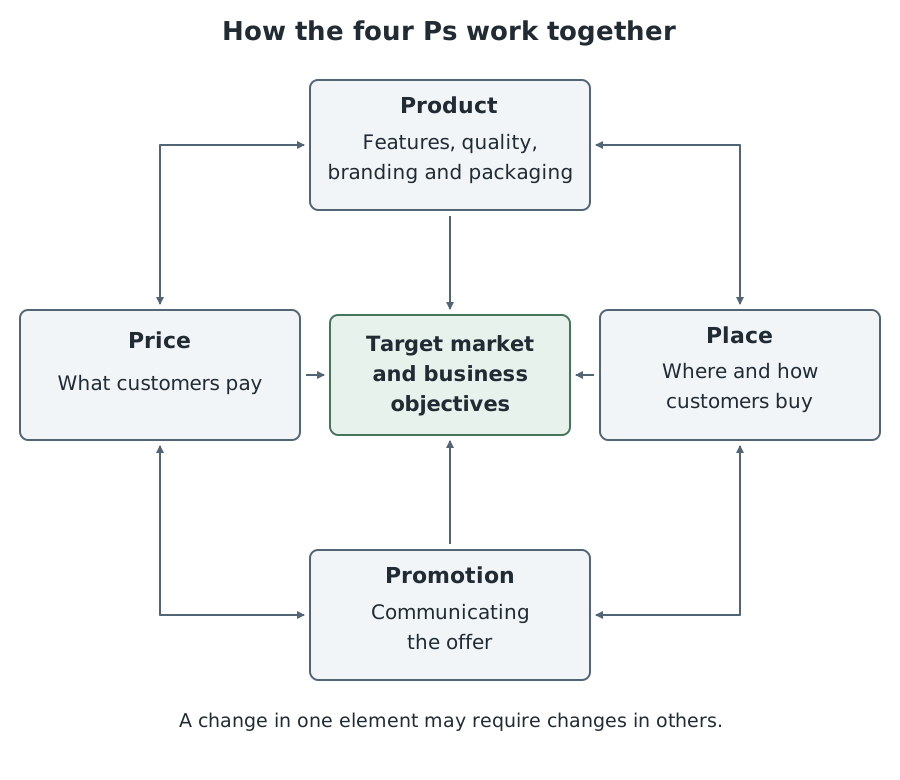
The four Ps need to support one another and suit the same customers and objectives.
The four elements are interdependent: a decision about one can affect the suitability of the others.
If a business launches a premium version of a product, improved features or packaging may increase costs and support a higher price. Promotion may need to explain the improvements, while the chosen sales outlets should suit the customers willing to pay for them.
A price increase can also change how customers judge the offer. It may strengthen a premium image, but it could reduce sales if customers cannot afford it or do not believe it offers enough extra value. Promotion may therefore need to explain the product’s benefits more clearly. A low price can appeal to price-conscious customers, although it may also make some customers question quality.
Place influences the rest of the mix too. Selling through selected outlets can support an exclusive image; wider distribution can make a mass-market product easier to buy. Promotion should direct customers towards the channels where the product is actually available. Advertising widely is less useful if interested customers cannot obtain the product.
These links do not mean every change requires all four Ps to change. The business must check whether the remaining elements still fit.
Nike illustrates how the elements can reinforce a shared brand image. Its emphasis on product quality and innovative design supports premium pricing. Its “Just Do It” promotion celebrates athleticism and determination, connecting the brand with sporting ambition rather than focusing only on low prices.
Online and physical sales channels make its products accessible to customers. The combination matters: product benefits support the price, promotion communicates the brand’s appeal, and place enables customers to act on that interest. A coherent mix can help a business stand out from competitors, although it does not guarantee success.
A useful recommendation begins with the business’s circumstances. Who are its customers? What do they value? Is the objective to increase sales, improve profit or establish a premium image? What money, staff and production capacity are available?
Consider a small bakery that wants to attract local customers willing to pay more for distinctive celebration cakes. A suitable product decision could be to offer customised designs. A higher price could reflect the extra ingredients and decorating time. Taking orders through the shop and its website could let customers discuss requirements and arrange collection. Promotion could use photographs of completed cakes to demonstrate quality and design options.
The reasoning links the elements: customers can see evidence of the customisation that helps justify the price, and the ordering arrangements suit a product made for a particular occasion. A blanket discount might attract more orders, but could reduce profit and weaken the intended premium image.
Implementation must also connect marketing with other business functions. Operations needs enough ingredients, equipment and time to produce the cakes. Human resources may need to arrange staff training or working hours. Finance needs to check whether the prices cover costs and whether the business can afford the promotional activity. A campaign that generates more orders than the bakery can fulfil could damage customer satisfaction.
A recommendation should therefore explain both its likely benefits and its limitations. The bakery could begin with a limited range of custom designs rather than promise unlimited choice. This would preserve some customer appeal while keeping production manageable. Sales, customer feedback and costs could then help it decide whether to expand the offer.
A marketing mix is not fixed. As a product moves through its life cycle, customer awareness, competition and sales can change. Businesses may respond by adapting several elements together.
| Stage | Possible changes to the mix and their purpose |
|---|---|
| Introduction | A business may launch a limited range, promote heavily to build awareness and initially use selected sales channels. A high launch price may help recover development costs where customers are willing to pay it. |
| Growth | New features or versions may attract more customers. Wider distribution improves availability, while continued promotion builds preference and loyalty. Price may be maintained or reduced to appeal to more buyers. |
| Maturity | With stronger competition and slower sales growth, the business may introduce variations, use more competitive prices and promote differences from rivals. Broad distribution can help defend market share. |
| Decline | The business may reduce product investment, lower prices to clear stock, cut promotion and stop using unprofitable sales channels. Alternatively, it may adapt the product to renew its appeal. |
These are possible responses, not automatic rules. Cutting price may increase demand but reduce the profit earned on each sale. Introducing a new version costs money and may not attract enough customers. The best response depends on the product, market and business’s resources.
The mix also evolves because the external environment changes, even when the product itself has not reached a new life-cycle stage.
Economic changes can affect what customers can afford. A business might introduce a lower-priced range or use discounts when household budgets are squeezed. However, it must consider whether the resulting sales will cover costs and whether discounts could damage its brand image.
Competition can encourage changes to product features, prices and promotion. Competition from streaming services such as Netflix has put pressure on Sky to adapt its packages and offer price promotions. Improving the offer may help retain customers, but repeated discounts can reduce profitability.
Technology can change place and promotion together. For example, a local restaurant using Just Eat gains an online ordering and delivery channel. It must make its offer clear online and ensure it can fulfil the orders generated. The change is more than simply adding an advertisement: the customer’s route to buying has changed.
Social preferences can influence product design and promotional messages. Lego’s move towards paper rather than plastic packaging illustrates a product-related response to environmental concerns. Promotion can explain the change, but the packaging must still perform its practical job of protecting the contents.
Legal changes or rulings may require businesses to alter products, packaging or advertising. These can restrict the choices available, so the remaining elements need to work within those limits.
A business should not react to every change in the same way. It should assess how strongly the change affects its customers, compare feasible responses and choose a mix whose expected benefits justify its costs. The central question remains: do the four Ps still work together for this business and its target market?
Get unlimited access to all revision notes, key terms, and exam tips.
Business circumstances → suitable activity → customer response → effect on sales, costs or profit.
Check that the other Ps support the choice and that finance, staff and operations can implement it. Weigh benefits against drawbacks before deciding.
Responses depend on the business: life-cycle stages do not dictate one fixed mix.
Income, competition, technology, social preferences and legal changes can all require adjustments. Judge whether the revised mix remains coherent, affordable and suitable for customers.
Get unlimited access to all revision notes, key terms, and exam tips.
Apply recommendations to the business’s customers, product, objectives and available resources rather than suggesting activities that could suit any business.
Explain the links between the Ps: show why a change in one element may require changes in others.
Build a chain of reasoning from the proposed activity to customer response, sales, costs or profit. More sales do not automatically mean more profit.
Justify your final recommendation by weighing benefits against drawbacks and explaining which matters most in the given situation.
Marketing mix
The combination of product, price, place and promotion decisions a business uses to meet customer needs and achieve its objectives.
Integrated marketing mix
A combination of product, price, place and promotion decisions that support one another and suit the business’s target market and objectives.
Target market
The group of customers a business aims to sell its products or services to.
Product
The features, design, quality, branding and packaging of the good or service offered to customers.
Price
The amount customers are charged for a good or service.
Place
The distribution channels through which a good or service reaches customers and where it is available to buy.
Promotion
Activities used to communicate with customers, raise awareness and encourage purchases, such as advertising and sales promotions.
Product life cycle
The stages a product’s sales typically pass through over time, including introduction, growth, maturity and decline.
Put your knowledge into practice — try past paper questions for Business
Marketing mix
The combination of product, price, place and promotion decisions a business uses to meet customer needs and achieve its objectives.
Integrated marketing mix
A combination of product, price, place and promotion decisions that support one another and suit the business’s target market and objectives.
Target market
The group of customers a business aims to sell its products or services to.
Product
The features, design, quality, branding and packaging of the good or service offered to customers.
Price
The amount customers are charged for a good or service.
Place
The distribution channels through which a good or service reaches customers and where it is available to buy.
Promotion
Activities used to communicate with customers, raise awareness and encourage purchases, such as advertising and sales promotions.
Product life cycle
The stages a product’s sales typically pass through over time, including introduction, growth, maturity and decline.