

Loading…
Loading…
Loading…
OCR GCSE Psychology · J203
OCR J203 Check the specification (PDF) (opens in a new tab)
An experiment compares : different situations created by changing the independent variable (IV). The researcher measures the dependent variable (DV) to see whether behaviour differs between these conditions. describes how participants are organised across those conditions.
Suppose a researcher investigates whether background music affects reading time. The IV has two conditions: music and silence. The DV is the time taken to read a passage aloud. The researcher must decide whether each person reads in both conditions or whether separate groups complete them.
In a repeated measures design, the same participants take part in every condition. In the reading investigation, each participant would read with music and also in silence. Their reading times in the two conditions could then be compared.
The main strength is control of individual differences: characteristics that vary between people and could affect performance. Someone who naturally reads quickly is present in both conditions, rather than belonging only to one group. Each participant acts as their own comparison, so differences in reading ability between people do not explain the difference between conditions. This strengthens internal validity: the researcher can be more confident that the IV accounts for the change in the DV.
Repeated measures also needs fewer participants for the same number of results per condition. For example, ten people completing both conditions provide ten reading times in each condition. Separate groups would require twenty people to provide ten results per condition. This can make recruitment more manageable.
Repeated measures has a weakness: order effects. Performance may change because a condition comes first or second, rather than because of the IV.
A participant might read a passage faster the second time because they have practised it. Alternatively, they might become tired or bored and perform worse. If everyone completes music first and silence second, a faster reading time in silence could reflect practice rather than an effect of silence. This threatens validity because there is another explanation for the findings.
Researchers can use counterbalancing to control order effects. Half the participants complete music followed by silence; the other half complete silence followed by music. Everyone still completes both conditions, so this remains repeated measures. Any general advantage or disadvantage of going second is spread across the two conditions rather than attached to just one.
Counterbalancing does not make participants forget their first attempt or remove fatigue. It reduces the systematic influence of order when the results are compared.
Completing both conditions may also make the aim easier to guess. Participants might realise that the researcher is testing the effect of music and deliberately alter their reading speed. These demand characteristics can reduce validity because the measured behaviour reflects participants' expectations as well as the IV.
In an independent measures design, different participants take part in each condition. Each person completes only one condition. In the reading investigation, one group reads with music and a separate group reads in silence; the researcher compares the groups' reading times.
This avoids order effects caused by completing successive conditions. Participants cannot improve through practising the task in a previous condition or become bored from repeating it. Taking part in only one condition may also make the aim less obvious, reducing the likelihood of demand characteristics, although participants can still guess an aim from other clues.
The main limitation is individual differences between the groups. If the music group happens to contain more naturally fast readers, their shorter reading times might reflect reading ability rather than music. This weakens internal validity.
Random allocation helps reduce this problem. For example, the researcher could put twenty participants' names into a hat, allocate the first ten drawn to music and the remaining ten to silence. Chance determines allocation, preventing the researcher from deliberately placing stronger readers in one condition. However, chance does not guarantee that the groups will have identical abilities.
Independent measures also requires more participants than repeated measures to obtain the same number of results in each condition, increasing recruitment demands.
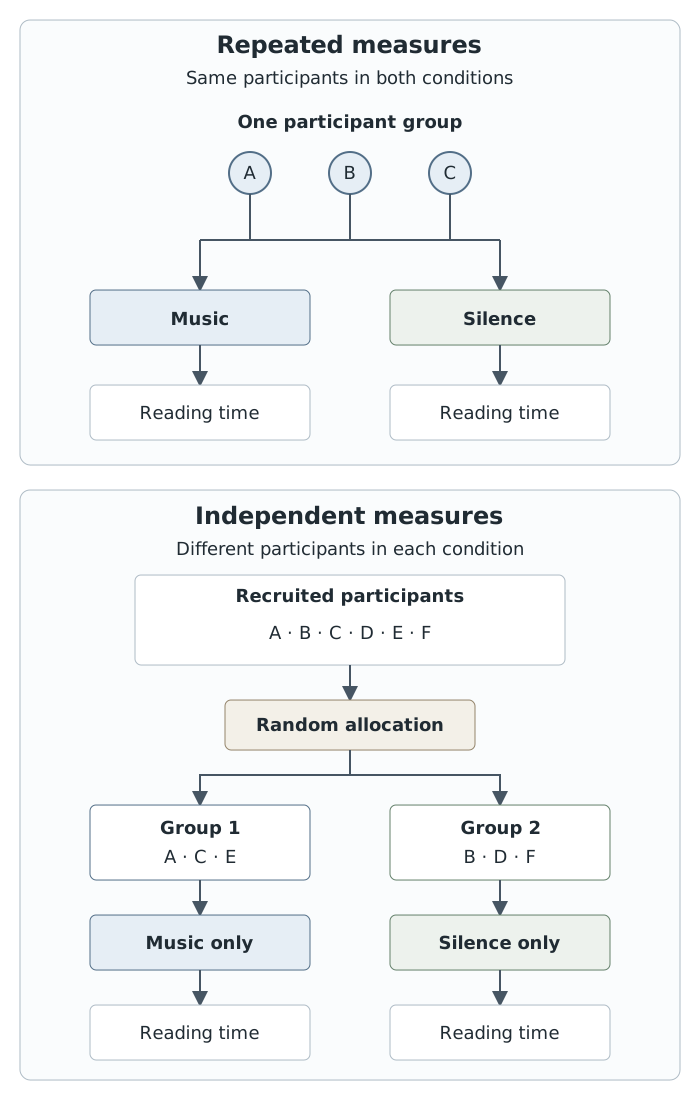
Both designs compare music with silence; they differ in whether the same people or separate groups complete the conditions.
Neither design is always better. Repeated measures is useful when individual differences are likely to strongly affect performance, but repeating the task may introduce practice, fatigue or clues about the aim. Independent measures is useful when repeating a task would change performance substantially, but differences between the groups remain a possible explanation.
A justified choice identifies the greater problem for the particular task. For reading the same passage twice, avoiding practice may favour independent measures. If differences in participants' abilities are the greater concern and order effects can be controlled effectively, repeated measures may be preferable.
Both designs still need consistent instructions, materials and measurement. Standardising these features supports reliability, while controlling alternative explanations supports validity. Simply choosing a design does not guarantee reliable or valid findings.
| Design | Strengths | Weaknesses |
|---|---|---|
| Repeated measures | Controls individual differences; fewer participants needed | Order effects; aim may be easier to guess |
| Independent measures | No order effects from completing both conditions; aim may be less obvious | Individual differences between groups; more participants needed |
Ask whether a difference in results could reflect participant differences, practice/fatigue, or changed behaviour after guessing the aim, rather than the IV. These threaten validity.
Consistent instructions and measurements support reliability. Neither design automatically guarantees it.
Identify the design from who takes part in each condition, not from whether the experiment takes place in a laboratory.
Link each strength or weakness to its consequence for the findings: name the issue, explain why the design creates or avoids it, then apply it to the investigation.
Keep your evaluation consistent with the design you identified. A strength of independent measures will not answer a question about repeated measures.
Random allocation assigns recruited participants to conditions; it is not the same as randomly selecting a sample.
Counterbalancing changes the order of conditions, not whether participants complete both conditions.
It can see this note and what your specification asks for.
Answers are free with an account.
1 free note left this week
Get more free notesYour answer sets when this note comes back for review, or marks it complete.
Was this note helpful?
Log in to tell us whether it helped, or to report a problem.
Last updated
Experimental design
The way participants are organised in relation to the conditions of an experiment.
Repeated measures design
An experimental design in which the same participants take part in every condition.
Independent measures design
An experimental design in which different participants take part in each condition, with each participant completing only one condition.
Individual difference
A difference between participants, such as reading ability or memory capacity, that could affect the dependent variable.
Order effect
A change in performance caused by the position of a condition in the sequence, such as improvement through practice or poorer performance through fatigue.
Counterbalancing
A way of controlling order effects by having different participants complete the experimental conditions in different orders.
Random allocation
Assigning participants to experimental conditions using chance rather than the researcher's choice.
Demand characteristic
A cue in a study that allows participants to guess its aim and may lead them to change their behaviour.
Validity
The extent to which a study measures what it intends to measure. In an experiment, internal validity concerns whether changes in the dependent variable can be attributed to the independent variable rather than other influences.
Reliability
The consistency of a measure or finding, for example when a procedure is repeated under the same conditions.
Put your knowledge into practice — try past paper questions for Psychology
Experimental design
The way participants are organised in relation to the conditions of an experiment.
Repeated measures design
An experimental design in which the same participants take part in every condition.
Independent measures design
An experimental design in which different participants take part in each condition, with each participant completing only one condition.
Individual difference
A difference between participants, such as reading ability or memory capacity, that could affect the dependent variable.
Order effect
A change in performance caused by the position of a condition in the sequence, such as improvement through practice or poorer performance through fatigue.
Counterbalancing
A way of controlling order effects by having different participants complete the experimental conditions in different orders.
Random allocation
Assigning participants to experimental conditions using chance rather than the researcher's choice.
Demand characteristic
A cue in a study that allows participants to guess its aim and may lead them to change their behaviour.
Validity
The extent to which a study measures what it intends to measure. In an experiment, internal validity concerns whether changes in the dependent variable can be attributed to the independent variable rather than other influences.
Reliability
The consistency of a measure or finding, for example when a procedure is repeated under the same conditions.