

Loading…
Loading…
Loading…
OCR GCSE Psychology · J203
OCR J203 · Piaget's Theory of Cognitive Development Check the specification (PDF) (opens in a new tab)
Conservation of number means understanding that the number of objects stays the same when their arrangement changes, as long as none are added or removed. A row can become longer because its counters are moved further apart, without containing any more counters. The task therefore tests whether a child judges number from appearance or understands what has actually changed.
Jean Piaget, a Swiss psychologist, argued that children's thinking develops through stages. In the pre-operational stage, approximately 2–7 years, children are strongly influenced by how things look. In the concrete operational stage, approximately 7–11 years, they become more able to reason logically about physical objects and conserve quantities. Piaget proposed that different conservation abilities develop at different times, with number developing before mass and then liquid.
Piaget devised several conservation tasks. They were described in The Child's Conception of Number, translated from French into English in 1952. This study concerns one of his tests of conservation of number, rather than a test of every part of his developmental theory.
The study aimed to show that children in the concrete operational stage were more likely to conserve number than children in the pre-operational stage.
The hypothesis predicted that concrete operational children would conserve number, whereas pre-operational children would not. This prediction is stronger than the eventual conclusion: the findings showed an age-related tendency, not that every child fitted the prediction perfectly.
The study can be considered a natural experiment. Its independent variable was the children's age, which occurred naturally and could not be assigned or manipulated by Piaget. The dependent variable was whether the child could conserve number.
It was also cross-sectional: Piaget compared different children at different ages rather than following the same children as they grew older. It therefore used an independent measures design, with different children in the age groups being compared. This gives a comparison of ages, but does not directly show how each individual child's understanding changes over time.
The sample was relatively small and consisted of schoolchildren from Geneva, Switzerland, including Piaget's own three children. The exact sample size is unknown. Counters were the only materials used.
First, the child saw two rows of counters of equal length. Both rows contained the same number, arranged in one-to-one correspondence: each counter was directly opposite a counter in the other row. This made it easy to see that the groups matched.
Piaget asked, ‘Is there the same number of counters in each row?’ He then changed the spacing of one row so that it appeared longer or shorter than the other. No counters were added or removed. The child was asked the same question again.
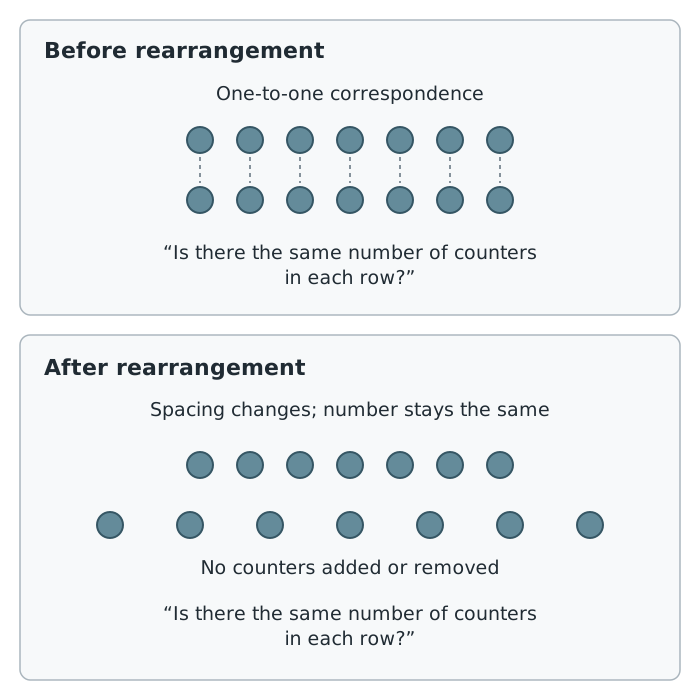
Both rows contain seven counters before and after rearrangement. A longer row does not necessarily contain more counters.
The important distinction is between row length and number of counters. Only the spacing and appearance changed. A child who understood conservation could recognise that rearranging the counters had not changed how many there were. A logical justification could be that nothing had been added or taken away.
Children aged 3–4 typically said that the longer, transformed row had ‘more’. Their judgement followed the row's appearance rather than the unchanged number of counters.
Some children aged 5–6, in the late pre-operational stage, correctly said that the rows contained the same number both before and after the transformation. However, they rarely gave adequate reasons for their judgements. Giving the right answer and explaining it logically were therefore important distinctions.
Many concrete operational children, especially the older ones, recognised that both rows still contained the same number. They could also give logical justifications for their answers.
Piaget concluded that children aged approximately 7–11 were more likely to conserve number than children aged approximately 2–7. This supported the connection between conservation and concrete operational thinking. However, the exceptions among younger children mean that the conclusion should not be treated as an absolute rule.
A major criticism concerns asking the same question twice. A child may regard the adult researcher as an important authority figure and assume that being asked again means the first answer was wrong. The child might then change an initially correct answer to give the response they think the adult wants. These are demand characteristics.
This matters because an incorrect second answer might reflect the child's interpretation of the conversation, rather than an inability to conserve number. Rose and Blank, and Samuel and Bryant, found that substantially more children answered correctly when the question was asked only once, after the transformation. Their findings suggest that Piaget's procedure could underestimate younger children's understanding.
The deliberate rearrangement and questioning were unlike an ordinary everyday situation, raising concerns about ecological validity. Children might think the adult had changed the row for a reason and therefore expected a different answer.
McGarrigle and Donaldson made the change appear accidental. They laid out two rows of sweets and established that the child thought the numbers were equal. A ‘naughty teddy’ then appeared and messed up one row while playing. After the teddy was returned to its box, the child was asked whether the rows still contained the same number of sweets.
The children were aged 4–6, and more than half answered correctly. Making the transformation appear accidental improved younger children's performance. This suggests that the meaning children attached to Piaget's task could make conservation appear to develop later than it actually does.
Piaget's small sample came from one geographical area and culture. It might not represent children with different experiences, so generalisation needs caution.
Cross-cultural research offers a more balanced picture. Research involving children in Australia, the Netherlands, England, New Zealand, Poland and Uganda found broadly similar age trends, although the rate at which conservation developed varied slightly between countries. A review of cross-cultural Piagetian research likewise found evidence for general developmental stages, but differences in the rate of development linked to environmental factors.
Overall, Piaget's study provides evidence for an age-related development of conservation. Later research does not simply remove that pattern: it shows that questioning, task context and children's environments also matter. The most justified conclusion is that conservation tends to improve with development, but this particular task may underestimate younger children's abilities and cannot establish an identical timetable for every child.
Equal-length rows, equal numbers, one-to-one correspondence → ask whether numbers are equal → change one row's spacing without adding or removing counters → repeat the question.
For the method, identify age as the naturally occurring IV and ability to conserve number as the DV. Rearranging the counters was part of the procedure, not the IV used to compare age groups.
Distinguish the findings for 3–4-year-olds from those for 5–6-year-olds: some older pre-operational children answered correctly but rarely justified their answers adequately.
Link each criticism to its consequence: repeating the question could prompt children to change their answer, so an incorrect response might not show an inability to conserve.
Do not invent a sample size or numerical results. The exact sample size is unknown, and the main findings are reported as age-related patterns.
It can see this note and what your specification asks for.
Answers are free with an account.
1 free note left this week
Get more free notesYour answer sets when this note comes back for review, or marks it complete.
Was this note helpful?
Log in to tell us whether it helped, or to report a problem.
Last updated
Conservation of number
The ability to understand that the number of objects remains the same when their arrangement changes, provided none are added or removed.
One-to-one correspondence
An arrangement in which each object in one group is paired with exactly one object in another group.
Natural experiment
A study in which the independent variable occurs naturally rather than being manipulated by the researcher.
Cross-sectional study
Research that compares different groups of people of different ages rather than following the same people as they grow older.
Independent measures design
A research design in which different participants take part in each condition or group being compared.
Demand characteristics
Cues in a study that lead participants to work out what the researcher expects and change their behaviour accordingly.
Ecological validity
The extent to which a study's findings apply to behaviour in everyday situations.
Generalisability
The extent to which research findings can be applied beyond the participants and circumstances studied.
Put your knowledge into practice — try past paper questions for Psychology
Conservation of number
The ability to understand that the number of objects remains the same when their arrangement changes, provided none are added or removed.
One-to-one correspondence
An arrangement in which each object in one group is paired with exactly one object in another group.
Natural experiment
A study in which the independent variable occurs naturally rather than being manipulated by the researcher.
Cross-sectional study
Research that compares different groups of people of different ages rather than following the same people as they grow older.
Independent measures design
A research design in which different participants take part in each condition or group being compared.
Demand characteristics
Cues in a study that lead participants to work out what the researcher expects and change their behaviour accordingly.
Ecological validity
The extent to which a study's findings apply to behaviour in everyday situations.
Generalisability
The extent to which research findings can be applied beyond the participants and circumstances studied.
Overall: age-related improvement is supported, but Piaget's procedure may underestimate younger children's competence.