

Loading…
Loading…
Loading…
OCR GCSE Psychology · J203
OCR J203 · Piaget's Theory of Cognitive Development Check the specification (PDF) (opens in a new tab)
Cognitive development is the development of mental abilities such as thinking, understanding and reasoning. Swiss psychologist Jean Piaget argued that children do not simply know less than adults: they think in different ways. As they develop, new forms of thinking become possible.
Piaget developed his theory by observing his own children and their friends and testing their cognitive abilities at different ages. He described children as ‘little scientists’ who actively explore their surroundings and build understanding through experience. Development involves both interaction with the environment and biological maturation: the natural development of the body and brain as children grow.
A schema is a mental framework that helps us organise and interpret information. For example, a child might have a horse schema involving four legs, a mane and a particular body shape. Piaget believed that children are born with some schemas and develop more through experience.
Two processes explain how schemas help learning. Assimilation happens when an existing schema is used to make sense of something new. A child seeing an unfamiliar breed of horse can recognise it as a horse using their existing schema.
Accommodation happens when new information does not fit, so understanding must change. A child might initially call a zebra a horse. On learning that it is a different animal, the child changes their understanding and develops a separate zebra schema. The important difference is that assimilation uses an existing framework, whereas accommodation changes it or creates a new one.
Piaget proposed four invariant stages: all children pass through the same sequence, with each stage bringing a different way of thinking. He presented the stages as universal and linked them to fixed age periods.
Infants learn mainly through their senses and movements, such as looking, touching and grasping. Motor co-ordination develops, along with a body schema—an awareness of their own body—which eventually allows them to recognise themselves in a mirror.
A major achievement is object permanence, the understanding that an object still exists when it cannot be seen. Piaget proposed that young infants initially lack this understanding: when a toy disappears, they behave as though it no longer exists. At around 8 months, searching for a hidden toy indicates that object permanence is developing.
Children increasingly use language and symbols, but their thinking is not yet consistently logical. Animism means believing that inanimate objects are alive or have feelings. A child might believe that a teddy bear feels lonely when left alone.
Their thinking is also egocentric: they have difficulty viewing a situation from someone else's perspective. For example, they may assume that another person can see exactly what they themselves can see, even when that person is looking from a different position.
Children at this stage lack reversibility, the ability to mentally reverse an action or sequence. They may also judge quantity from appearance alone. Water poured into a taller glass can seem like ‘more’ because they focus on its greater height rather than considering the glass's width as well.
Thinking becomes more logical, particularly when dealing with real objects and familiar situations. In Piaget's account, animism and egocentric thinking decline, and children develop reversibility and decentration.
Decentration means considering more than one feature at once. A child can recognise that a glass is both taller and narrower, rather than judging its contents only by the height of the water.
These changes support conservation: understanding that quantity remains constant despite a change in appearance, as long as nothing is added or removed. After water is poured into a differently shaped glass, a child can reason that the amount is unchanged. Decentration allows them to consider both dimensions; reversibility allows them to imagine pouring the water back into the original glass.
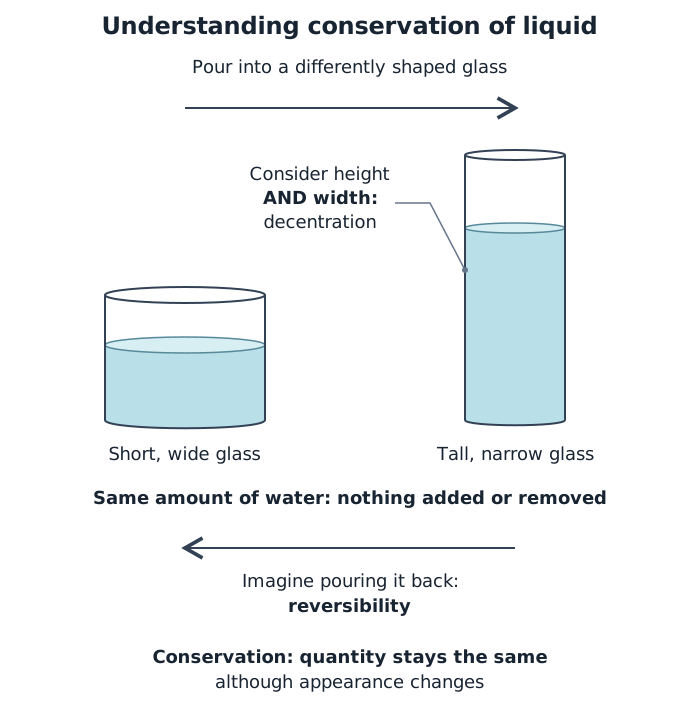
Decentration and reversibility help a child understand why changing the glass does not change the amount of water.
Children also become able to arrange objects in order, such as shortest to tallest, a skill called seriation, and develop linguistic humour, such as understanding wordplay.
Piaget proposed that children now develop abstract and hypothetical thinking. Abstract thinking deals with ideas that are not directly represented by physical objects. Hypothetical thinking considers possibilities: ‘What would happen if…?’
Unlike concrete-operational thinking, reasoning is no longer limited to real objects and immediate experiences. A young person can consider an imagined situation and work systematically through possible solutions to a problem.
Supporting evidence: Piaget's 1952 conservation of number study found that children in the concrete-operational stage were more likely to conserve number than children in the pre-operational stage. This supports the proposed change in thinking between the stages. However, evidence for this distinction does not establish every feature of all four stages.
Research limitations: Observations of his own children and their friends gave Piaget detailed insight into development, but this was a narrow group. Their experiences may not represent those of children from other families or cultures, limiting how confidently the findings can be generalised. Studying children he knew also creates a risk that his expectations influenced his interpretation of their behaviour.
Underestimating abilities: A child's failure on a task may not mean they lack the underlying understanding. For example, an infant might understand that a hidden object still exists but lack the motor skills needed to search for it. This challenges the use of observable task performance as a straightforward measure of cognitive ability.
Reductionism explains complex behaviour through a limited set of factors. Piaget's theory can be criticised as reductionist because its account of children progressing through fixed stages places too much emphasis on biological maturation and independent discovery.
Although Piaget recognised interaction with the environment, critics argue that he gave insufficient attention to support from teachers, parents and peers, and to cultural influences. A parent explaining a problem, or a teacher guiding a child's reasoning, can affect what the child understands. Children with different learning opportunities may therefore develop differently.
A holistic explanation considers these influences together, including how maturation, experience, social support and culture interact. Piaget's stages offer a useful, clear framework, supported by findings such as age differences in conservation. Nevertheless, a fuller explanation of cognitive development needs to account for the child's social and cultural circumstances as well as maturation.
Children actively build understanding through exploration and biological maturation.
For assimilation, identify the existing schema being used. For accommodation, explain how the schema changes because the new information does not fit.
Egocentrism means difficulty taking another person's perspective, not simply being selfish.
Link decentration and reversibility to conservation: considering both height and width, or mentally undoing the change, helps explain why quantity stays constant.
When evaluating reductionism, name the neglected influences—teachers, parents, peers and culture—and explain why they matter for cognitive development.
Present the stages and their ages as Piaget's proposals, rather than as unquestionable facts about every child.
It can see this note and what your specification asks for.
Answers are free with an account.
1 free note left this week
Get more free notesYour answer sets when this note comes back for review, or marks it complete.
Was this note helpful?
Log in to tell us whether it helped, or to report a problem.
Last updated
Cognitive development
The development of mental abilities such as thinking, understanding and reasoning.
Schema
A mental framework, based on experience, that helps a person organise and interpret information.
Assimilation
Using an existing schema to understand a new object or experience without changing the schema.
Accommodation
Changing an existing schema, or developing a new one, when new information does not fit existing understanding.
Invariant stage
A developmental stage within a fixed sequence that, according to Piaget, all children pass through.
Object permanence
Understanding that an object continues to exist even when it cannot be seen.
Animism
Believing that inanimate objects are alive or have feelings.
Egocentrism
An inability to view a situation from another person's perspective.
Decentration
The ability to consider more than one feature of an object or situation at the same time.
Reversibility
The ability to mentally reverse an action or sequence of events.
Conservation
Understanding that quantity remains the same when appearance changes, provided nothing is added or removed.
Reductionism
Explaining complex behaviour through a limited set of factors rather than considering the full range of influences.
Holism
Understanding behaviour as a whole by considering how multiple influences interact.
Put your knowledge into practice — try past paper questions for Psychology
Cognitive development
The development of mental abilities such as thinking, understanding and reasoning.
Schema
A mental framework, based on experience, that helps a person organise and interpret information.
Assimilation
Using an existing schema to understand a new object or experience without changing the schema.
Accommodation
Changing an existing schema, or developing a new one, when new information does not fit existing understanding.
Invariant stage
A developmental stage within a fixed sequence that, according to Piaget, all children pass through.
Object permanence
Understanding that an object continues to exist even when it cannot be seen.
Animism
Believing that inanimate objects are alive or have feelings.
Egocentrism
An inability to view a situation from another person's perspective.
Decentration
The ability to consider more than one feature of an object or situation at the same time.
Reversibility
The ability to mentally reverse an action or sequence of events.
Conservation
Understanding that quantity remains the same when appearance changes, provided nothing is added or removed.
Reductionism
Explaining complex behaviour through a limited set of factors rather than considering the full range of influences.
Holism
Understanding behaviour as a whole by considering how multiple influences interact.
| Stage | Age | Main features |
|---|---|---|
| Sensori-motor | Birth–2 years | Learning through senses and movement; object permanence develops around 8 months. |
| Pre-operational | 2–7 years | Animism and egocentrism; lacks reversibility and conservation. |
| Concrete-operational | 7–11 years | Logical thinking about concrete situations; decentration, reversibility and conservation. |
| Formal operational | 11 years–adulthood | Abstract and hypothetical reasoning; systematic problem-solving. |
Conservation connection: considering height and width together, and mentally reversing a change, helps children recognise unchanged quantity.
Judgement: a useful framework, but not a complete explanation of every child's development.