

Loading…
Loading…
Loading…
OCR GCSE Psychology · J203
OCR J203 · Social Learning Theory Check the specification (PDF) (opens in a new tab)
Social learning theory, developed by Albert Bandura, explains how people learn behaviour by observing and imitating others. Applied to criminality, it suggests that criminal or anti-social behaviour can be learnt through social experience rather than being something a person is simply born with.
The learner does not have to commit an offence to begin learning about it. Watching someone else can provide both an example of how to behave and information about whether that behaviour seems rewarding. Children may be particularly influenced by the behaviour they see around them.
A role model is someone a person looks up to or wants to resemble. Role models can include parents, older siblings, peers, celebrities and fictional characters in films or video games. They do not have to be people the learner meets in real life.
Identification means wanting to be like a role model. People are more likely to identify with someone they admire or see as similar to themselves. This helps explain why two people who witness the same behaviour might respond differently: they may not identify with the person performing it to the same extent.
For example, suppose a young person admires an older sibling who steals from shops. Wanting to resemble that sibling may make the young person more likely to copy the stealing. Having a role model does not itself cause criminality; what matters here is the behaviour the model demonstrates and how the learner responds to it.
Observation is watching another person’s behaviour. The observer can form a mental representation: an understanding or memory of what the person did. In this explanation, internalisation means taking the observed behaviour into one’s own understanding, so it can guide a later action. Someone who has observed pickpocketing, for instance, may learn how the act is carried out before ever attempting it themselves.
Imitation is copying the observed behaviour. Learning and performing are therefore distinct: a person may understand how to carry out an act without choosing to do it. Observing criminal behaviour makes imitation possible, but does not mean imitation is inevitable.
Vicarious reinforcement occurs when an observer sees someone else rewarded for their behaviour. The reward may be material, such as money or stolen goods, or social, such as admiration and increased status. Seeing these outcomes makes the behaviour appear worthwhile and increases the likelihood of imitation.
In the shoplifting example, seeing the older sibling keep stolen goods and gain approval from friends could encourage the young person to copy them. The young person has not received the reward: they have learnt by watching the sibling receive it.
The opposite influence is vicarious punishment. Seeing a role model arrested or sent to prison can make imitation less likely because the observer sees negative consequences. Social learning therefore involves observing outcomes, not just copying every action that is witnessed.
Once the learner performs the behaviour, their own experience becomes important. Direct reinforcement means personally receiving a reward for an action, making it more likely to be repeated.
If the young person steals successfully and keeps the item, that gain can directly reinforce their stealing. Vicarious reinforcement helps explain why they might first imitate the sibling; direct reinforcement helps explain why they might continue. The consequences of their own actions influence whether the behaviour persists.
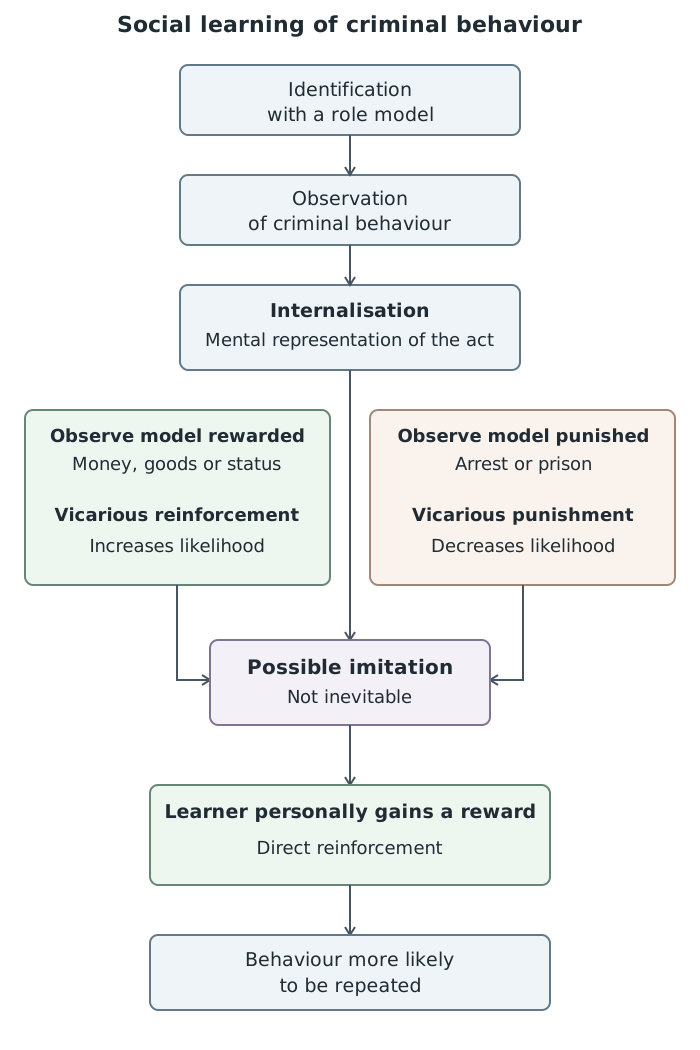
Learning from a role model’s consequences differs from being rewarded for your own behaviour. Neither observation nor identification makes imitation inevitable.
A strength is that social learning theory has supporting research. Cooper and Mackie (1986) found evidence that playing or observing an aggressive video game could increase subsequent play with aggressive toys. This supports the idea that exposure to aggressive models can influence later behaviour. However, aggressive toy play is not the same as committing a crime, so this evidence does not by itself establish that observation causes criminal offending.
A major criticism concerns the nature/nurture debate. Nature refers to biological influences, including inherited characteristics; nurture refers to environmental influences and experience. Social learning theory emphasises nurture through role models, observation and reinforcement. Critics argue that this gives too little attention to possible biological influences, such as genes or differences in brain functioning.
Consider a child and parent who both offend. Social learning theory could explain this through the child observing and imitating the parent. But biological relatives also share genes. The family pattern alone cannot establish whether learning, inherited characteristics or a combination explains their behaviour.
Another limitation is that many people observe criminal behaviour without becoming criminals. Identification and observed consequences help explain some differences, but observation alone is not a sufficient explanation of offending. A justified conclusion is that social learning theory provides a useful account of how criminal behaviour can be acquired and maintained, without being a complete explanation of why every individual does or does not offend.
Bandura: criminal behaviour can be learnt through observing and imitating others.
Rewards can include stolen goods, money, approval or status.
Judgement: useful for explaining the acquisition and continuation of criminal behaviour, but not a complete explanation.
Distinguish reinforcement by who receives the reward: the role model receives it in vicarious reinforcement; the learner receives it in direct reinforcement.
Apply each process to the behaviour in the question. Explain who the role model is, what is observed and how the consequences affect imitation.
For evaluation, explain why a limitation matters. Shared genes and a shared environment make it difficult to establish why criminal behaviour runs in a family.
Evidence about aggressive play can support social learning, but it does not directly demonstrate the learning of criminal offences.
It can see this note and what your specification asks for.
Answers are free with an account.
1 free note left this week
Get more free notesYour answer sets when this note comes back for review, or marks it complete.
Was this note helpful?
Log in to tell us whether it helped, or to report a problem.
Last updated
Social learning theory
Albert Bandura’s explanation that behaviour can be learnt by observing and imitating others, influenced by the consequences of their actions.
Role model
A person or character whom someone admires, looks up to or wants to resemble.
Identification
The process of wanting to be like a role model, which makes adopting their behaviour more likely.
Observation
Watching another person’s behaviour and its consequences.
Imitation
Copying behaviour that has been observed.
Vicarious reinforcement
Seeing someone else rewarded for behaviour, making the observer more likely to imitate it.
Vicarious punishment
Seeing someone else punished for behaviour, making the observer less likely to imitate it.
Direct reinforcement
Personally receiving a reward after performing behaviour, making that behaviour more likely to be repeated.
Internalisation
Taking observed behaviour into one’s own understanding, forming a mental representation that can guide later actions.
Nature/nurture debate
The debate about the relative contributions of biological influences, such as inherited characteristics, and environmental influences, such as learning, to behaviour.
Put your knowledge into practice — try past paper questions for Psychology
Social learning theory
Albert Bandura’s explanation that behaviour can be learnt by observing and imitating others, influenced by the consequences of their actions.
Role model
A person or character whom someone admires, looks up to or wants to resemble.
Identification
The process of wanting to be like a role model, which makes adopting their behaviour more likely.
Observation
Watching another person’s behaviour and its consequences.
Imitation
Copying behaviour that has been observed.
Vicarious reinforcement
Seeing someone else rewarded for behaviour, making the observer more likely to imitate it.
Vicarious punishment
Seeing someone else punished for behaviour, making the observer less likely to imitate it.
Direct reinforcement
Personally receiving a reward after performing behaviour, making that behaviour more likely to be repeated.
Internalisation
Taking observed behaviour into one’s own understanding, forming a mental representation that can guide later actions.
Nature/nurture debate
The debate about the relative contributions of biological influences, such as inherited characteristics, and environmental influences, such as learning, to behaviour.