

Loading…
Loading…
Loading…
OCR GCSE Geography A · J383
OCR J383 · 2.2.6 Urban Challenges in LIDCs and EDCs Check the specification (PDF) (opens in a new tab)
Lagos is a major coastal city in south-western Nigeria, an emerging and developing country (EDC). Its jobs and services attract people, while births exceeding deaths also increase its population. When population growth outpaces the provision of homes, transport and waste collection, the city’s infrastructure struggles to meet demand.
These challenges are connected. New housing creates additional journeys and rubbish, while poorly serviced settlements face particular risks from flooding and pollution. Urban change is therefore not simply about building more: it is also about making services accessible and managing their environmental effects.
Rapid urbanisation has increased demand for housing in Lagos. Many low-income households cannot obtain suitable formal housing, contributing to the growth of informal settlements such as Makoko and Ajegunle.
Informal housing provides shelter close to urban jobs, but homes may be poorly built, overcrowded and vulnerable to flooding. Limited access to safe water, electricity and sewage disposal makes everyday life more difficult. Crowding can help infectious diseases spread, while sewage entering drains or groundwater can contaminate water supplies.
The challenge is therefore both the availability and the quality of housing. Simply increasing the number of homes does not solve the problem if poorer residents cannot afford them or if water, sanitation and transport are missing. Lagos also has wealthy residential areas, including Victoria Island, showing that housing difficulties are unevenly experienced rather than affecting everyone equally.
Lagos’s expanding population generates more journeys between residential areas and workplaces. Increasing car ownership and historically limited rail provision have placed heavy pressure on roads. Minibuses known as danfos provide important transport, but large numbers of vehicles compete for road space.
Commuters can spend up to three hours a day in traffic. Delays reduce time available for work and family life, while late workers and deliveries impose costs on businesses. Exhaust emissions also contribute to poor air quality and respiratory illness.
Transport provision matters even for residents without cars. Unreliable or expensive public transport can restrict access to employment, education and healthcare. A successful response must therefore move people efficiently and affordably, not just make driving easier.
Lagos produces a large volume of waste, but collection does not reach all of it. Rubbish left in streets or dumped in waterways pollutes the environment. It can also obstruct drains, worsening flooding and allowing contaminated water to spread through residential areas.
Olusosun is a major landfill site in Lagos. Around 500 people have worked there sorting waste to recover materials for sale. This recycling provides livelihoods and retrieves useful resources, but sorting rubbish by hand without adequate protective equipment exposes workers to sharp objects and infection. Processing electrical waste can release toxic fumes, creating further health risks.
Decomposing waste also produces methane, which contributes to climate change and can fuel fires. Waste management is therefore not solved merely by moving rubbish to a landfill: collection, safe disposal, recycling and worker protection all matter.
Lagos introduced its bus rapid transit (BRT) system in March 2008. The initial 22 km route connected the mainland with Lagos Island. It was developed through a government-led transport project supported by World Bank finance and technical advice, making it a top-down strategy.
BRT buses use dedicated lanes. Separating buses from ordinary traffic makes journeys faster and more reliable, while a single bus carries many passengers who would otherwise occupy several smaller vehicles. Compared with an underground railway, BRT offers a relatively lower-cost way to provide high-capacity public transport.
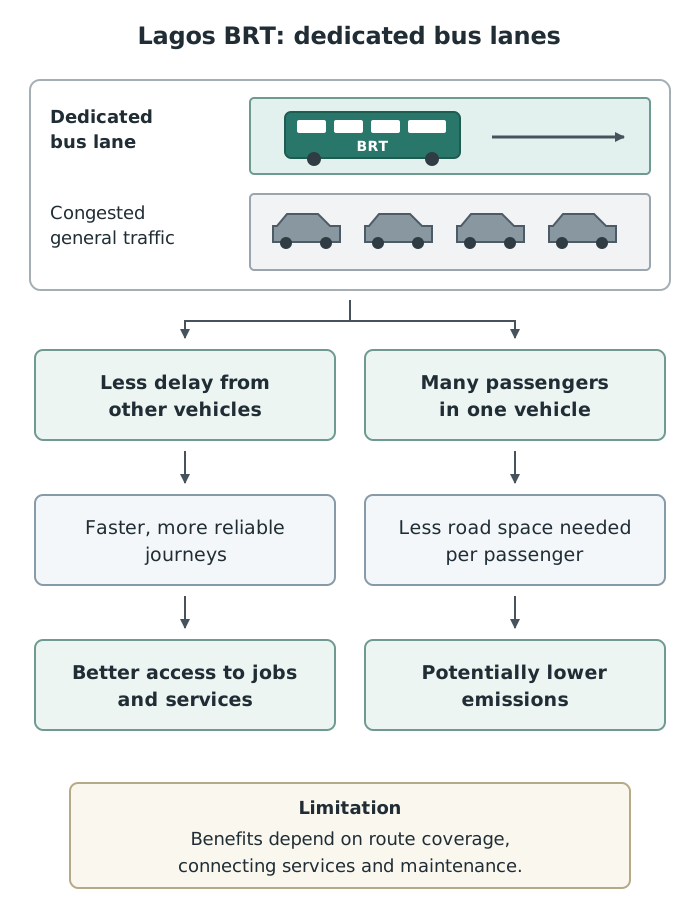
Dedicated lanes and high passenger capacity help BRT improve transport, but a connected network is needed to spread the benefits.
A World Bank account published in 2015 reported that the system carried more than 200,000 passengers daily. Along its corridor, it carried 25% of trips using only 4% of vehicles. This demonstrates why carrying more people per vehicle can reduce pressure on road space.
The reported results show benefits across three dimensions of sustainability:
However, these results do not mean that congestion disappeared throughout Lagos. A route benefits the areas it serves most directly; people elsewhere still need connecting services. BRT has to be supplemented by other transport, including danfos. Buses also need continuing funding, maintenance and effective protection of their dedicated lanes, and they still produce emissions.
Overall, BRT is a strong sustainable response to transport provision and congestion because it combines affordable access, efficient use of road space and lower emissions. Its success is greatest when it forms part of a connected public transport network. It cannot by itself solve Lagos’s housing shortage or waste-management problems, which require their own investment and management.
Reported in 2015: over 200,000 passengers daily; 25% of corridor trips using 4% of vehicles; journey times reduced by 25 minutes; fares fell from 230 to 100 naira; about 2,000 direct jobs; 13% lower CO₂ emissions associated with the project.
Judgement: strong social, economic and environmental benefits, but coverage, connecting services and ongoing maintenance limit its ability to solve city-wide congestion.
Use named Lagos examples: Makoko or Ajegunle for housing, Olusosun for waste and the BRT for transport.
Explain a chain of effects rather than listing problems: uncollected waste can block drains, increasing flooding and spreading polluted water.
When assessing sustainability, weigh social, economic and environmental benefits against limitations, then give a justified judgement.
Date the BRT results: the fares and journey-time improvements reported in 2015 are evidence of past success, not necessarily present-day conditions.
It can see this note and what your specification asks for.
Answers are free with an account.
1 free note left this week
Get more free notesYour answer sets when this note comes back for review, or marks it complete.
Was this note helpful?
Log in to tell us whether it helped, or to report a problem.
Last updated
Urbanisation
The increasing proportion of a population living in towns and cities.
Informal settlement
Housing built without formal planning permission, often with insecure land ownership and limited access to services.
Infrastructure
The basic structures and networks needed for a place to function, such as roads, water pipes and waste collection systems.
Traffic congestion
A build-up of traffic that slows movement because demand exceeds the capacity of the road network.
Bus rapid transit (BRT)
A high-capacity bus system using dedicated lanes to provide faster, more reliable public transport.
Sustainability
Meeting present needs while protecting the ability of future generations to meet theirs, balancing social, economic and environmental concerns.
Top-down strategy
An approach in which governments or other large organisations plan and manage improvements.
Put your knowledge into practice — try past paper questions for Geography A
Urbanisation
The increasing proportion of a population living in towns and cities.
Informal settlement
Housing built without formal planning permission, often with insecure land ownership and limited access to services.
Infrastructure
The basic structures and networks needed for a place to function, such as roads, water pipes and waste collection systems.
Traffic congestion
A build-up of traffic that slows movement because demand exceeds the capacity of the road network.
Bus rapid transit (BRT)
A high-capacity bus system using dedicated lanes to provide faster, more reliable public transport.
Sustainability
Meeting present needs while protecting the ability of future generations to meet theirs, balancing social, economic and environmental concerns.
Top-down strategy
An approach in which governments or other large organisations plan and manage improvements.