

Loading…
Loading…
Loading…
OCR GCSE Geography A · J383
OCR J383 · 1.1.4 Check the specification (PDF) (opens in a new tab)
Coastal landforms develop as the sea erodes rock, transports sediment and deposits it elsewhere. Erosion wears away and removes material; occurs when moving water loses enough energy to leave sediment behind. , , , and develop through erosion. and are accumulations of deposited sediment.
The same coastline can contain both types of landform. Exposed headlands experience powerful wave attack, while nearby sheltered bays provide places where sediment can accumulate.
A headland projects into the sea, whereas a bay curves inwards into the land. They commonly develop on a discordant coastline, where bands of rock of different resistance run across the coastline and are exposed to the sea.
Waves erode the less-resistant rock more quickly, making it retreat inland to form bays. More-resistant rock erodes more slowly and remains projecting into the sea as headlands. This difference in the rate of erosion is called differential erosion. Resistant rock is not immune to erosion: it simply withstands wave attack for longer.
The Dorset coast provides a concrete example. Less-resistant Bagshot Beds have been eroded to form Studland Bay, while Wealden clays and greensands have been eroded around Swanage Bay. More-resistant chalk forms headlands including Ballard Point, and limestone forms headlands including Durlston Head.
Once headlands and bays develop, erosion remains concentrated around exposed headlands. Bays are more sheltered, allowing deposition to build beaches. The rock pattern therefore helps explain both the shape of the coastline and where sediment collects.
Even resistant rock contains weaknesses, such as joints and faults. Waves exploit these weaknesses rather than eroding every part of a headland equally.
Hydraulic action occurs when waves strike the rock and force water and air into cracks. The pressure helps enlarge them. Abrasion occurs when sediment carried by waves scrapes and batters the rock. Together, these processes can widen a crack at the cliff base into a cave.
Continued erosion deepens the cave. If it breaks through the headland, an opening with sea on both sides forms: an arch. Wave erosion continues to widen the opening, while weathering weakens the roof. Weathering is the breakdown of rock in place, rather than its removal by the sea.
Eventually, the roof becomes unstable and collapses. An isolated pillar of rock remains offshore: a stack. Further erosion can undermine the stack until it collapses into a much lower stump, which may only be visible at low tide.
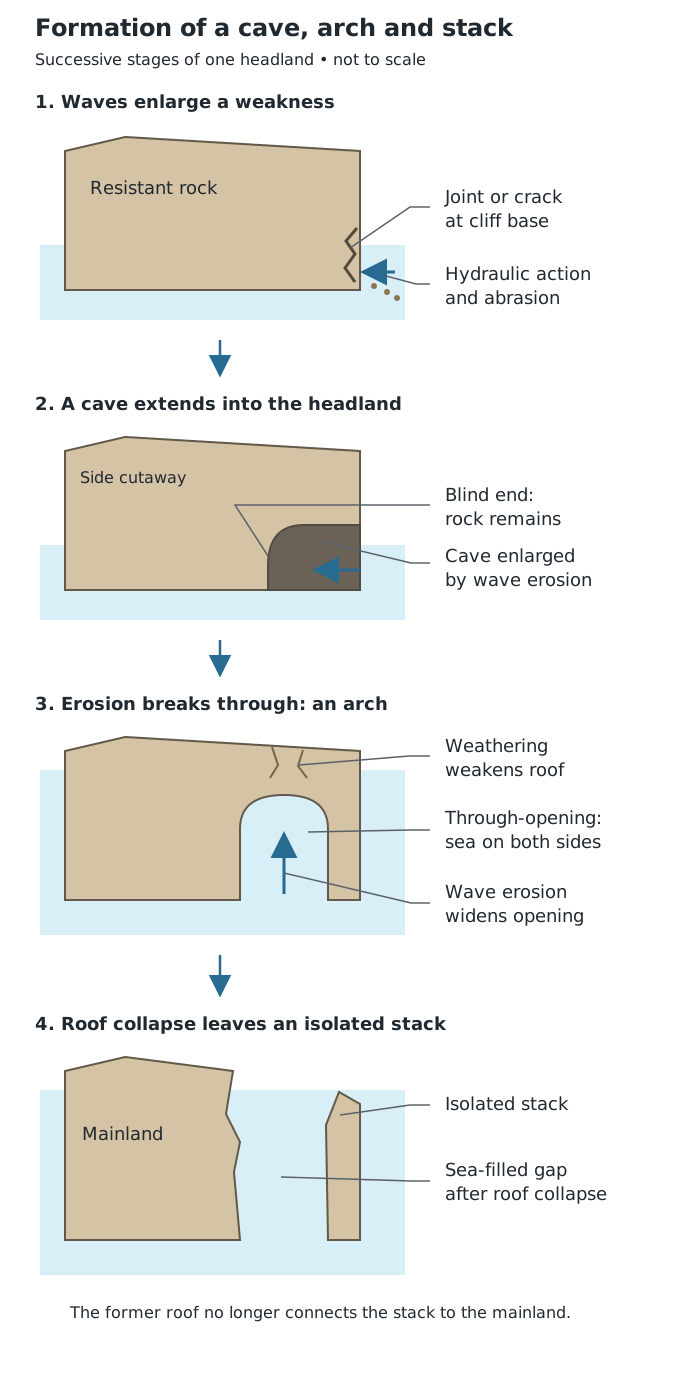
Wave erosion enlarges weaknesses in a headland; erosion and weathering eventually lead to roof collapse and an isolated stack.
The important connection is between process and change: erosion enlarges the opening, weathering weakens the roof, and collapse separates the stack from the mainland. These are successive stages of a changing headland, not unrelated features.
A beach is an accumulation of sand or shingle along the shore. Waves and currents bring sediment to the coast, and deposition occurs where conditions allow it to remain. Sheltered bays are common locations because wave energy is lower there.
When a wave breaks, water moves up the beach as swash, then returns down the slope as backwash. Constructive waves have stronger swash than backwash. They carry sediment up the beach but remove less on the return journey, so the beach builds up.
Beaches are not permanent, fixed deposits. During storms, stronger backwash can carry sediment away again. Their shape changes as the balance between deposition and removal changes.
Sediment can also travel along the coast. When waves approach at an angle, their swash carries sand and pebbles diagonally up the beach. Backwash flows down the beach slope under gravity. Repeated swash and backwash move sediment along the shore in a zigzag pattern: longshore drift.
Where the coastline changes direction, such as at an estuary, sediment can continue beyond the bend. As wave energy falls, deposition builds a narrow ridge extending into the sea. This is a spit, attached to the land at one end. Further supplies of sediment allow it to grow longer.
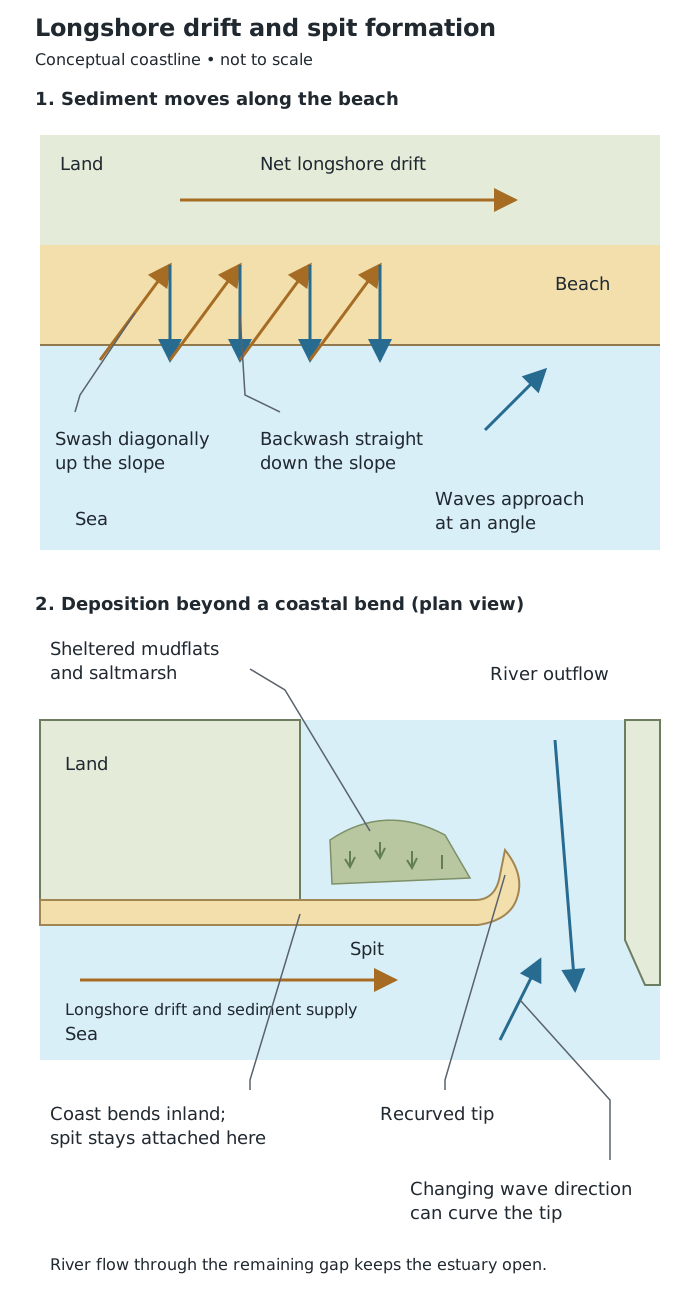
Longshore drift supplies sediment that can be deposited beyond a bend in the coastline, building a spit.
Changes in wind and wave direction can curve the tip into a hooked or recurved end. River flow through an estuary can prevent the spit from extending right across its mouth. Behind the spit, sheltered water allows fine sediment to settle, creating mudflats where saltmarsh vegetation may become established.
Spurn Point, at the Humber Estuary in north-east England, is an example of a spit. Its formation illustrates the connection between sediment transport along the coast and deposition where the coastline changes direction.
For a formation question, link each process to its result: for example, hydraulic action enlarges a crack, so a cave develops.
Explain both sides of differential erosion: less-resistant rock retreats faster to form bays, while more-resistant rock remains as headlands.
Distinguish erosion by the sea from weathering of rock in place. Both contribute to the collapse of an arch.
In a spit diagram, label the direction of longshore drift, the change in coastline direction and the attached end of the spit.
Do not use attrition to explain erosion of a cliff: attrition wears down sediment as pieces collide with one another.
It can see this note and what your specification asks for.
Answers are free with an account.
1 free note left this week
Get more free notesYour answer sets when this note comes back for review, or marks it complete.
Was this note helpful?
Log in to tell us whether it helped, or to report a problem.
Last updated
Headland
An area of land that projects out into the sea beyond the surrounding coastline.
Bay
An indentation in the coastline where the land curves inwards.
Discordant coastline
A coastline where bands of rock of different resistance run across the coastline, exposing them to erosion by the sea.
Differential erosion
The wearing away of different rocks at different rates because their resistance to erosion varies.
Hydraulic action
Erosion caused by the force of water striking rock, including air being compressed in cracks by waves.
Abrasion
Erosion caused by sediment carried by water scraping or battering against rock.
Weathering
The breakdown of rock in place by physical, chemical or biological processes.
Cave
A hollow in a coastal cliff formed as waves enlarge a weakness in the rock.
Arch
An opening eroded through a headland, with a roof of rock remaining above it.
Stack
An isolated pillar of coastal rock left when an arch roof collapses.
Beach
An accumulation of sand or shingle along the shore, formed by deposition.
Longshore drift
The movement of sediment along a coast as angled swash carries it up the beach and backwash carries it down the slope.
Spit
A narrow ridge of sand or shingle extending into the sea, attached to the coast at one end.
Put your knowledge into practice — try past paper questions for Geography A
Headland
An area of land that projects out into the sea beyond the surrounding coastline.
Bay
An indentation in the coastline where the land curves inwards.
Discordant coastline
A coastline where bands of rock of different resistance run across the coastline, exposing them to erosion by the sea.
Differential erosion
The wearing away of different rocks at different rates because their resistance to erosion varies.
Hydraulic action
Erosion caused by the force of water striking rock, including air being compressed in cracks by waves.
Abrasion
Erosion caused by sediment carried by water scraping or battering against rock.
Weathering
The breakdown of rock in place by physical, chemical or biological processes.
Cave
A hollow in a coastal cliff formed as waves enlarge a weakness in the rock.
Arch
An opening eroded through a headland, with a roof of rock remaining above it.
Stack
An isolated pillar of coastal rock left when an arch roof collapses.
Beach
An accumulation of sand or shingle along the shore, formed by deposition.
Longshore drift
The movement of sediment along a coast as angled swash carries it up the beach and backwash carries it down the slope.
Spit
A narrow ridge of sand or shingle extending into the sea, attached to the coast at one end.