

Loading…
Loading…
Loading…
OCR GCSE Combined Science B · J260
OCR J260 · Electrical Energy Efficiency Check the specification (PDF) (opens in a new tab)
A system is an object or group of objects that we choose to study. Energy can be stored in different ways: a moving object has a kinetic store, a stretched spring has an elastic store, and warm objects have thermal stores. Working and heating transfer energy between stores.
The principle of conservation of energy states that energy cannot be created or destroyed. In a closed system, no energy crosses the system's boundary, so its total energy remains constant. Individual stores can increase or decrease, but their changes balance overall.
Consider a vehicle slowing down as its brakes act. Energy decreases in the vehicle's kinetic store and increases in the thermal stores of the brakes and nearby surroundings. If we consider only the vehicle, energy can leave that system. If we include everything receiving the energy within a closed system, the total energy has not changed: it is stored differently.
When a moving ball hits a wall, some energy is transferred by sound and some increases the thermal stores of the ball, wall and surroundings. The ball may stop, but its energy has not disappeared.
Energy is dissipated when it spreads out and becomes stored in less useful ways, usually in the thermal stores of the surroundings. Once spread through a large surrounding area, it is difficult to use that energy to make the ball move again. This is why we describe it as wasted, even though it is still conserved.
Whether a transfer is useful depends on the device's purpose. In a kettle, increasing the water's thermal store is useful; warming the surrounding air is unwanted. In a motor, producing movement is useful, while warming the motor through friction is usually unwanted.
Lubrication reduces friction between moving surfaces. For example, oil in a motor allows its moving parts to move more easily against one another. Less energy is transferred to thermal stores by friction, leaving a greater proportion available for useful movement.
Thermal insulation reduces the rate of energy transfer by heating. Double glazing, for example, reduces unwanted energy transfer from a warm room to colder surroundings. Insulation slows the transfer; it does not create energy or prevent all transfer indefinitely.
These methods tackle different unwanted transfers: lubrication reduces frictional heating, whereas insulation slows energy transfer from warmer objects to colder surroundings.
Energy is transferred through a building's walls when the inside is warmer than the outside. Two important factors are wall thickness and the material's thermal conductivity.
Keeping other conditions the same:
A building with thin metal-sheet walls would therefore lose energy rapidly compared with one whose walls are thicker and made from a low-conductivity material. Thickness and conductivity are separate properties: changing either can affect the rate of cooling.
Efficiency compares the useful energy transferred with the total energy transferred into a device:
Both energies must use the same units, usually joules. Because the units cancel, efficiency has no unit. The ratio lies between 0 and 1; multiplying it by 100 gives the percentage efficiency.
For a transfer in which all the supplied energy is accounted for as outputs:
If the wasted energy is given instead of the useful energy, subtract it from the total input before calculating efficiency.
Efficiency increases when a greater proportion of the input becomes useful output. Lubricating a motor or insulating a heated system can achieve this by reducing unwanted transfers. Recovering otherwise wasted thermal energy for a useful heating task can also improve the overall efficiency of a system. The energy is being put to better use, not created.
A Sankey diagram makes the energy balance visible. The input arrow splits into output arrows. The width of each arrow is proportional to the energy it represents; arrowheads show the direction of transfer.
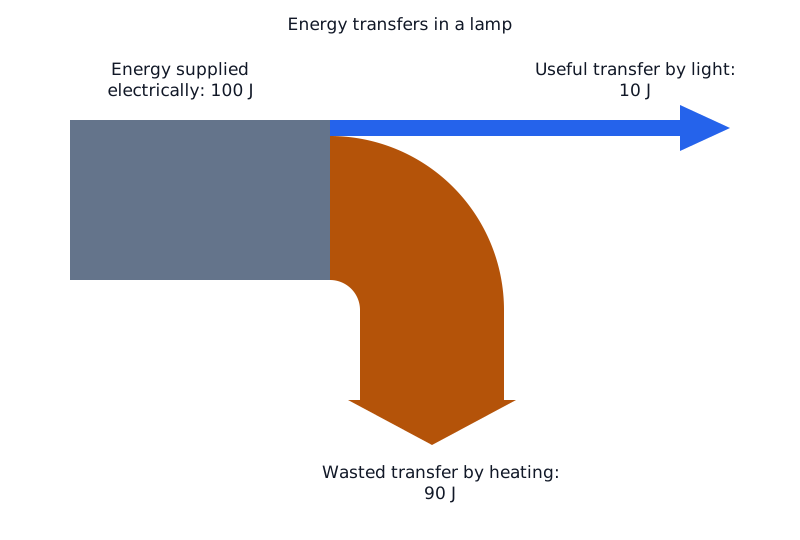
The output arrows account for all 100 J supplied: 10 J transferred by light and 90 J by heating.
Energy supplied electrically: 100 J. Useful transfer by light: 10 J. Wasted transfer by heating: 90 J. Wasted energy = 100 − 10 = 90 J. Efficiency = 10 ÷ 100 × 100% = 10%. Arrow shaft widths are proportional to energy.
Here, 100 J is supplied electrically to a lamp. Of this, 10 J is transferred usefully by light and 90 J is transferred by heating. The two outputs add to the input, demonstrating conservation of energy.
The useful arrow is one-tenth of the input width, so the lamp's efficiency is , or 10%. The much wider wasted branch shows that most of the input does not serve the lamp's intended purpose of providing light.
First identify the input and all outputs, calculating any missing output from conservation of energy. Then choose one width scale for every arrow.
For the lamp above, a convenient scale is one square of width for every 10 J. Draw the input arrow 10 squares wide. Split it into a useful arrow one square wide continuing to the right and a wasted arrow nine squares wide bending downwards. Label each arrow with its transfer and energy in joules.
Measure widths across the arrows, perpendicular to their direction. The output widths must add to the input width: here, squares. A more efficient lamp receiving the same input would have a wider useful branch and a narrower wasted branch.
Describe wasted energy as transferred to less useful stores, not destroyed or used up.
For a closed-system explanation, include the surroundings receiving energy within your chosen system boundary.
Use the same units for useful and total energy. Efficiency has no unit; multiply the ratio by 100 to express it as a percentage.
In a Sankey diagram, arrow width—not length—is proportional to energy transferred. The output widths must add up to the input width.
When comparing walls, keep other conditions the same: greater thickness reduces cooling, while greater thermal conductivity increases cooling.
It can see this note and what your specification asks for.
Answers are free with an account.
1 free note left this week
Get more free notesYour answer sets when this note comes back for review, or marks it complete.
Was this note helpful?
Log in to tell us whether it helped, or to report a problem.
Last updated
System
An object or group of objects chosen for study.
Closed system
A system in which no energy is transferred across its boundary to or from the surroundings.
Conservation of energy
The principle that energy cannot be created or destroyed, so the total energy of a closed system remains constant.
Dissipation
The spreading out of energy into less useful stores, usually the thermal stores of the surroundings.
Lubrication
The use of a substance such as oil between moving surfaces to reduce friction and unwanted heating.
Thermal insulation
A material or arrangement that reduces the rate of energy transfer by heating.
Thermal conductivity
A property describing how readily a material transfers energy by conduction. Higher thermal conductivity means faster transfer under otherwise identical conditions.
Efficiency
The ratio of useful energy transferred to total energy transferred: .
Sankey diagram
An energy-transfer diagram in which arrow widths are proportional to the amounts of energy transferred.
Put your knowledge into practice — try past paper questions for Combined Science B
System
An object or group of objects chosen for study.
Closed system
A system in which no energy is transferred across its boundary to or from the surroundings.
Conservation of energy
The principle that energy cannot be created or destroyed, so the total energy of a closed system remains constant.
Dissipation
The spreading out of energy into less useful stores, usually the thermal stores of the surroundings.
Lubrication
The use of a substance such as oil between moving surfaces to reduce friction and unwanted heating.
Thermal insulation
A material or arrangement that reduces the rate of energy transfer by heating.
Thermal conductivity
A property describing how readily a material transfers energy by conduction. Higher thermal conductivity means faster transfer under otherwise identical conditions.
Efficiency
The ratio of useful energy transferred to total energy transferred: .
Sankey diagram
An energy-transfer diagram in which arrow widths are proportional to the amounts of energy transferred.
Use matching energy units. Efficiency is a unitless ratio from 0 to 1.