

Loading…
Loading…
Loading…
OCR GCSE Combined Science B · J260
OCR J260 · Energy Resources and the National Grid Check the specification (PDF) (opens in a new tab)
An energy resource is a source from which we can transfer energy for a useful purpose. Homes need energy for heating, cooking, lighting and appliances. Workplaces need it for these purposes and for activities such as running machinery. Transport also uses energy, commonly supplied by fuels made from oil.
Electricity is not a primary energy resource. It is a way of transferring energy from resources such as wind, nuclear fuel or sunlight to devices where it is needed. A home may therefore use natural gas directly in a boiler while also using electricity generated from several different resources.
Non-renewable resources have finite supplies and are not replaced on a human timescale. They include the fossil fuels coal, oil and natural gas, as well as nuclear fuel. Burning fossil fuels releases energy from their chemical stores; nuclear fuel releases energy from its nuclear store instead.
Renewable resources are naturally replenished on a timescale that allows continued use. They include wind, sunlight, water used for hydroelectricity, tides and biofuels. A wind turbine does not use up a fixed stock of wind, and water in a hydroelectric reservoir can be replenished by rainfall.
Biofuels, such as wood and fuels made from plant crops, can be replaced by growing more plants. Their continued use depends on replacing the material that is harvested. Plants absorb carbon dioxide during photosynthesis, but burning the biofuel releases carbon dioxide back into the atmosphere. Being renewable does not mean that a resource produces no emissions.
Renewable also does not mean available whenever needed. Sunlight varies with daylight and cloud cover, and wind strength changes. This distinction matters when choosing resources to meet electricity demand.
Most electricity generation follows a shared pattern: something turns a turbine, and the turbine drives a generator. The turbine has blades that are pushed by moving steam, water or air.
In a generator, movement between a magnet and a wire produces a voltage across the wire. In many power stations, a magnet spins near a wire. When the generator is connected to a circuit, this voltage can drive a current, transferring energy electrically.
The important difference between resources is therefore often how the turbine is made to turn, rather than how the generator works.
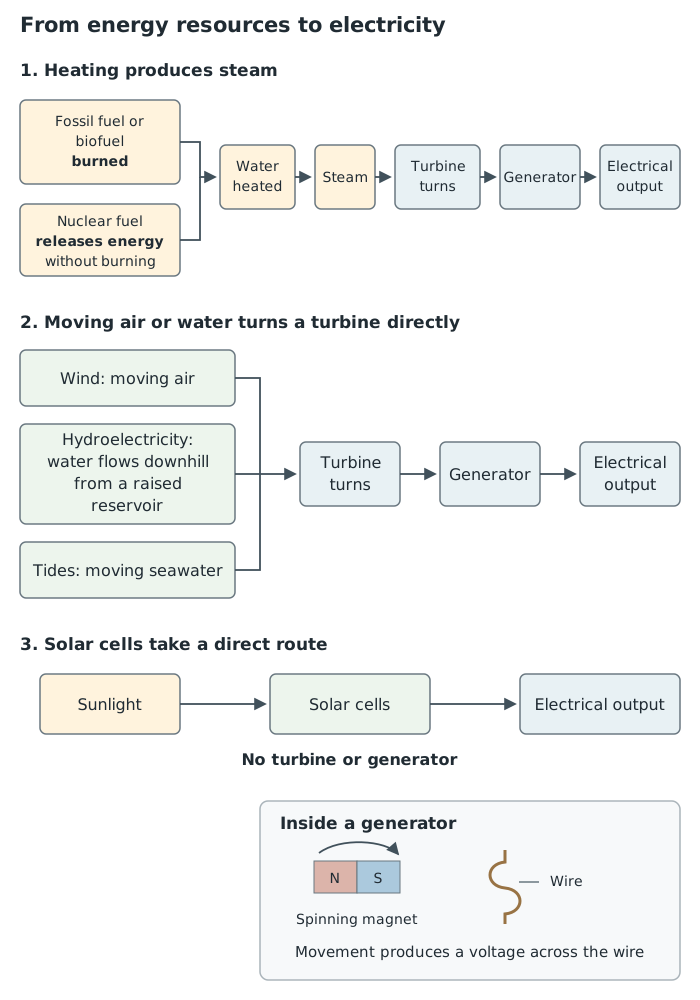
Most resources turn a turbine that drives a generator. Solar cells produce an electrical output directly.
In a fossil-fuel power station, coal, oil or gas is burned to heat water. The steam produced turns a turbine, which drives a generator. Energy passes from the chemical store of the fuel to the heated water and steam, then to the moving turbine and generator, before being transferred electrically.
A nuclear power station also uses heating to produce steam that turns a turbine and generator. However, the energy comes from nuclear fuel rather than from burning a fossil fuel. The steam–turbine–generator stages are similar; the source of heating is different.
Biofuel can also be burned to provide heating for electricity generation. This makes its generation method similar to that of fossil fuels, even though its resource can be replenished by growing new biological material.
These methods do not transfer all the input energy to electricity. Some energy is dissipated to the surroundings, particularly through heating.
Wind: moving air pushes the turbine blades. Energy from the wind's kinetic store is transferred mechanically to the turbine and generator, then transferred electrically.
Hydroelectricity: water is stored in a reservoir above the turbines. As it flows downhill, its gravitational potential energy decreases and it gains kinetic energy. Flowing water turns the turbines, which drive generators. Unlike a fuel-burning power station, no steam is needed.
Tides: the regular rise and fall of sea level produces moving water that can turn turbines. Water may flow through a tidal barrage or past turbines placed in tidal currents. As with hydroelectricity, moving water drives the turbine; the difference is what causes the water to move.
Wind and water generation therefore share the turbine–generator stages with fuel-based generation but do not need to heat water first.
Solar cells transfer energy from sunlight directly to an electrical output. There is no turbine, steam or generator in this process. Cells can be combined into panels on buildings or into large solar farms.
Solar cells can supply electricity in remote places, for example to power a rural road sign. They produce no greenhouse gases during operation, but their output depends on the sunlight reaching them. A large area of cells is needed to produce a large electrical output.
A pattern describes how energy use is distributed, while a trend describes how it changes over time. To explain either, connect the figures to what energy is being used for.
In UK homes, heating dominates energy use. In 2025, an estimated 60.8% of domestic energy consumption was for space heating and 17.4% for water heating. Heating rooms and water requires substantial energy, particularly in cold weather. Natural gas is commonly used to heat water for central heating systems.
Domestic consumption has nevertheless fallen despite an increase in the number of households. Between 2000 and 2025, energy used for space and water heating fell by 32%, from 39.3 to 26.6 million tonnes of oil equivalent. This unit allows different fuels to be compared by their energy content. More efficient heating and reduced unwanted energy transfers help explain how heating needs can be met using less energy. Falling gas consumption accounted for much of the overall domestic reduction.
Workplace use depends on the activity. Offices use energy for heating, lighting and electrical equipment, whereas manufacturing can require large amounts of heat and energy to drive machinery. In 2025, industrial heat production accounted for an estimated 50% of UK industrial energy consumption, compared with 19% for mechanical energy use, such as engines.
Since 1970, UK industrial output has been maintained or increased while overall industrial energy consumption has decreased. Improved process efficiency and changes in the products being manufactured help explain this trend. A fall in energy use does not necessarily mean less work is being done.
The UK's energy supply combines renewable and non-renewable resources. This allows resources with different characteristics to contribute to heating, transport and electricity generation.
UK primary energy consumption—energy used before conversion losses, together with fuels used directly—peaked in the early 2000s at around 235 million tonnes of oil equivalent per year. It has since fallen, reaching 162.5 million tonnes of oil equivalent in 2025. Increasing renewable generation and reduced fossil-fuel use for electricity generation are linked to this decline.
Part of the explanation is that wind and solar generation avoid the steam-producing stage and its associated conversion losses. Consequently, lower primary energy consumption does not necessarily mean an equally large reduction in the energy delivered to users.
When interpreting national data, first check whether it shows all energy use or only electricity. Then identify the dates, units and changes before explaining them using changes in resources, efficiency and the activities that require energy.
| Resource | Route to electricity |
|---|---|
| Fossil fuel or |
When comparing electricity generation, identify both the shared stages and what drives the turbine. Solar cells are an exception: they do not use a turbine or generator.
Nuclear fuel is non-renewable even though it is not a fossil fuel. Renewable does not mean continuously available or pollution-free.
For a data question, give the direction of the trend and supporting figures, then explain a plausible reason. Keep the dates, units and context clear.
Do not confuse total energy consumption with electricity consumption: fuels can also be used directly for heating and transport.
It can see this note and what your specification asks for.
Answers are free with an account.
1 free note left this week
Get more free notesYour answer sets when this note comes back for review, or marks it complete.
Was this note helpful?
Log in to tell us whether it helped, or to report a problem.
Last updated
Energy resource
A source from which energy can be transferred for uses such as heating, transport or electricity generation.
Renewable energy resource
An energy resource that is naturally replenished on a timescale that allows continued use.
Non-renewable energy resource
An energy resource with a finite supply that is not replaced on a human timescale.
Fossil fuel
Coal, oil or natural gas: a fuel formed from ancient organisms that releases energy from its chemical store when burned.
Biofuel
A fuel made from recently living biological material, such as plant crops or wood.
Turbine
A device with blades that is turned by moving air, water or steam.
Generator
A device that transfers energy mechanically to an electrical output by relative movement between a magnet and a wire.
Hydroelectricity
Electricity generation using water flowing downhill from a raised reservoir to turn turbines.
Solar cell
A device that transfers energy from sunlight directly to an electrical output.
Put your knowledge into practice — try past paper questions for Combined Science B
Energy resource
A source from which energy can be transferred for uses such as heating, transport or electricity generation.
Renewable energy resource
An energy resource that is naturally replenished on a timescale that allows continued use.
Non-renewable energy resource
An energy resource with a finite supply that is not replaced on a human timescale.
Fossil fuel
Coal, oil or natural gas: a fuel formed from ancient organisms that releases energy from its chemical store when burned.
Biofuel
A fuel made from recently living biological material, such as plant crops or wood.
Turbine
A device with blades that is turned by moving air, water or steam.
Generator
A device that transfers energy mechanically to an electrical output by relative movement between a magnet and a wire.
Hydroelectricity
Electricity generation using water flowing downhill from a raised reservoir to turn turbines.
Solar cell
A device that transfers energy from sunlight directly to an electrical output.
| Burning → heating water → steam → turbine → generator |
| Nuclear fuel | Nuclear energy release → heating water → steam → turbine → generator |
| Wind | Moving air → turbine → generator |
| Hydroelectricity | Raised water flows downhill → turbine → generator |
| Tides | Tidal movement of water → turbine → generator |
| Sunlight | Solar cells → electrical output directly |
A generator produces a voltage through movement between a magnet and a wire. Solar cells need no turbine or generator.