

Loading…
Loading…
Loading…
OCR GCSE Combined Science B · J260
OCR J260 · Electrical Energy Efficiency Check the specification (PDF) (opens in a new tab)
A battery contains energy in a chemical store. When it supplies a current to an appliance, this store decreases and energy is transferred electrically to the appliance. An electric current is a flow of charge; when the current transfers energy to a device, it does electrical work. Work done is another way of describing energy transferred, and is measured in joules (J).
What happens to the energy depends on the device. A battery-powered motor transfers energy to the kinetic store of its moving parts. A heater transfers energy to the thermal store of its heating element. In a kettle, energy then passes by heating from the hot element to the water, increasing the water’s thermal store.
For a mains-powered appliance, the energy may originally come from the chemical store of fuel at a power station. Electricity provides a convenient way to transfer this energy over a distance to homes, where an electric current does work on devices such as motors and heaters. The chemical store is at the source; the wires provide a route for electrical energy transfer.
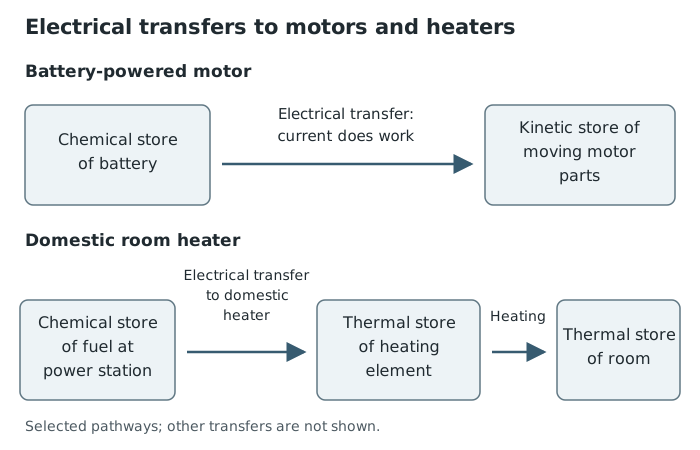
Energy stores are shown in boxes; arrows show how energy is transferred between them.
Power is the rate at which energy is transferred, or the rate at which work is done. It tells you how quickly a transfer happens, rather than the total amount transferred.
One watt (W) means one joule transferred each second. A 1000 W appliance therefore transfers 1000 J every second while operating at that power. One kilowatt (kW) is 1000 W.
An appliance’s power rating tells you its operating power. For the same running time, an appliance with twice the power transfers twice as much energy. For the same power, running an appliance for twice as long also doubles the energy transferred.
This connects the appliance’s operation to changes in energy stores: a heater used for longer transfers more energy to thermal stores, while the energy store supplying it decreases by a greater amount. The total electrical energy supplied need not all produce the intended change in the appliance or the object being heated.
The energy transferred depends on both power and running time:
Here, is energy transferred, is power and is time. Use power in watts and time in seconds to obtain energy in joules.
Suppose a kettle operates at 2000 W for 3 minutes. First convert the running time: . Then:
This is the total energy transferred electrically to the kettle during that time, not necessarily the energy gained by the water alone.
You can also rearrange the relationship to find an unknown power or time:
A kilowatt-hour (kWh) is the energy transferred by a 1 kW appliance operating for 1 hour. The same equation works with a different matching set of units:
Suppose a 2 kW heater runs for 30 minutes. This is 0.5 hours, so it transfers . A 1 kW heater running for 1 hour transfers the same amount of energy. The first transfers energy faster, but operates for less time.
Because and :
Both joules and kilowatt-hours measure energy. Kilowatt-hours are simply more convenient for the large transfers involved in domestic electricity use.
Power is energy transferred per second: .
Match the units: W × s gives J; kW × h gives kWh. Convert minutes before substituting.
A higher power rating means more energy transferred per second, not necessarily more energy transferred overall: time also matters.
A kilowatt-hour is a unit of energy, not power. Do not write kW/h.
Describe both the starting energy store and the resulting change, as well as the electrical transfer between them.
It can see this note and what your specification asks for.
Answers are free with an account.
1 free note left this week
Get more free notesYour answer sets when this note comes back for review, or marks it complete.
Was this note helpful?
Log in to tell us whether it helped, or to report a problem.
Last updated
Chemical store
Energy stored in substances such as fuels and batteries, which can decrease as chemical reactions take place.
Electric current
The flow of electric charge.
Work done
Energy transferred by a force or by an electric current. Work done is measured in joules (J).
Power
The rate at which energy is transferred or work is done. One watt means one joule transferred per second.
Power rating
The stated power of an appliance under its intended operating conditions, usually given in watts or kilowatts.
Kilowatt-hour
A unit of energy equal to the energy transferred by a 1 kW appliance operating for 1 hour: .
Put your knowledge into practice — try past paper questions for Combined Science B
Chemical store
Energy stored in substances such as fuels and batteries, which can decrease as chemical reactions take place.
Electric current
The flow of electric charge.
Work done
Energy transferred by a force or by an electric current. Work done is measured in joules (J).
Power
The rate at which energy is transferred or work is done. One watt means one joule transferred per second.
Power rating
The stated power of an appliance under its intended operating conditions, usually given in watts or kilowatts.
Kilowatt-hour
A unit of energy equal to the energy transferred by a 1 kW appliance operating for 1 hour: .
For equal times, greater power means greater energy transfer. At equal power, longer use means greater energy transfer. Different powers and running times can give the same total energy.