

Loading…
Loading…
Loading…
OCR GCSE Combined Science B · J260
OCR J260 · Wave Motion and Interactions Check the specification (PDF) (opens in a new tab)
A wave reaching the boundary between two materials can be reflected back into the first material or pass into the second. This boundary is called an interface. Light arriving at a glass surface, for example, can partly reflect and partly pass into the glass.
A ray diagram represents the direction in which light travels using straight lines with arrows. To describe what happens at a surface, draw a normal: a line at right angles to the surface, through the point where the ray meets it. All the angles used here are measured between a ray and this normal.
In reflection, a wave returns into the material it came from. Light reflects from mirrors, and reflected sound can produce an echo.
The incoming ray is the incident ray. The outgoing ray is the reflected ray. For a plane mirror, the law of reflection is:
For example, a ray arriving at to the normal leaves at to the normal on the other side. Its direction changes, but its speed, frequency and wavelength do not change because it remains in the same material.
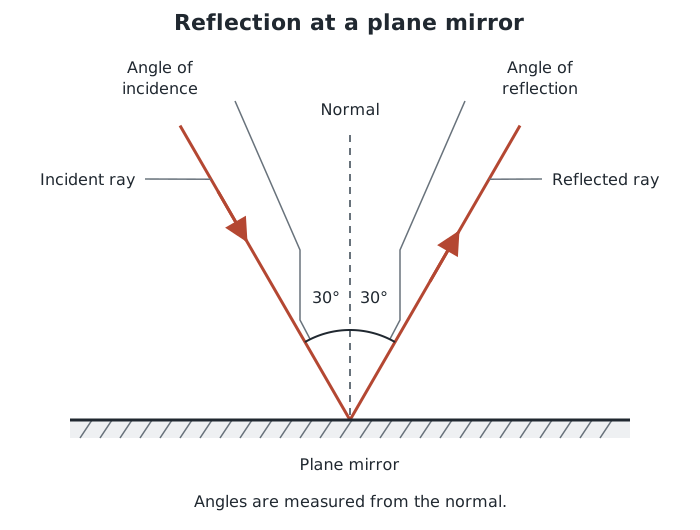
Both angles are measured from the normal: the angle of incidence equals the angle of reflection.
You need a ray box with a thin single slit, a plane mirror and holder, white paper, a pencil, a ruler and a protractor.
The investigation is complete when you have several clear ray paths and angle pairs to compare. The angles of incidence and reflection should be equal, allowing for measurement uncertainty. A narrow ray makes its direction easier to mark precisely.
Do not look directly into the ray box. Some ray boxes become hot, so let them cool before handling them. Keep the mirror secure and handle its glass edges carefully. Dim the lighting only enough to see the rays while still working safely.
Waves travel at different speeds in different substances. Refraction happens when a wave passes into a material where its speed is different. If it enters at an angle to the normal, its direction changes too.
Light travels more slowly in glass than in air. When it enters glass at an angle, it bends towards the normal: the angle of refraction is smaller than the angle of incidence. When it leaves glass for air, it speeds up and bends away from the normal.
This is about the speed of the wave in each material, not simply how heavy or dense the material is. The useful rule is:
If the ray enters along the normal, its speed still changes, but its direction does not.
Imagine a straight wavefront approaching glass at an angle. A wavefront joins points at the same stage of their vibration, such as neighbouring crests. One end reaches the glass first and slows down while the other end is still travelling faster in air. This turns the wavefront, changing the direction of travel.
The wave's frequency stays the same as it crosses the boundary. Using the wave equation,
a decrease in speed with unchanged frequency means a decrease in wavelength. Light therefore has a shorter wavelength in glass than in air. On returning to air, its speed and wavelength increase again.
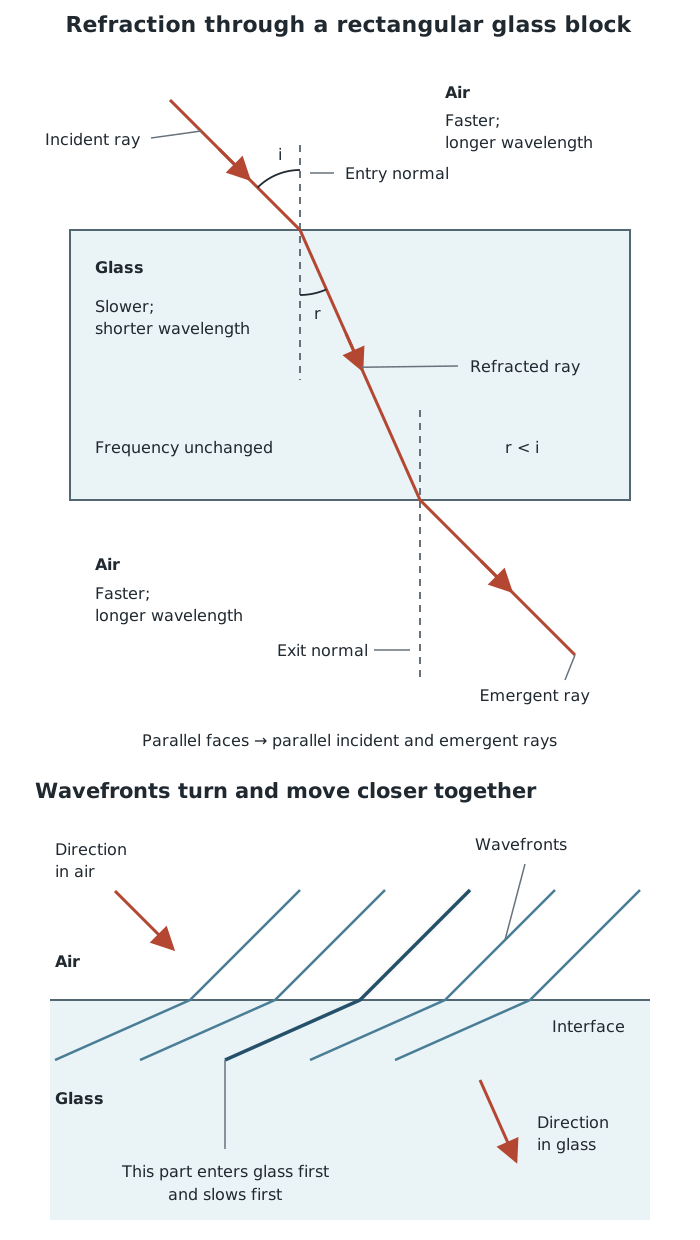
Light slows and bends towards the normal on entering glass. Its frequency stays constant, so its wavelength decreases.
A rectangular glass prism, often called a glass block, lets you trace the ray at both the entry and exit surfaces. You need the prism, a ray box with a thin slit, white paper, a pencil, a ruler and a protractor.
You now have ray paths and measurements showing that the ray bends towards the normal on entering the glass. Draw a separate normal at the exit point to show that it bends away from the normal on leaving. With parallel entry and exit faces, the emergent ray is parallel to the incident ray, but displaced sideways.
Use the same ray-box precautions as for the mirror investigation, and handle the glass prism carefully.
Wave speed in a material can also depend on wavelength. In glass, blue light travels more slowly than red light and is refracted more strongly.
White light contains a mixture of colours. A triangular glass prism can separate these colours because they are refracted by different amounts. This is dispersion. The prism separates colours already present in the white light; it does not create new colours.
Measure angles from the normal, not from the surface. The normal is perpendicular to the surface at the point where the ray meets it.
Put arrows on ray diagrams to show the direction in which light travels.
Explain refraction using a change in wave speed. Entering a new material does not change the wave's frequency.
In practical descriptions, explain how you mark the rays and then use a ruler and protractor to obtain the angles.
A rectangular prism is a transparent block with rectangular faces; a prism does not have to be triangular.
It can see this note and what your specification asks for.
Answers are free with an account.
1 free note left this week
Get more free notesYour answer sets when this note comes back for review, or marks it complete.
Was this note helpful?
Log in to tell us whether it helped, or to report a problem.
Last updated
Interface
The boundary where two different materials meet.
Reflection
The return of a wave into the material it came from when it reaches a boundary.
Refraction
A change in wave speed as a wave passes between materials, which changes its direction if it enters at an angle to the normal.
Normal
An imaginary line perpendicular to a surface at the point where a ray meets it.
Angle of incidence
The angle between the incoming ray and the normal.
Angle of reflection
The angle between the reflected ray and the normal.
Angle of refraction
The angle between the ray travelling into the new material and the normal.
Plane mirror
A flat reflecting surface.
Dispersion
The separation of light into its component colours because different wavelengths are refracted by different amounts.
Put your knowledge into practice — try past paper questions for Combined Science B
Interface
The boundary where two different materials meet.
Reflection
The return of a wave into the material it came from when it reaches a boundary.
Refraction
A change in wave speed as a wave passes between materials, which changes its direction if it enters at an angle to the normal.
Normal
An imaginary line perpendicular to a surface at the point where a ray meets it.
Angle of incidence
The angle between the incoming ray and the normal.
Angle of reflection
The angle between the reflected ray and the normal.
Angle of refraction
The angle between the ray travelling into the new material and the normal.
Plane mirror
A flat reflecting surface.
Dispersion
The separation of light into its component colours because different wavelengths are refracted by different amounts.
Plane mirror: stand the mirror upright, mark its position and normal, shine a narrow ray, mark both ray paths and measure their angles. Repeat for several incident angles; compare the angle pairs.
Rectangular prism: trace its outline, mark incident and emergent rays, remove it and join the entry and exit points. Measure incidence and refraction from the entry normal; repeat for several incident angles.
Use a ruler and protractor, keep the mirror or prism aligned, and dim the lighting to see the rays. Avoid looking into the ray box and allow hot equipment to cool.