

Loading…
Loading…
Loading…
OCR GCSE Combined Science B · J260
OCR J260 · Energy Resources and the National Grid Check the specification (PDF) (opens in a new tab)
A cell and a mains socket both provide a potential difference, or voltage. This is a difference between two points that can drive an electric current when there is a complete conducting path. Voltage is measured in volts (V).
A cell supplies a direct voltage: its positive and negative terminals keep the same polarity. In a simple battery-powered circuit, the current therefore flows in one direction only. This is direct current (d.c.).
An alternating voltage repeatedly reverses polarity. One terminal becomes positive relative to the other, then negative, and the pattern repeats. In a simple circuit, this causes the current to reverse direction repeatedly: alternating current (a.c.). The positive and negative signs describe opposite polarities, not whether the electricity is present or absent.
The UK domestic mains supply is a.c., at a frequency of 50 Hz and about 230 V. A frequency of 50 Hz means 50 complete cycles every second. During each cycle, the voltage passes through both positive and negative values. The quoted 230 V describes the mains supply; it does not mean its voltage stays constant throughout a cycle.
Electricity must travel from power stations to the places where it is used. The National Grid is the network of transmission cables and transformers that makes this possible.
A step-up transformer increases the alternating voltage before electrical power is transferred along high-voltage transmission cables. For the same power transfer, a higher voltage allows a lower current. This reduces the energy dissipated as heating in the cables, so more of the transferred energy reaches users.
Near the places where electricity is needed, step-down transformers reduce the voltage again. Homes receive a supply of about 230 V rather than the much higher transmission voltage.
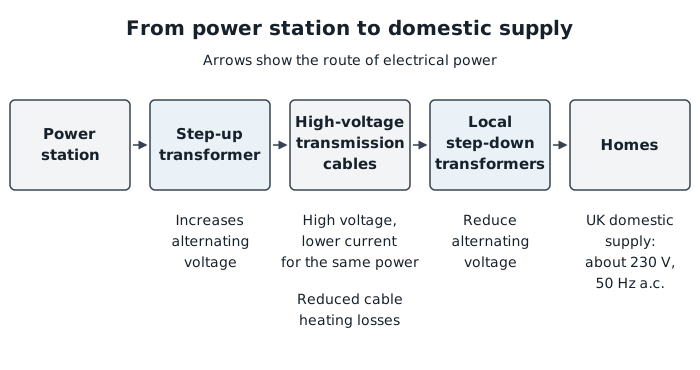
Transformers raise the voltage for efficient transmission and reduce it again for domestic use.
The two transformer roles work together: high voltage is useful for efficient transmission over long distances, while lower voltage is needed for domestic use. A domestic supply is still dangerous despite being lower than the transmission voltage.
A three-core mains cable contains live, neutral and earth wires. Each has a different function.
| Wire | Insulation colour | Function | Potential relative to earth |
|---|---|---|---|
| Live | Brown | Supplies the alternating voltage to the appliance | About 230 V |
| Neutral | Blue | Completes the normal circuit through the appliance | Approximately 0 V |
| Earth | Green and yellow | Connects a metal casing to earth for safety | Approximately 0 V |
These values mean that the potential difference is about 230 V between live and neutral, about 230 V between live and earth, and approximately 0 V between neutral and earth. Because the supply is alternating, the live wire’s polarity reverses rather than remaining permanently positive.
Neutral and earth are not interchangeable. Neutral carries current during normal operation. Earth normally carries no current: it provides a safety path if a fault occurs.
For example, a damaged live wire inside a metal-cased appliance could touch the casing and make it live. An earth wire connected to the casing provides a low-resistance path to earth. The resulting large fault current can melt a fuse, breaking the circuit and disconnecting the supply.
Opening an appliance switch breaks its normal circuit, stopping current through the appliance. However, the section of live wire between the supply and the open switch can still have a potential difference of about 230 V relative to earth.
If someone touches this live section while also connected to earth, their body can provide a new conducting path. A dangerous current can then pass through them even though the appliance’s switch is open. No current in the appliance does not mean no voltage at the live wire.
An earthed object is connected to earth and is at approximately 0 V. Connecting it to a live wire creates a path across a large potential difference. A low-resistance connection can produce a very large current and dangerous heating.
If a person forms the connection between the live wire and an earthed object, the current can pass through their body, causing a potentially fatal electric shock. Never touch exposed mains wiring or attempt to investigate these effects. Switching an appliance off is not a substitute for safely isolating it from the mains supply.
50 Hz means 50 complete cycles each second, not 50 changes of direction.
State potential differences between two points: live–neutral ≈ 230 V, live–earth ≈ 230 V and neutral–earth ≈ 0 V.
An open appliance switch stops current through the appliance, but does not necessarily remove the potential difference between the supply-side live wire and earth.
Distinguish the wires: neutral carries current during normal operation; earth normally carries current only during a fault.
It can see this note and what your specification asks for.
Answers are free with an account.
1 free note left this week
Get more free notesYour answer sets when this note comes back for review, or marks it complete.
Was this note helpful?
Log in to tell us whether it helped, or to report a problem.
Last updated
Potential difference
The difference in electrical potential between two points, which can drive a current through a complete conducting path. It is measured in volts (V) and is also called voltage.
Alternating voltage
A voltage whose polarity repeatedly reverses, alternating between positive and negative values.
Direct voltage
A voltage whose polarity does not reverse, such as the voltage supplied by a cell.
Frequency
The number of complete cycles each second, measured in hertz (Hz).
National Grid
The network of cables and transformers that distributes electrical power from power stations to users.
Transformer
A device that increases or decreases an alternating voltage. A step-up transformer increases it; a step-down transformer decreases it.
Live wire
The mains wire that supplies the alternating voltage to an appliance. It is about 230 V relative to neutral or earth.
Neutral wire
The mains wire that completes the normal circuit through an appliance and is at approximately the same potential as earth.
Earth wire
A safety wire connecting an appliance’s metal casing to earth. It normally carries no current but provides a low-resistance path during a fault.
Put your knowledge into practice — try past paper questions for Combined Science B
Potential difference
The difference in electrical potential between two points, which can drive a current through a complete conducting path. It is measured in volts (V) and is also called voltage.
Alternating voltage
A voltage whose polarity repeatedly reverses, alternating between positive and negative values.
Direct voltage
A voltage whose polarity does not reverse, such as the voltage supplied by a cell.
Frequency
The number of complete cycles each second, measured in hertz (Hz).
National Grid
The network of cables and transformers that distributes electrical power from power stations to users.
Transformer
A device that increases or decreases an alternating voltage. A step-up transformer increases it; a step-down transformer decreases it.
Live wire
The mains wire that supplies the alternating voltage to an appliance. It is about 230 V relative to neutral or earth.
Neutral wire
The mains wire that completes the normal circuit through an appliance and is at approximately the same potential as earth.
Earth wire
A safety wire connecting an appliance’s metal casing to earth. It normally carries no current but provides a low-resistance path during a fault.