

Loading…
Loading…
Loading…
OCR GCSE Combined Science B · J260
OCR J260 · Wave Motion and Interactions Check the specification (PDF) (opens in a new tab)
A wave is a disturbance that transfers energy from one place to another without an overall transfer of matter. The distinction is easiest to see on a rope. Move one end up and down and a disturbance travels along it, although each part of the rope only moves about its original position. The rope does not travel along with the wave.
Water ripples provide similar evidence. Place a small floating object, such as a ping-pong ball, on the water in a ripple tank. As ripples pass, the ball bobs up and down rather than being carried across the tank with each crest. The passing disturbance reaches new places while the water moves locally.
Sound also travels without carrying air all the way from its source to the listener. You can hear a sound across a room without a stream of air blowing from the source towards you. A vibrating source makes nearby air particles move backwards and forwards; their interactions make neighbouring particles vibrate in turn. The disturbance and energy travel through the air, while the particles oscillate about their positions.
In a transverse wave, the vibrations are at right angles to the direction in which the wave travels. A wave travelling horizontally along a rope can have vertical vibrations. Its highest points are called crests and its lowest points troughs.
In a longitudinal wave, the vibrations are parallel to the direction of travel. Sound in air is longitudinal: particles move backwards and forwards along the direction in which the sound travels. This creates alternating compressions, where particles are close together and pressure is higher, and rarefactions, where particles are further apart and pressure is lower. A spring pushed and pulled along its length models this behaviour.
Light is an electromagnetic wave, and all electromagnetic waves are transverse. Their oscillating disturbance is not a vibration of air or water particles.
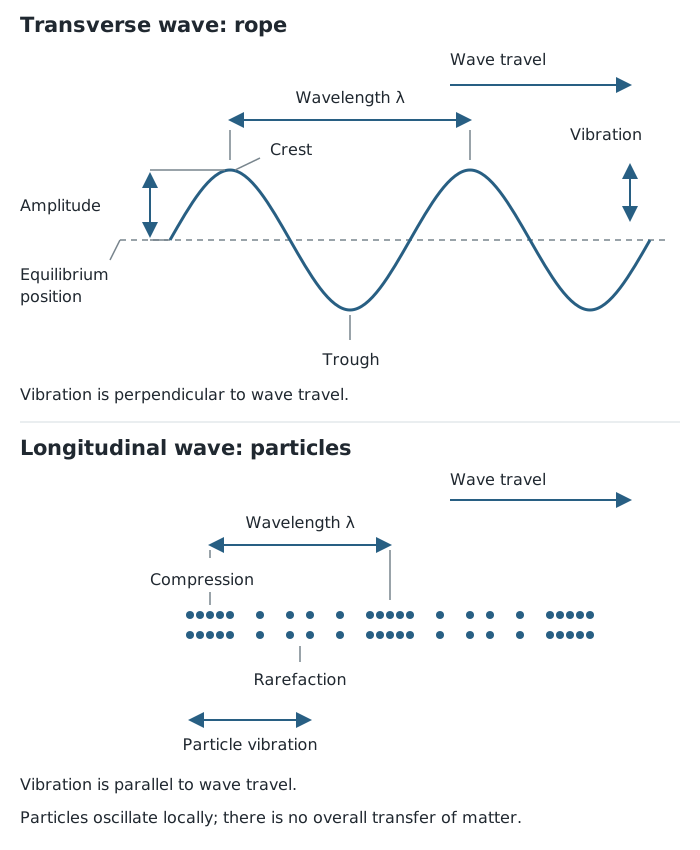
Wavelength is measured along the direction of travel. The direction of vibration distinguishes transverse from longitudinal waves.
The equilibrium position is the undisturbed position. Amplitude is the greatest displacement from that position. On a rope-wave diagram, it is the vertical distance from the equilibrium line to a crest or trough. A larger amplitude means a larger vibration.
Wavelength, written , is the shortest distance between points at the same stage of consecutive waves. For a transverse wave, measure from one crest to the next crest, or from one trough to the next trough. For a longitudinal wave, measure between the centres of neighbouring or neighbouring . Wavelength and amplitude are both measured in metres, but they describe different distances.
Frequency, , is the number of complete waves passing a fixed point each second. Its unit is the hertz, Hz: a frequency of 5 Hz means five complete waves pass each second.
Period, , is the time for one complete oscillation, or for one complete wave to pass a fixed point. It is measured in seconds. More oscillations each second means less time for each oscillation, so:
For example, if five complete waves pass each second, each takes s to pass.
A drawing of displacement against distance is a snapshot of the wave at one instant, so its horizontal spacing gives wavelength. A graph of displacement against time follows one point as it oscillates, so the time between successive peaks gives period.
Wave speed is the distance travelled by the disturbance each second. During one period, a repeating wave advances by one . If complete waves pass each second and each occupies a distance , then:
Here is wave speed in m/s, is frequency in Hz and is wavelength in m. The same relationship applies to water waves, sound waves and waves across the electromagnetic spectrum.
To find a different quantity, rearrange it:
Suppose water ripples have a frequency of 4 Hz and a wavelength of 0.05 m. Their speed is m/s: a crest travels 0.20 m each second.
Suppose a sound wave travels at 340 m/s and has a frequency of 680 Hz. Its wavelength is m. For an electromagnetic wave travelling at m/s with a frequency of Hz, the wavelength is 3.0 m.
The equation does not mean that increasing frequency always increases speed. If speed stays constant under the same conditions, increasing frequency makes wavelength shorter.
A ripple tank is a shallow tank of water with a transparent base. A vibrating paddle or dipper produces repeated ripples. A lamp makes their pattern visible on a screen beneath the tank. The repeated bands show wavefronts: points at the same stage of the wave, such as a line of crests.
Use a ruler, stopwatch, lamp and vibrating paddle, with a stroboscope if available. Keep the water depth constant throughout a set of measurements and wait until the paddle produces a regular pattern.
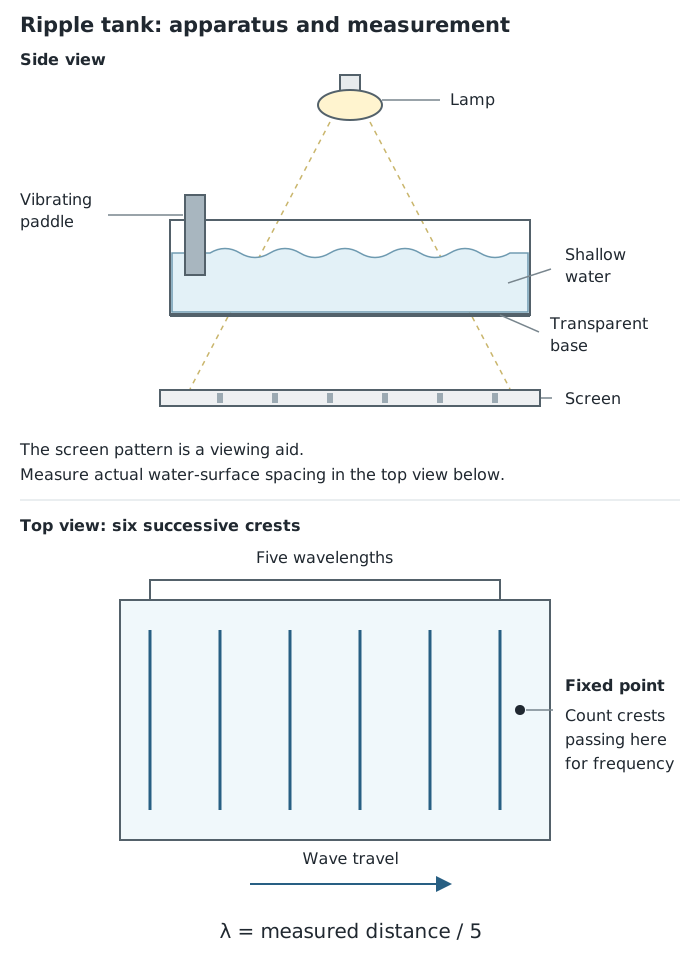
Count waves at a fixed point to find frequency, and measure several crest-to-crest intervals to find wavelength.
To measure frequency, choose one fixed point and count the number of complete waves passing it during a measured time . Then calculate:
Count over a longer interval, such as 60 seconds, to reduce the effect of timing errors. Repeat the measurement and compare the results.
To measure wavelength, identify neighbouring wavefronts at the same stage. A stroboscope flashes regularly; when its flashing frequency matches the wave frequency, the pattern appears stationary and becomes easier to measure. Measure across several wavelength intervals and divide by the number of intervals. For example, the distance from the first to the sixth crest contains five wavelengths. Ensure that the ruler measures the actual wave spacing: an enlarged projected pattern needs a corresponding scale correction.
Calculate speed using the measured frequency and wavelength in .
You can also measure speed directly. Follow one identifiable crest across a known distance and time its journey, then calculate . In a projected pattern, one person can trace the moving crest's position while another times the movement, provided the projected distance is correctly scaled. Repeat and average the speeds. Timing a longer journey reduces the relative effect of reaction time, but the crest must remain identifiable.
Keep electrical connections away from water, keep hands dry and deal with spills promptly. Only use strobe lighting after the teacher has checked that it is safe for everyone present, particularly anyone with photosensitive epilepsy.
One method uses two microphones connected to a data logger. Measure the distance between the microphones and place them along the direction in which the sound will travel. Make a short, distinct sound beyond the first microphone so it passes that microphone before reaching the second.
The recordings show when the same sound reaches each microphone. Measure the time difference between corresponding arrivals, then calculate:
Repeat the measurement and calculate a mean speed. A larger microphone separation produces a longer time interval, making the delay easier to distinguish. Keep the microphones in the same positions and use a sound loud enough to detect clearly, but not painfully loud or close to anyone's ears.
An alternative uses an echo from a large solid wall. Stand a measured distance from the wall, for example about 50 m away, make a short sound and time the delay until its echo returns. The sound travels to the wall and back, so:
Use a clear open area away from traffic and other hazards. Repeat the timing because reaction time makes a single stopwatch measurement unreliable. A clear, separate echo is needed; if it overlaps the original sound, the return time cannot be measured reliably.
Compare the direction of vibration with the direction of wave travel when identifying transverse and longitudinal waves.
Measure amplitude from the equilibrium position to a crest or trough, not from crest to trough.
Count wavelength intervals, not crests: six consecutive crests span five wavelengths.
Convert wavelengths to metres and frequencies to hertz before using v = fλ to find a speed in m/s.
For an echo, the sound travels to the wall and back, so the distance travelled is twice the distance to the wall.
A displacement–distance graph shows wavelength; a displacement–time graph at one point shows period.
It can see this note and what your specification asks for.
Answers are free with an account.
1 free note left this week
Get more free notesYour answer sets when this note comes back for review, or marks it complete.
Was this note helpful?
Log in to tell us whether it helped, or to report a problem.
Last updated
Wave
A disturbance that transfers energy in the direction of travel without an overall transfer of matter.
Amplitude
The maximum displacement from the equilibrium, or undisturbed, position. Measured in metres.
Wavelength
The shortest distance between two points at the same stage of consecutive waves, such as neighbouring crests or neighbouring compressions. Symbol ; measured in metres.
Frequency
The number of complete oscillations, or complete waves passing a fixed point, per second. Symbol ; measured in hertz (Hz).
Period
The time taken for one complete oscillation, or for one complete wave to pass a fixed point. Symbol ; measured in seconds.
Transverse wave
A wave in which the vibrations are perpendicular to the direction of wave travel.
Longitudinal wave
A wave in which the vibrations are parallel to the direction of wave travel.
Compression
A region of a longitudinal wave where particles are closer together than usual.
Rarefaction
A region of a longitudinal wave where particles are further apart than usual.
Wave speed
The distance travelled by a wave per second. Symbol ; measured in metres per second (m/s).
Put your knowledge into practice — try past paper questions for Combined Science B
Wave
A disturbance that transfers energy in the direction of travel without an overall transfer of matter.
Amplitude
The maximum displacement from the equilibrium, or undisturbed, position. Measured in metres.
Wavelength
The shortest distance between two points at the same stage of consecutive waves, such as neighbouring crests or neighbouring compressions. Symbol ; measured in metres.
Frequency
The number of complete oscillations, or complete waves passing a fixed point, per second. Symbol ; measured in hertz (Hz).
Period
The time taken for one complete oscillation, or for one complete wave to pass a fixed point. Symbol ; measured in seconds.
Transverse wave
A wave in which the vibrations are perpendicular to the direction of wave travel.
Longitudinal wave
A wave in which the vibrations are parallel to the direction of wave travel.
Compression
A region of a longitudinal wave where particles are closer together than usual.
Rarefaction
A region of a longitudinal wave where particles are further apart than usual.
Wave speed
The distance travelled by a wave per second. Symbol ; measured in metres per second (m/s).
Use m/s, Hz, m and s. At constant speed, higher frequency means shorter wavelength.
Ripple tank: produce regular waves at constant water depth. Count waves past a fixed point in time : . Measure several wavelength intervals and divide by their number; a matched stroboscope makes the pattern appear stationary. Calculate , or time a crest across a known distance. Repeat measurements; account for projection scale. Keep water away from electrical connections and check strobe safety.
Sound with microphones: measure microphone separation and the delay between the same sound arriving at each. Calculate .
Sound with an echo: measure distance to a wall and the echo delay. Calculate because the journey is out and back. Repeat and average; avoid excessive noise.