

Loading…
Loading…
Loading…
OCR GCSE Combined Science B · J260
OCR J260 · Electromagnetic Spectrum Properties Check the specification (PDF) (opens in a new tab)
Visible light is one kind of electromagnetic radiation. Radio waves, microwaves and X-rays belong to the same family, even though our eyes cannot detect them. The complete range is called the electromagnetic spectrum.
Electromagnetic radiation transfers energy from one place to another. It does not need a material medium, so it can travel through the vacuum of space. This is how energy from the Sun reaches Earth across the space between them.
All electromagnetic radiation travels through a vacuum at the same speed: approximately . This is extremely fast, but it is finite: radiation takes time to travel a distance rather than arriving instantly. Gamma rays do not travel faster than radio waves through space.
The seven main regions, from longest to shortest wavelength, are:
Radio → microwave → infrared → visible → ultraviolet → X-rays → gamma rays.
Wavelength is the distance between corresponding points on successive waves, such as neighbouring crests. Frequency is the number of complete oscillations each second, measured in hertz (Hz).
Moving from radio waves towards gamma rays, wavelength decreases while frequency increases. With the same wave speed, more closely spaced crests mean that more crests pass a point each second. Higher-frequency radiation also carries more energy. Radio waves are therefore at the long-wavelength, low-frequency, low-energy end; gamma rays are at the opposite end.
This energy comparison concerns the radiation's frequency. It does not mean that every gamma-ray source transfers more energy overall than every radio transmitter: the amount of radiation emitted also matters.
Our eyes detect only the small visible region of the spectrum. Within it, the order from longer to shorter wavelength is red, orange, yellow, green, blue, indigo, violet. Red has a lower frequency than violet. Infrared lies just beyond the red end, and ultraviolet just beyond the violet end; neither is visible to human eyes.
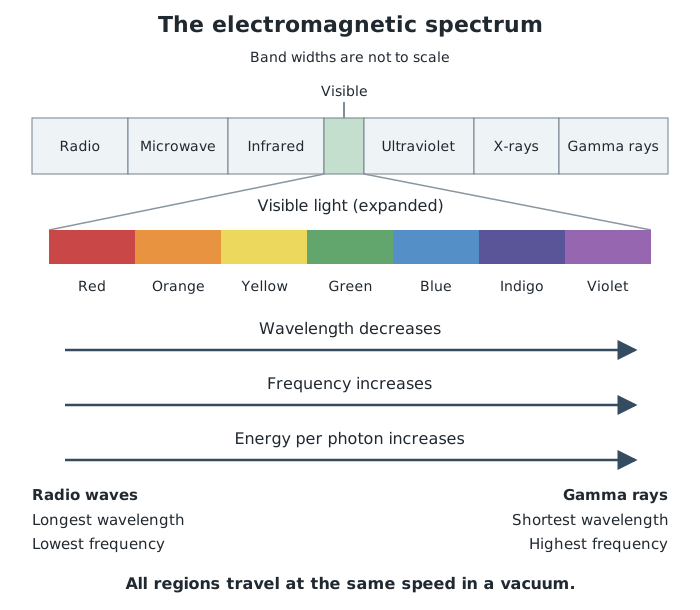
From radio to gamma rays, wavelengths become shorter while frequency and energy increase. Visible light is only a small region of the spectrum.
A source emits radiation. An absorber takes in that radiation and receives energy from it. The source and absorber do not have to touch.
In a microwave oven, the microwave-producing device is the source and the food is the absorber. Microwaves transfer energy to the food when they are absorbed, increasing its internal energy and heating it.
For sunlight reaching Earth, the Sun is the source. Earth's surface absorbs some of the incoming radiation and gains energy. These examples follow the same pattern: source → electromagnetic radiation → absorber.
Radiation passing through a material is not the same as radiation being absorbed. Energy is transferred to the material when it absorbs the radiation.
When electromagnetic radiation reaches a material, it may be absorbed, transmitted or reflected:
A material may do more than one of these: some incoming radiation can be reflected while the rest is transmitted or absorbed.
The response depends on both the material and the wavelength. A substance that transmits one region of the spectrum need not transmit another. For example, glass can transmit visible light while absorbing some ultraviolet radiation. Being transparent to our eyes therefore does not mean being transparent to all electromagnetic radiation.
This wavelength dependence helps explain why different radiations can have different effects on the same object, despite belonging to the same electromagnetic family.
An oscillation is a repeated change back and forth. In an electrical circuit, an alternating current repeatedly reverses direction, causing electric charge to oscillate.
In a transmitting aerial connected to a high-frequency alternating-current circuit, charge moves back and forth. These electrical oscillations produce radio waves with the same frequency as the oscillations in the circuit.
The reverse process can happen at a receiving aerial. Incoming radio waves can induce oscillations in the receiving electrical circuit: they cause an alternating current, again at the same frequency as the waves. This current allows the radio waves to be detected.
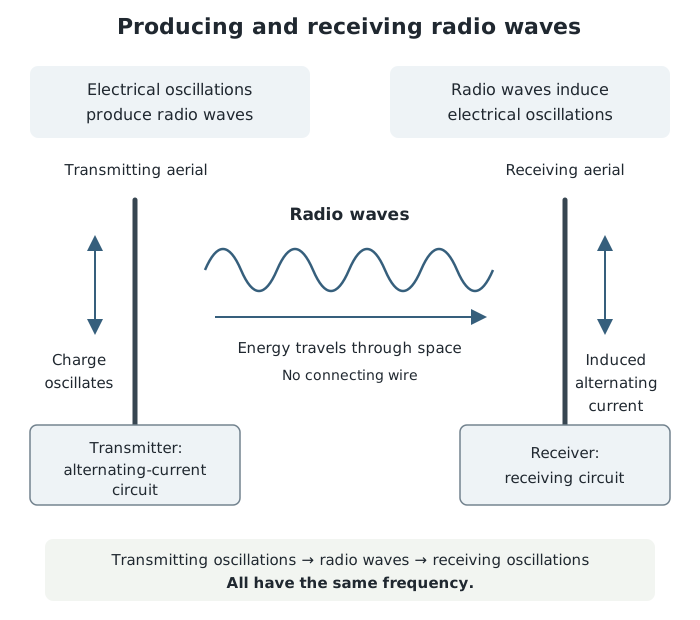
Electrical oscillations produce radio waves, which can induce oscillations at the same frequency in a receiving circuit.
The connection works in both directions: electrical oscillations can produce radio waves, and radio waves can produce electrical oscillations. The waves transfer energy between the transmitter and receiver without a wire joining them.
Radio → microwave → infrared → visible → ultraviolet → X-rays → gamma rays
In this direction:
Visible light runs red to violet in the same direction. Our eyes detect only this limited frequency range.
All electromagnetic radiation travels through space at the same very high but finite speed: approximately .
Learn the spectrum in one direction first: radio to gamma means decreasing wavelength, increasing frequency and increasing energy.
Include red to violet within the visible region: red has a longer wavelength and lower frequency than violet.
The common speed applies to electromagnetic radiation travelling through space or a vacuum, not through every material.
In an energy-transfer explanation, identify the source, the radiation and the absorber.
For radio waves, distinguish the oscillating current that produces the waves from the oscillating current induced in the receiving circuit. Both have the same frequency as the waves.
It can see this note and what your specification asks for.
Answers are free with an account.
1 free note left this week
Get more free notesYour answer sets when this note comes back for review, or marks it complete.
Was this note helpful?
Log in to tell us whether it helped, or to report a problem.
Last updated
Electromagnetic spectrum
The complete range of electromagnetic radiation, arranged by wavelength or frequency.
Wavelength
The distance between corresponding points on successive waves, such as one crest and the next.
Frequency
The number of complete oscillations each second, measured in hertz (Hz).
Source
An object or device that emits radiation.
Absorber
A substance or object that takes in radiation and receives energy from it.
Absorption
The taking in of radiation by a material, transferring energy to that material.
Transmission
The passage of radiation through a material.
Reflection
The return of radiation from a surface rather than its passage through the material.
Oscillation
A repeated change or movement back and forth about a central position or value.
Alternating current
An electric current that repeatedly reverses direction.
Put your knowledge into practice — try past paper questions for Combined Science B
Electromagnetic spectrum
The complete range of electromagnetic radiation, arranged by wavelength or frequency.
Wavelength
The distance between corresponding points on successive waves, such as one crest and the next.
Frequency
The number of complete oscillations each second, measured in hertz (Hz).
Source
An object or device that emits radiation.
Absorber
A substance or object that takes in radiation and receives energy from it.
Absorption
The taking in of radiation by a material, transferring energy to that material.
Transmission
The passage of radiation through a material.
Reflection
The return of radiation from a surface rather than its passage through the material.
Oscillation
A repeated change or movement back and forth about a central position or value.
Alternating current
An electric current that repeatedly reverses direction.
Source → radiation → absorber: absorption transfers energy to the absorber.
Materials may absorb, transmit or reflect radiation. Their response depends on the material and wavelength.