

Loading…
Loading…
Loading…
OCR GCSE Combined Science B · J260
OCR J260 · Electromagnetic Spectrum Properties Check the specification (PDF) (opens in a new tab)
Electromagnetic radiation transfers energy. When matter absorbs radiation, its atoms or molecules may gain energy or undergo a change. The reverse can also happen: changes within matter can release energy as electromagnetic radiation.
Different changes produce different regions of the spectrum. Changes involving molecules can emit or absorb infrared, changes involving atomic electrons can produce visible light, ultraviolet or X-rays, and changes within atomic nuclei can emit gamma rays.
An atom has a small, positively charged nucleus surrounded by negatively charged electrons. The electrons occupy energy levels, associated with different distances from the nucleus. Electrons in higher levels have more energy than those in lower levels.
When an atom absorbs a suitable amount of energy from electromagnetic radiation, an electron can move to a higher energy level, generally further from the nucleus. The atom is then in an excited state. The electron has not left the atom: it has changed its energy and arrangement within it.
An electron can later move back to a lower energy level. It loses energy, which is emitted as electromagnetic radiation. Depending on the energy difference between the levels, this radiation can be visible light, ultraviolet or X-rays. A larger energy difference produces higher-frequency radiation.
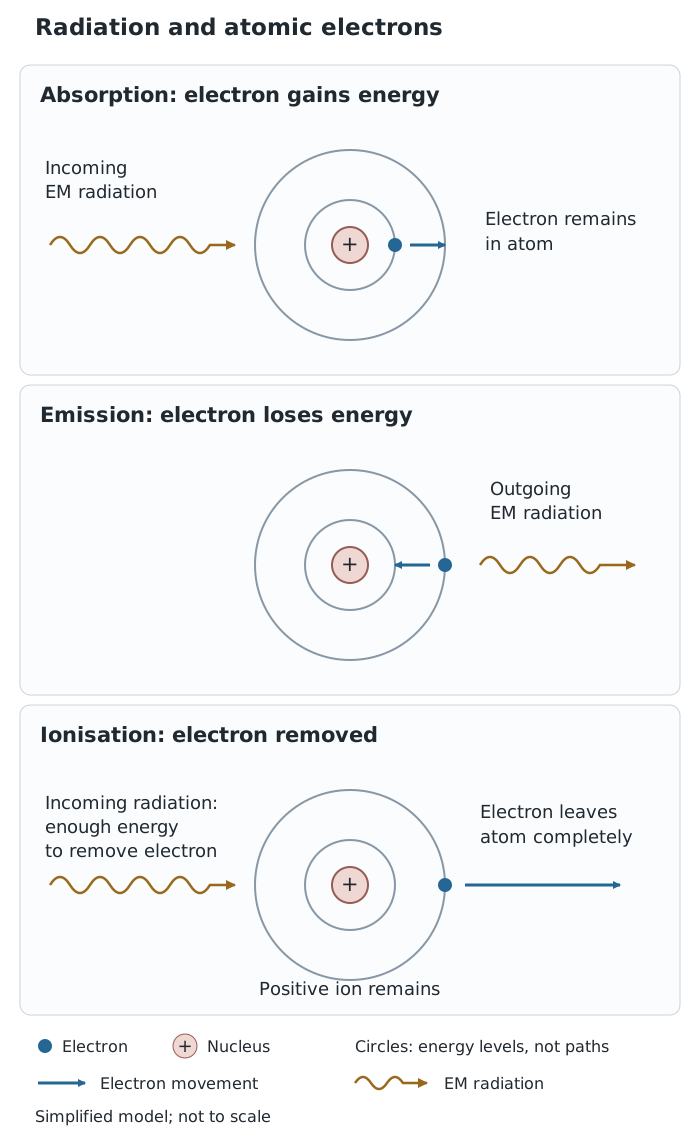
Absorption can raise an electron’s energy; emission lowers it. Ionisation removes an electron completely.
Absorption and emission are therefore connected processes: absorption can increase an electron’s energy, while emission accompanies a decrease in its energy.
If enough energy is absorbed, an outer electron can leave the atom completely. This is ionisation, rather than just movement to another energy level.
A neutral atom has equal numbers of positive protons and negative electrons. Losing a negative electron leaves it with an overall positive charge, so it becomes a positive ion. For example, a neutral sodium atom can lose its outer electron to become a sodium ion:
High-energy ultraviolet, X-rays and gamma rays can carry enough energy to remove electrons when absorbed by some atoms. They are therefore examples of ionising radiation. Whether ionisation occurs depends on whether the absorbed radiation supplies enough energy to remove an electron from that particular atom.
Molecules can absorb and emit infrared radiation through changes in their motion, including vibration. Absorbing infrared increases their energy and can heat a material; emitting infrared transfers energy away. This explains why infrared is useful for heating.
Gamma rays originate in the nucleus, not in the surrounding electrons. A nucleus with excess energy can lose that energy by emitting gamma radiation. This is a different process from the electron energy changes that can produce visible light, ultraviolet and X-rays.
Together, molecular, atomic and nuclear changes account for the generation and absorption of radiation over a wide range of frequencies.
Some ultraviolet radiation from the Sun is absorbed by oxygen molecules high in the atmosphere. The absorbed energy can split an oxygen molecule, , into separate oxygen atoms. An oxygen atom can then combine with another oxygen molecule to form ozone, .
Ozone also absorbs ultraviolet radiation. Oxygen and ozone therefore absorb harmful ultraviolet before it reaches the ground, protecting living organisms from damage. They do not remove all ultraviolet: some still reaches Earth’s surface, so atmospheric protection does not make exposure to sunlight risk-free.
Ultraviolet, X-rays and gamma rays can damage human bodily tissues when absorbed. High-energy radiation can ionise atoms and molecules, disrupting chemical bonds and reactions within cells.
Two important consequences are:
Ultraviolet can damage skin, causing sunburn and increasing the risk of skin cancer. X-rays and gamma rays can penetrate into the body and damage internal tissues. Harm is not inevitable after every exposure: risk depends on the radiation, the dose absorbed and the tissues exposed.
Reducing unnecessary exposure lowers risk. For sunlight, shade, covering skin and suitable sunscreen reduce ultraviolet exposure. For X-rays and gamma rays, exposure time can be limited, distance from a source increased where possible, and suitable shielding used, such as lead or concrete.
Different regions are useful because of how their radiation travels and interacts with matter.
| Region | Practical use | Why it is useful |
|---|---|---|
| Radio waves | Radio and television broadcasting | They carry information from a transmitter to receivers. |
| Microwaves | Microwave ovens | Absorption transfers energy to food, heating it. |
| Infrared | Heaters and thermal imaging | Absorption heats materials; detectors can form images from emitted infrared. |
| Visible light | Lighting and photography | Eyes and camera detectors respond to visible light. |
| Ultraviolet | Sterilising equipment | It can damage and kill microorganisms. |
| X-rays | Medical imaging | Their ability to pass through body tissues allows internal structures to be investigated. |
| Gamma rays | Treating cancer | Their ability to damage and kill cells can be used to destroy cancer cells. |
The same interaction can be both beneficial and hazardous. Ultraviolet can kill microorganisms, but it can also damage human cells. Gamma rays can destroy cancer cells, but healthy cells may also be damaged.
Medical decisions therefore balance benefit against risk. An X-ray may provide information needed for treatment, justifying a carefully controlled exposure. In cancer treatment, radiation is directed at the tumour and exposure is planned to limit damage to healthy tissue. A useful assessment explains both the benefit and the hazard, then considers whether the benefit justifies the controlled risk.
Loss of an outer electron makes an atom a .
Distinguish an electron moving to a higher energy level from an electron leaving the atom completely: only the second process ionises the atom.
State that gamma rays come from the nucleus, whereas visible light, ultraviolet and X-rays can be emitted when atomic electrons lose energy.
Keep the qualification ‘high-energy ultraviolet’: not all ultraviolet radiation can ionise atoms.
Explain a radiation hazard as a chain: absorption → damage to cells or DNA → tissue damage or increased cancer risk.
When assessing a medical use, weigh its benefit against the risk and explain how exposure is controlled.
It can see this note and what your specification asks for.
Answers are free with an account.
1 free note left this week
Get more free notesYour answer sets when this note comes back for review, or marks it complete.
Was this note helpful?
Log in to tell us whether it helped, or to report a problem.
Last updated
Electron
A negatively charged particle found in energy levels at different distances from an atom’s nucleus.
Energy level
One of the allowed energies an electron can have in an atom; these levels are associated with different distances from the nucleus.
Ion
An atom or group of atoms with an overall electrical charge because it has gained or lost electrons.
Ionisation
The formation of ions. Radiation can cause ionisation by removing electrons from atoms or molecules.
Emission
The release of electromagnetic radiation, transferring energy away from a source.
Absorption
The transfer of energy from incoming radiation to the material it encounters.
Ozone
A gas whose molecules contain three oxygen atoms, . Ozone in the atmosphere absorbs ultraviolet radiation and helps protect life on Earth.
Put your knowledge into practice — try past paper questions for Combined Science B
Electron
A negatively charged particle found in energy levels at different distances from an atom’s nucleus.
Energy level
One of the allowed energies an electron can have in an atom; these levels are associated with different distances from the nucleus.
Ion
An atom or group of atoms with an overall electrical charge because it has gained or lost electrons.
Ionisation
The formation of ions. Radiation can cause ionisation by removing electrons from atoms or molecules.
Emission
The release of electromagnetic radiation, transferring energy away from a source.
Absorption
The transfer of energy from incoming radiation to the material it encounters.
Ozone
A gas whose molecules contain three oxygen atoms, . Ozone in the atmosphere absorbs ultraviolet radiation and helps protect life on Earth.
High-energy ultraviolet, X-rays and gamma rays can ionise some atoms when absorbed.
Cell damage or death → tissue damage. DNA damage → mutations → possible cancer. Ultraviolet can cause sunburn and increase skin cancer risk; X-rays and gamma rays can damage internal tissues.
Reduce unnecessary exposure using shorter exposure times, distance and suitable shielding. Balance medical benefits against controlled risks.
Ultraviolet absorbed by oxygen → oxygen atoms → ozone forms. Ozone also absorbs ultraviolet, reducing harmful radiation reaching life at the surface.