

Loading…
Loading…
Loading…
OCR GCSE Combined Science B · J260
OCR J260 · Density, Heat Capacity, and Latent Heat Check the specification (PDF) (opens in a new tab)
A system is the object or group of objects we choose to study—for example, the water inside a kettle. Its internal energy is the total kinetic and potential energy of its particles: energy associated with their movement and their positions relative to one another.
Energy can be transferred to a material by heating it with a fuel or an electric heater. Doing work on a material can also increase its internal energy: rubbing your hands together warms them without a flame or heater. Heating and work are different ways of transferring the same conserved quantity, energy.
An increase in internal energy can raise a material's temperature or cause a change of state. These changes need different equations.
Specific heat capacity, , is the energy required to raise the temperature of 1 kg of a substance by 1°C. Its unit is J/kg/°C.
A substance with a larger specific heat capacity needs more energy for the same mass and temperature rise. Equivalently, if equal masses receive equal amounts of energy, the material with the larger specific heat capacity has the smaller temperature rise.
For a temperature change without a change of state:
Here is the change in internal energy in joules (J), is mass in kilograms (kg), and is temperature change in degrees Celsius (°C). Calculate the temperature change using:
For example, suppose 0.50 kg of water, with , warms from 20°C to 40°C. Its temperature rise is 20°C, so its internal energy increases by . Twice as much water would need twice as much energy for that rise.
When a material cools, its internal energy decreases and energy is transferred to the surroundings. The same relationship gives the magnitude of the energy released if you use the size of the temperature fall.
Specific latent heat, , is the energy required to change the state of 1 kg of a substance without changing its temperature. Its unit is J/kg: unlike specific heat capacity, it has no temperature-change factor.
During melting or boiling, energy continues to enter the substance even though its temperature remains constant. Its internal energy increases as the particles' arrangement and separation change, rather than through a temperature rise.
There are two commonly used forms:
Melting and vaporisation require an input of energy. Freezing and condensation release energy.
The energy needed for a change of state is:
Here is energy in J, is the mass that changes state in kg, and is specific latent heat in J/kg.
Suppose 0.20 kg of a solid is already at its melting temperature and has a given specific latent heat of fusion of 150 000 J/kg. Melting it requires . That energy melts the material; it does not raise its temperature.
If a solid starts below its melting temperature, first calculate the energy to warm it using , then the energy to melt it using . Add these separate energy transfers to find the total.
In an electric kettle, energy is transferred electrically from the supply to the heating element, then by heating to the water. The internal energy of the water increases and its temperature rises. The kettle itself and the surrounding air also warm, so not all the supplied energy reaches the water.
Once the water is boiling, further energy transfers cause liquid water to become gas rather than raising the temperature of the boiling water. Reaching boiling temperature and changing all the water into gas are therefore different calculations.
When an object slows down, its kinetic energy store decreases. During braking, friction transfers energy to the internal energy stores of the brakes and other parts of the surroundings, increasing their temperatures. Air resistance can also transfer energy to the surroundings.
When a moving object hits an obstacle, its kinetic energy decreases. Energy may temporarily be stored elastically as the objects deform. Permanent deformation and friction increase the internal energy of the objects, while sound transfers some energy to the surroundings. Energy is conserved, but it becomes spread among more stores.
For an electric heater, calculate the supplied energy using:
Power is measured in watts (W), potential difference in volts (V), current in amperes (A), and time in seconds (s).
For example, a 100 W heater operating for 60 s supplies 6000 J. If all this energy heats a 0.50 kg block with , its temperature rise is:
For a moving object, its kinetic energy is:
Here is the moving object's mass in kg and is its speed in m/s. Calculate the decrease in kinetic energy, then use that energy in if it heats a material.
For example, a 2.0 kg object moving at 10 m/s has 100 J of kinetic energy. If it stops and all 100 J heats a 0.10 kg part with , that part warms by . If some energy heats other objects or is transferred by sound, its temperature rise will be smaller.
A metal block can be heated electrically to measure its specific heat capacity. You need a balance, a block with holes for an electric heater and thermometer, suitable insulation, a low-voltage d.c. supply, an ammeter, a voltmeter and a stopwatch.
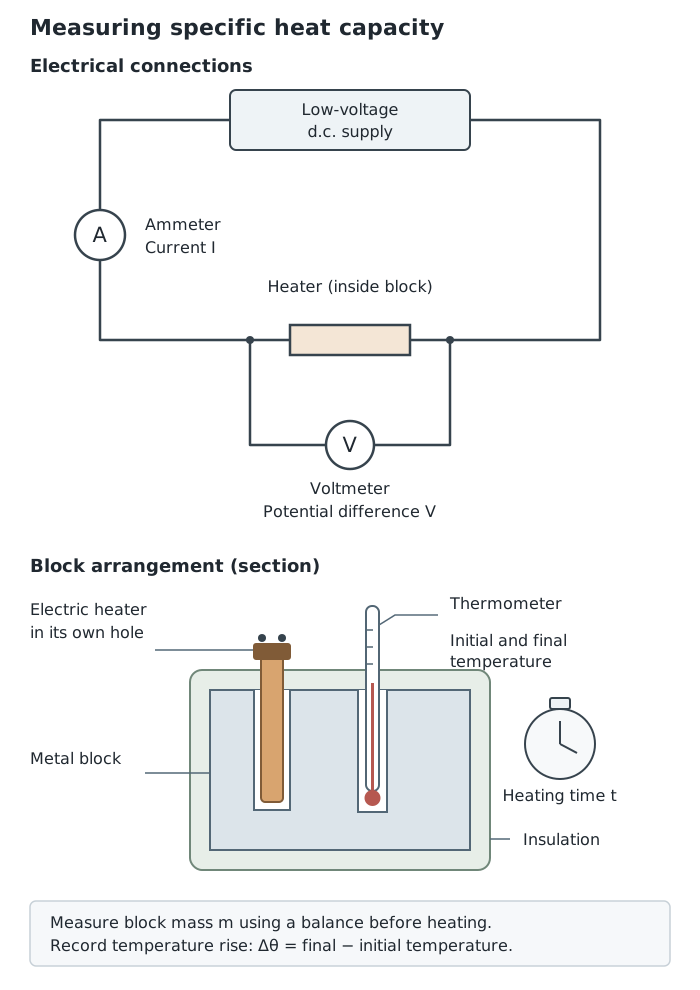
Measure the energy supplied electrically and the block's temperature rise to calculate its specific heat capacity.
Use the low-voltage supply rather than exposed mains connections. Keep leads secure, avoid touching the hot block or heater, and allow them to cool before handling or repeating the experiment. Do not switch on a heater outside the block, and avoid overheating insulation that could soften or be damaged.
The calculation assumes that all the supplied energy increases the block's internal energy. In practice, some heats the heater and thermometer or escapes to the surroundings. This makes the temperature rise smaller and can make the calculated specific heat capacity too high. Insulation reduces this problem. Repeating the measurement after cooling helps check consistency.
For a liquid, the same principle can be used with a measured mass in an insulated container, a lid, an immersed heater and a thermometer. Keep electrical connections dry and handle hot liquid carefully.
Use the temperature change, not the final temperature, in ΔE = mcΔθ.
Convert mass to kilograms and time to seconds before substituting into equations.
Use E = mL for a change of state at constant temperature, not for warming a substance to its melting or boiling point.
In linked calculations, identify which object each mass refers to: the moving object's mass and the heated material's mass may differ.
State any assumption that all the electrical energy supplied or kinetic energy lost increases the internal energy of the material.
It can see this note and what your specification asks for.
Answers are free with an account.
1 free note left this week
Get more free notesYour answer sets when this note comes back for review, or marks it complete.
Was this note helpful?
Log in to tell us whether it helped, or to report a problem.
Last updated
Internal energy
The total kinetic and potential energy of the particles within a system.
Specific heat capacity
The energy required to raise the temperature of 1 kg of a substance by 1°C, measured in J/kg/°C.
Specific latent heat
The energy required to change the state of 1 kg of a substance without changing its temperature, measured in J/kg.
Specific latent heat of fusion
The energy required per kilogram to change a substance from solid to liquid at its melting temperature. The same energy per kilogram is released during freezing.
Specific latent heat of vaporisation
The energy required per kilogram to change a substance from liquid to gas at its boiling temperature. The same energy per kilogram is released during condensation.
Work
A transfer of energy when a force causes an object to move, including transfers that increase a material's internal energy.
Put your knowledge into practice — try past paper questions for Combined Science B
Internal energy
The total kinetic and potential energy of the particles within a system.
Specific heat capacity
The energy required to raise the temperature of 1 kg of a substance by 1°C, measured in J/kg/°C.
Specific latent heat
The energy required to change the state of 1 kg of a substance without changing its temperature, measured in J/kg.
Specific latent heat of fusion
The energy required per kilogram to change a substance from solid to liquid at its melting temperature. The same energy per kilogram is released during freezing.
Specific latent heat of vaporisation
The energy required per kilogram to change a substance from liquid to gas at its boiling temperature. The same energy per kilogram is released during condensation.
Work
A transfer of energy when a force causes an object to move, including transfers that increase a material's internal energy.
Kettle: electrical transfer → heater → increased internal energy of water and surroundings.
Braking or collision: kinetic energy decreases; internal energy increases, with possible deformation and sound transfers.
Measure mass, initial and final temperatures, voltage, current and heating time. Insulate the material; ammeter in series, voltmeter across the heater.
Use a low-voltage supply and allow hot apparatus to cool before handling. Energy escaping to the surroundings reduces the measured temperature rise and can overestimate .