

Loading…
Loading…
Loading…
OCR GCSE Combined Science B · J260
OCR J260 · Density, Heat Capacity, and Latent Heat Check the specification (PDF) (opens in a new tab)
Density is mass per unit volume: it tells us how much mass is packed into a given amount of space. Two objects can occupy the same volume but have very different masses. A bag of feathers has much less mass than an equally sized bag of metal, so the feathers have a lower density.
Density is not simply another word for mass. A large object can have a large mass while being made from a low-density material. To compare densities, we must consider both mass and volume.
The relationship is:
Here, (the Greek letter rho) is density in kg/m³, is mass in kg and is volume in m³. A density of 1000 kg/m³ means that one cubic metre of the material has a mass of 1000 kg.
Rearranging gives to find mass and to find volume.
Every density measurement needs a mass and a volume. For a regularly shaped solid, such as a rectangular block, its volume can be calculated from its dimensions.
For a rectangular block, , where , and are its length, width and height. For a cube of side length , . For a cylinder, , where is its radius and its height. A sphere has volume .
Keep all dimensions in the same unit. Converting lengths to metres before multiplying produces a volume in m³. Alternatively, calculate in cm³ and then convert: because , . Convert grams to kilograms by dividing by 1000.
A stone does not have a simple set of dimensions from which to calculate its volume. Instead, measure how much water it displaces. When an object is completely submerged, the water pushed aside has the same volume as the object.
First measure the dry object’s mass on a balance. If it fits inside a measuring cylinder, record the initial water volume, gently lower the object into the water and record the final volume. The object’s volume is:
For a larger object, use a displacement or Eureka can. Fill it until water flows from its spout, then wait until dripping stops. Put a measuring cylinder beneath the spout and gently lower the object until it is fully submerged. Wait until the overflow stops and measure the collected water: this is the object’s volume.
The object must not dissolve in or absorb the water. Make sure no air bubbles are trapped against it, because these would also displace water. Read the bottom of the water’s curved surface at eye level. Divide the object’s mass by its displaced volume to obtain its density.
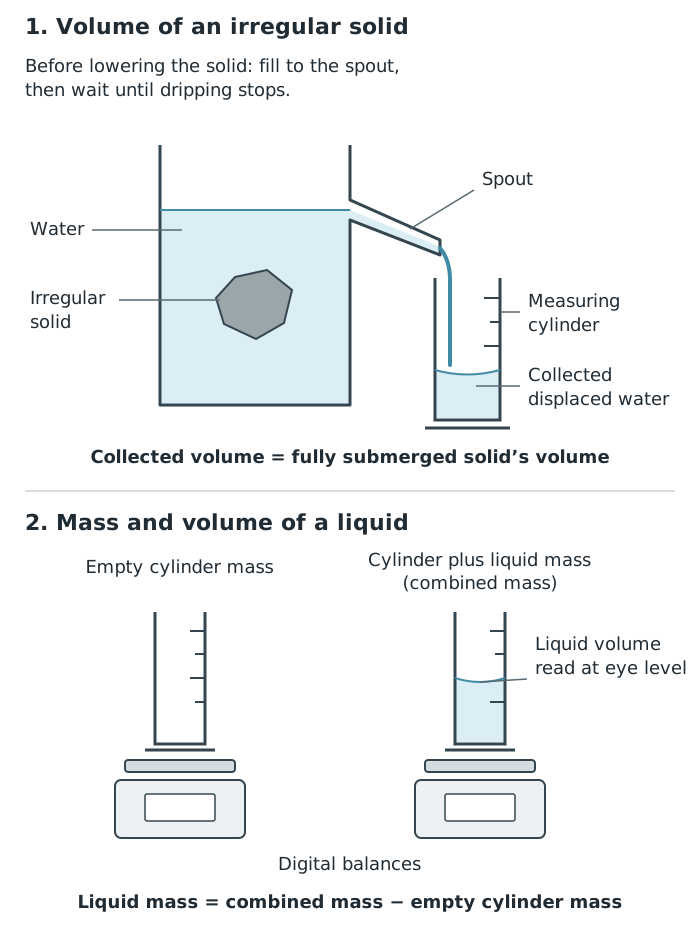
Displacement gives an irregular solid’s volume; subtracting the container’s mass gives the mass of a liquid.
A liquid needs a container, but the container’s mass must not be included in the liquid’s density calculation.
Repeat measurements to check their consistency. Keep the outside of the cylinder dry so that droplets do not add extra mass. In both liquid and displacement measurements, keep water away from the balance, clear up spills promptly and handle glassware and heavy objects carefully. Lower objects gently rather than dropping them into a cylinder.
During a change of state, mass is conserved if none of the substance escapes. For example, if 20 g of liquid evaporates, the gas produced also has a mass of 20 g. In an open container, some gas may leave, so the mass remaining in the container can decrease.
A fixed mass can occupy a different volume after a change. Gas particles are much farther apart than particles in a liquid, so the same mass usually occupies a much larger volume as a gas and has a much lower density.
The equation explains the connection: at constant mass, increasing volume decreases density. If the volume doubles, density halves; if the volume halves, density doubles. For a calculation involving a change, find the conserved mass using , then use that same mass in .
For an answer in kg/m³, convert mass to kilograms and volume to cubic metres before substituting.
A volume conversion is cubed: 1 cm³ = 10⁻⁶ m³, not 0.01 m³.
For a liquid, subtract the empty container’s mass. For displacement, use the displaced volume, not the total water volume.
If you measure a cylinder’s diameter, halve it before using V = πr²h.
It can see this note and what your specification asks for.
Answers are free with an account.
1 free note left this week
Get more free notesYour answer sets when this note comes back for review, or marks it complete.
Was this note helpful?
Log in to tell us whether it helped, or to report a problem.
Last updated
Density
The mass per unit volume of a material: . Its SI unit is kilograms per cubic metre (kg/m³).
Volume
The amount of space occupied by an object or substance, measured in cubic metres (m³) in SI units.
Displacement
The movement of liquid out of the space taken up by an immersed object. A fully submerged object displaces its own volume of liquid.
Conservation of mass
The principle that total mass remains unchanged during a change, provided no material enters or leaves the system.
Put your knowledge into practice — try past paper questions for Combined Science B
Density
The mass per unit volume of a material: . Its SI unit is kilograms per cubic metre (kg/m³).
Volume
The amount of space occupied by an object or substance, measured in cubic metres (m³) in SI units.
Displacement
The movement of liquid out of the space taken up by an immersed object. A fully submerged object displaces its own volume of liquid.
Conservation of mass
The principle that total mass remains unchanged during a change, provided no material enters or leaves the system.
Use density in kg/m³, mass in kg and volume in m³.
Repeat measurements, read water levels at eye level and avoid trapped air bubbles.
If no material enters or leaves, use the same mass before and after a change:
At constant mass: larger volume → lower density. Doubling volume halves density.