

Loading…
Loading…
Loading…
OCR GCSE Combined Science B · J260
OCR J260 · Properties and Risks of Nanoparticles Check the specification (PDF) (opens in a new tab)
A nanoparticle is a particle approximately 1–100 nanometres in size. At this scale, a material can behave differently from the same substance in bulk. Choosing a useful nanomaterial therefore involves more than naming its chemical composition: its size, exposed surface and arrangement of atoms also matter.
Nanoparticles have a very high surface area to volume ratio. A large proportion of their atoms are at the surface, where they can interact with surrounding substances. For a material that acts as a catalyst, this gives more surface available for reactions for a given amount of material. Nanoparticulate catalysts can therefore be effective in small quantities. This does not mean that every nanoparticle is a catalyst: the material must also have suitable chemical properties.
Their tiny size also allows nanoparticles to be incorporated into other materials to change their properties, or to penetrate biological tissues. That last possibility creates both opportunities for medicine and concerns about health.
Titanium dioxide nanoparticles in sunscreen block ultraviolet radiation while leaving much less visible white material on the skin. In contrast, bulk titanium dioxide is used as a white pigment in paint. The same chemical substance is useful for different purposes because its particle size affects its properties.
Silver nanoparticles on the fibres of medical clothing and surgical masks provide antibacterial properties while the fabric remains flexible. Here, incorporating nanoparticles gives an existing material an additional useful property.
Carbon provides another important set of examples. Carbon atoms can form sheets, cages and tubes. These different arrangements produce materials with different combinations of strength, conductivity and shape.
Graphene is a single layer of carbon atoms arranged in hexagonal rings, only one atom thick. Each carbon atom forms three strong covalent bonds to neighbouring carbon atoms. These bonds extend across the sheet, making graphene a giant covalent structure rather than a collection of small molecules.
The strong bonds give graphene very high tensile strength: it resists being pulled apart. Adding graphene to another material can help produce a strong, lightweight composite.
Each carbon atom has four outer electrons but uses only three in bonding. This leaves a delocalised electron that can move through the sheet and carry electrical charge. Graphene therefore conducts electricity even though it is not a metal.
Graphene is also extremely thin, flexible and almost transparent. Together with its electrical conductivity, these properties make it useful for electronic circuits, sensors and touchscreens. Its strength and its conductivity have different structural explanations: strong bonds explain strength; mobile electrons explain conductivity.
Fullerenes are hollow carbon molecules shaped as cages or tubes. Their atoms form rings, mainly hexagons, with other ring sizes occurring in some structures.
Buckminsterfullerene, , contains 60 carbon atoms arranged in a roughly spherical cage of pentagons and hexagons, rather like a football. Its hollow structure can be used to carry a drug, helping deliver it to a target area in the body. Its roughly spherical shape also allows molecules to roll past one another, making fullerenes useful as lubricants to reduce friction. The large exposed surface of some fullerenes also makes them useful in catalysis.
Carbon nanotubes are cylindrical fullerenes: long, narrow, hollow tubes with walls formed from a hexagonal network of bonded carbon atoms. They have a very high length-to-diameter ratio.
Strong covalent bonds give nanotubes high tensile strength, so they can reinforce composites without adding much mass. Delocalised electrons can move along conducting nanotubes, making them useful in very small electronic components. Nanotubes also conduct thermal energy well, helping transfer heat through a material.
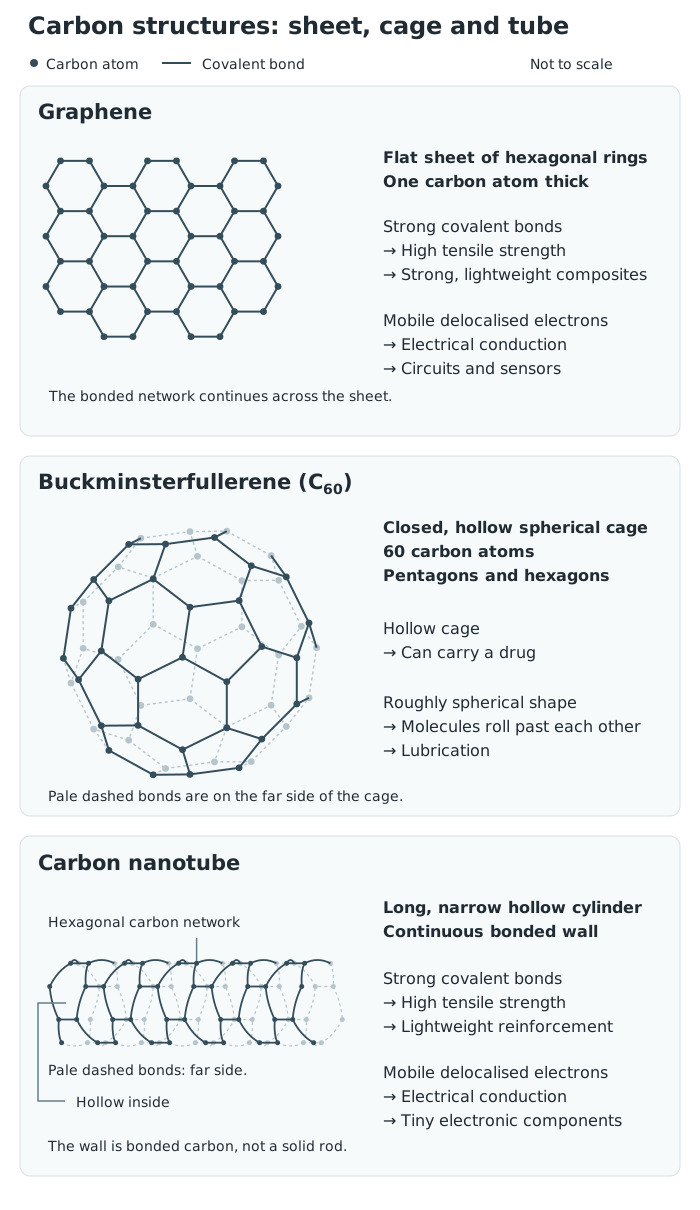
Carbon atoms arranged as a sheet, cage or hexagonal-network tube give materials different useful properties.
When recognising these structures, look at the overall shape as well as the rings. Graphene is a flat, single sheet; buckminsterfullerene is a closed cage; a nanotube is a hollow cylinder. Hexagonal rings alone do not identify graphene.
A hazard is something with the potential to cause harm; risk concerns how likely harm is under particular conditions of exposure. Nanoparticles are not one substance, so they should not all be treated as having the same risk.
Their small size can allow them to enter biological tissues. This is useful for drug delivery, but it also means that potentially harmful particles may reach tissues that larger particles would not. Some nanoparticles may not be easily removed from the body.
Their high surface area provides many opportunities to interact with surrounding substances. For a nanoparticle with harmful chemical activity, that large exposed surface could increase its effects on biological tissues. A property that improves performance in a product can therefore also increase concern about exposure.
For example, silver nanoparticles have useful antibacterial effects, but this benefit does not by itself establish that every form of exposure is harmless to people. Similarly, the ability of a fullerene drug carrier to enter tissues makes it important to investigate both where it delivers the medicine and what happens to the carrier afterwards.
A useful property can often be tested relatively quickly: researchers can measure whether a material blocks ultraviolet radiation, conducts electricity or slows bacterial growth. These results can demonstrate a possible application without establishing long-term safety.
Health effects may take years to appear. Nanoparticles have not been used widely for long enough to detect every possible long-term effect. Researchers also need to consider different materials, amounts and ways of entering the body. Evidence about one nanoparticle cannot automatically establish the safety of another.
This helps explain why there is more information about applications than about possible health effects. The uncertainty is a reason for careful testing, not proof that harm will occur.
A useful judgement considers what the material achieves, who is exposed, how much exposure occurs and how certain the safety evidence is.
For sunscreen, the benefit is protection from ultraviolet radiation. This must be weighed against any possible effects of exposure to the particular nanoparticles used. Rejecting the product simply because it contains nanoparticles would ignore its protective benefit; declaring it safe solely because it blocks ultraviolet radiation would ignore a separate safety question.
For silver-containing medical clothing, the antibacterial benefit may be valuable where preventing infection matters. The judgement should also consider exposure during use and whether nanoparticles remain incorporated in the material or become available for contact.
For a fullerene drug carrier, improved delivery could provide a substantial medical benefit. Direct entry into the body also makes investigation of toxicity, removal and long-term effects especially important. A serious medical need may justify accepting a carefully assessed risk that would not be worthwhile for a minor cosmetic benefit.
There is therefore no single answer for all nanomaterials. A justified conclusion should weigh the specific benefit against the likely exposure and the remaining uncertainty.
| Material | Structure | Property and use |
|---|---|---|
| Graphene |
Link structure → property → use. For example, strong covalent bonds give carbon nanotubes high tensile strength, so they can reinforce lightweight composites.
Graphene is one carbon layer, not several layers. A carbon nanotube is a hollow cylinder, not a solid rod.
Explain electrical conductivity using mobile delocalised electrons, not simply by saying that the material contains carbon.
In risk–benefit questions, discuss the particular material, purpose and exposure. Give a justified conclusion rather than claiming that all nanoparticles are safe or dangerous.
A lack of evidence of long-term harm is not proof of safety. Keep possible health effects distinct from established effects.
It can see this note and what your specification asks for.
Answers are free with an account.
1 free note left this week
Get more free notesYour answer sets when this note comes back for review, or marks it complete.
Was this note helpful?
Log in to tell us whether it helped, or to report a problem.
Last updated
Nanoparticle
A particle approximately 1–100 nanometres in size. Its properties may differ from those of the same material in bulk.
Graphene
A single layer of carbon atoms arranged in hexagonal rings, forming a giant covalent structure one atom thick.
Fullerene
A hollow carbon molecule shaped as a cage or tube, with its atoms arranged in rings.
Carbon nanotube
A cylindrical fullerene with carbon atoms bonded into a long, narrow, hollow tube.
Delocalised electron
An electron that is not confined to one atom or bond and can move through a structure.
Catalyst
A substance that increases the rate of a reaction without being used up.
Composite
A material made by combining two or more materials to obtain useful properties.
Tensile strength
A material’s ability to resist being pulled apart.
Put your knowledge into practice — try past paper questions for Combined Science B
Nanoparticle
A particle approximately 1–100 nanometres in size. Its properties may differ from those of the same material in bulk.
Graphene
A single layer of carbon atoms arranged in hexagonal rings, forming a giant covalent structure one atom thick.
Fullerene
A hollow carbon molecule shaped as a cage or tube, with its atoms arranged in rings.
Carbon nanotube
A cylindrical fullerene with carbon atoms bonded into a long, narrow, hollow tube.
Delocalised electron
An electron that is not confined to one atom or bond and can move through a structure.
Catalyst
A substance that increases the rate of a reaction without being used up.
Composite
A material made by combining two or more materials to obtain useful properties.
Tensile strength
A material’s ability to resist being pulled apart.
| One flat layer of hexagonal carbon rings |
| Strong covalent bonds → strong composites; delocalised electrons → conducting electronics |
| Buckminsterfullerene, | Hollow, roughly spherical cage | Hollow space → drug carrying; spherical shape → lubrication |
| Carbon nanotube | Long, narrow, hollow cylinder with a hexagonal carbon-network wall | Strong bonds → lightweight reinforcement; mobile electrons → electronics |
Weigh the specific benefit against possible harm, exposure and uncertainty. A substantial medical benefit may justify a risk that a minor cosmetic benefit would not.