

Loading…
Loading…
Loading…
OCR GCSE Combined Science B · J260
OCR J260 · Chemical Bonds and Bulk Properties Check the specification (PDF) (opens in a new tab)
A piece of metal can conduct electricity and be hammered into a new shape. A salt crystal can be hard but shatter when struck. These are bulk properties: properties of a large amount of material, produced by many particles interacting.
An individual atom is not malleable and does not have a melting point. Melting describes a change in the arrangement and movement of particles throughout a substance. Even materials made from the same element can have different properties if their atoms are joined and arranged differently: diamond and graphite are both carbon, but diamond is hard while graphite is soft.
To understand a material, connect three things: which particles it contains, what holds them together and how they are arranged. Then consider what happens when the material is heated, pushed, stretched or connected to an electrical circuit.
An ionic bond is the electrostatic attraction between oppositely charged ions. A covalent bond involves a shared pair of electrons between two atoms. Metallic bonding is the electrostatic attraction between positive metal ions and delocalised electrons.
These chemical bonds are strong. Intermolecular forces, by contrast, are attractions between separate molecules and are usually much weaker than the covalent bonds inside them. This distinction explains why two substances containing covalent bonds can have very different melting points.
A substance melts when its particles gain enough energy to move out of their fixed positions. The stronger the attractions that must be overcome, the more energy is needed and the higher the melting point tends to be. What matters is which attractions hold the overall structure together—not simply whether strong bonds exist somewhere within it.
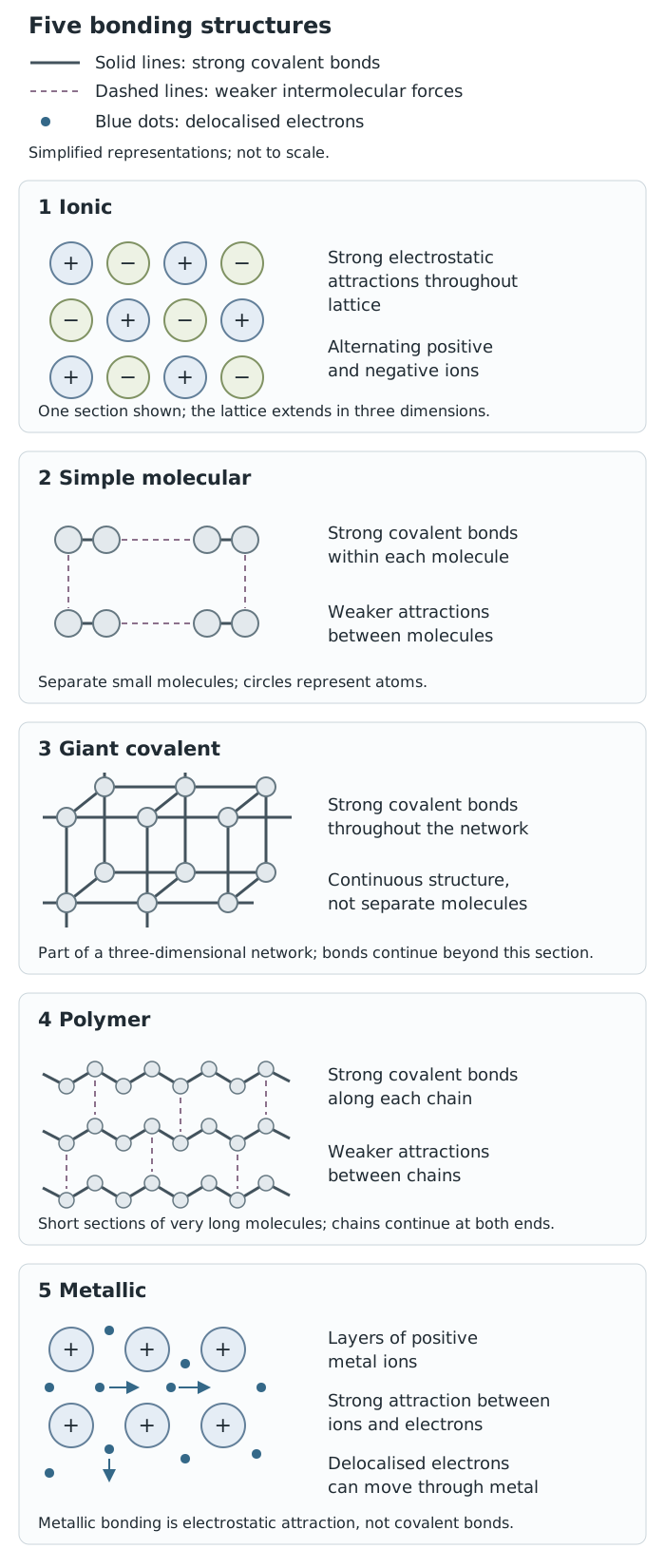
The location of strong bonds, weaker attractions and mobile charged particles helps explain each material’s bulk properties.
Sodium chloride consists of positive sodium ions and negative chloride ions in a regular, repeating three-dimensional ionic lattice. It does not consist of separate sodium chloride molecules. Strong electrostatic attractions act between oppositely charged ions throughout the lattice.
These attractions give ionic compounds generally high melting points: a large amount of energy is needed to overcome them. They also resist being pushed out of shape, so ionic crystals are typically hard.
However, hardness does not mean that a material cannot break. If a force shifts part of an ionic lattice, ions with the same charge can be brought alongside one another. They repel, and the crystal splits. This explains why ionic compounds are brittle, rather than easily reshaped by hammering.
Electrical conduction requires charged particles that are free to move. In solid sodium chloride, the ions have charge but are fixed in place, so the solid does not conduct. When it melts, the ions can move and carry charge. Sodium chloride solution also conducts because the dissolved ions can move through the water.
A simple molecular substance contains separate small molecules, such as oxygen, water or methane. The atoms within each molecule are held together by strong covalent bonds, but neighbouring molecules attract one another through weaker intermolecular forces.
During melting or boiling, molecules move apart without their internal covalent bonds breaking. Only the weaker intermolecular attractions need to be overcome, so simple molecular substances generally have low melting and boiling points compared with giant ionic or covalent structures.
Their solids are usually soft because relatively little force is needed to move molecules past one another. They do not normally conduct electricity: the molecules are uncharged overall, and there are no mobile ions or delocalised electrons to carry charge.
In a giant covalent structure, atoms are joined by strong covalent bonds in an extensive network, rather than forming separate small molecules. Diamond and silicon dioxide are examples.
To melt such a structure, many strong covalent bonds must be broken. This requires a large amount of energy, giving giant covalent substances very high melting points. A rigid three-dimensional network also resists changes in shape, so diamond and silicon dioxide are hard and cannot be readily reshaped.
Many giant covalent substances are brittle: when sufficient force is applied, bonds break and the structure cracks rather than allowing layers to slide into a new shape.
Most do not conduct electricity because they have no mobile charged particles. Graphite is an important exception: it has delocalised electrons that can carry charge. Its layered arrangement also makes it soft, showing why the label ‘giant covalent’ alone is not enough to predict every property.
A polymer consists of very long molecules. Strong covalent bonds join atoms along each chain, while weaker intermolecular forces attract neighbouring chains to one another.
The covalent bonds help the chains withstand stretching without breaking. However, the behaviour of the whole material also depends on how easily those chains can move past one another. If movement is relatively easy, the polymer can be flexible and easily reshaped. If the chains are held more firmly together, the material tends to be stiffer and harder.
For example, a poly(ethene) carrier bag can stretch because its chains can move relative to one another, while strong covalent bonds keep each chain intact. Many polymers soften when heated because increased particle movement allows the chains to slide more easily. This does not require the covalent bonds along the chains to break.
Long polymer molecules generally have stronger overall intermolecular attractions than small molecules, so more energy is needed to separate them. Polymer properties nevertheless vary: not every polymer is soft, flexible or easily melted. Most common polymers are poor electrical and thermal conductors, making them useful as insulating materials.
A metal has a giant structure of positive metal ions surrounded by delocalised electrons. These electrons are not attached to individual ions and can move through the structure. Strong electrostatic attractions between the ions and electrons hold the metal together.
Most metals have high melting points because substantial energy is needed to overcome these attractions. Metallic bonding also helps metals withstand forces without breaking.
Metals can usually be reshaped because layers of ions can slide past one another while the attraction to the delocalised electrons remains. Unlike a shifted ionic lattice, this does not bring alternating positive and negative ions into a repelling arrangement. Metals are therefore malleable and can also be drawn into wires: they are ductile.
In an alloy, atoms of different sizes disrupt the regular arrangement, making sliding more difficult. This generally makes an alloy harder and less easily reshaped than the pure metal.
The mobile electrons explain two further properties. They carry electrical charge, so metals conduct electricity. They also transfer energy through the structure, so metals conduct heat well.
A complete explanation follows a causal chain. For example: a metal contains delocalised electrons; these electrons can move through its structure; therefore they can carry electrical charge.
For melting point, identify the attractions that must be overcome. For hardness, strength, flexibility and reshaping, consider whether particles or chains can move without breaking the structure. For electrical conductivity, identify mobile charged particles. These connections explain the properties of the material as a whole, not properties of its individual atoms.
| Structure | What holds it together? | Key consequences |
|---|---|---|
| Ionic | Strong attractions between oppositely charged ions in a giant lattice | Usually high melting point; hard and brittle; conducts when molten or dissolved, not solid |
| Simple molecular | Strong covalent bonds within molecules; weaker intermolecular forces between them | Usually low melting point; solids often soft; normally no electrical conduction |
Link each property to the structure: identify the particles, describe the attractions and explain what can move or what must be overcome.
For conductivity, name the moving charged particles: ions in molten or dissolved ionic compounds; delocalised electrons in metals or graphite.
When a simple molecular substance melts, intermolecular forces are overcome—not the covalent bonds within its molecules.
Do not describe all covalent substances as having low melting points: distinguish simple molecules from giant covalent structures.
Hardness is not the same as strength or toughness. A material can resist scratching but still be brittle.
It can see this note and what your specification asks for.
Answers are free with an account.
1 free note left this week
Get more free notesYour answer sets when this note comes back for review, or marks it complete.
Was this note helpful?
Log in to tell us whether it helped, or to report a problem.
Last updated
Bulk property
A property of a large amount of material, arising from its particles, bonding and overall structure rather than belonging to an individual atom.
Ionic bond
An electrostatic attraction between oppositely charged ions.
Covalent bond
A bond in which two atoms share a pair of electrons.
Intermolecular force
An attraction between molecules, usually weaker than the covalent bonds within them.
Metallic bond
A strong electrostatic attraction between positive metal ions and delocalised electrons.
Delocalised electron
An electron that is not attached to one particular atom or ion and can move through a structure.
Lattice
A regular, repeating three-dimensional arrangement of particles.
Polymer
A substance made of very long molecules containing many repeating units joined by covalent bonds.
Hardness
Resistance to scratching or indentation.
Strength
The ability to withstand a force without breaking, for example when stretched or compressed.
Brittleness
The tendency to crack or break rather than change shape when a force is applied.
Flexibility
The ability to bend easily; a stiff material resists bending.
Malleability
The ability to be hammered or pressed into a new shape without breaking.
Put your knowledge into practice — try past paper questions for Combined Science B
Bulk property
A property of a large amount of material, arising from its particles, bonding and overall structure rather than belonging to an individual atom.
Ionic bond
An electrostatic attraction between oppositely charged ions.
Covalent bond
A bond in which two atoms share a pair of electrons.
Intermolecular force
An attraction between molecules, usually weaker than the covalent bonds within them.
Metallic bond
A strong electrostatic attraction between positive metal ions and delocalised electrons.
Delocalised electron
An electron that is not attached to one particular atom or ion and can move through a structure.
Lattice
A regular, repeating three-dimensional arrangement of particles.
Polymer
A substance made of very long molecules containing many repeating units joined by covalent bonds.
Hardness
Resistance to scratching or indentation.
Strength
The ability to withstand a force without breaking, for example when stretched or compressed.
Brittleness
The tendency to crack or break rather than change shape when a force is applied.
Flexibility
The ability to bend easily; a stiff material resists bending.
Malleability
The ability to be hammered or pressed into a new shape without breaking.
| Giant covalent | Strong covalent bonds throughout an extensive network | Very high melting point; rigid networks are hard and often brittle; usually no electrical conduction, but graphite conducts |
| Polymer | Strong covalent bonds along long chains; weaker attractions between chains | Chain movement controls flexibility and reshaping; many soften on heating; usually electrical and thermal insulators |
| Metallic | Strong attraction between positive metal ions and delocalised electrons | Usually high melting point; malleable and ductile; good electrical and thermal conduction |
Bulk properties arise from the whole structure, not individual atoms. Bond type and arrangement both matter.
Hardness means resistance to scratching or indentation; strength means resistance to breaking under force. A hard material can still be brittle.
Melting a simple molecular substance overcomes intermolecular forces, not its internal covalent bonds.