

Loading…
Loading…
Loading…
OCR GCSE Combined Science B · J260
OCR J260 · Acid Reactions and pH Check the specification (PDF) (opens in a new tab)
Acids can be used to make salts: ionic compounds containing positive metal ions, or ammonium ions, and negative ions derived from an acid. Choosing the reactants determines which salt is made. The type of substance reacting with the acid determines the other products.
For metal salts, the first part of the name comes from the metal. The second part comes from the acid:
| Acid | Acid formula | Salt name ending |
|---|---|---|
| Hydrochloric acid | Chloride | |
| Sulfuric acid | Sulfate | |
| Nitric acid | Nitrate |
For example, zinc reacting with sulfuric acid produces zinc sulfate. Magnesium carbonate reacting with nitric acid produces magnesium nitrate. Naming the salt is only the first step: we must also identify any gas or water formed.
Some metals react with dilute hydrochloric acid or dilute sulfuric acid to produce a salt and hydrogen:
metal + acid → salt + hydrogen
Metals above hydrogen in the reactivity series, such as magnesium, zinc and iron, can undergo these reactions. Copper is below hydrogen and does not react with these dilute acids in this way. More reactive metals generally react more vigorously under the same conditions. Sodium and potassium are too reactive for this salt-preparation method because their reactions with acids are dangerous.
Zinc reacting with dilute sulfuric acid gives zinc sulfate and hydrogen:
Magnesium reacting with dilute hydrochloric acid gives magnesium chloride and hydrogen:
The hydrogen escapes as bubbles, while the metal is gradually used up. The coefficient 2 before means that two units of hydrochloric acid are needed for each magnesium atom. It balances both the hydrogen and chlorine atoms.
Metal carbonates react with acids to form a salt, carbon dioxide and water:
metal carbonate + acid → salt + carbon dioxide + water
The carbon dioxide causes effervescence, meaning bubbling as gas escapes. This distinguishes a carbonate reaction from the reaction of an acid with a metal oxide or hydroxide, which produces salt and water without a gas.
For calcium carbonate and hydrochloric acid, the metal supplies the name calcium and the acid supplies chloride:
Magnesium carbonate and nitric acid instead produce magnesium nitrate:
These equations conserve atoms: there is the same number of each type of atom on both sides. The products differ from those of metal–acid reactions because the reactant is a carbonate compound, not the metal itself.
An ion is an atom or group of atoms with an electrical charge. An ionic compound contains positive and negative ions in proportions that make its overall charge zero. Its formula gives the simplest whole-number ratio of those ions.
Useful ions for these reactions include:
| Positive ion | Formula | Negative ion | Formula |
|---|---|---|---|
| Sodium | Chloride | ||
| Magnesium |
To deduce a formula, write the ions and their charges, then find the smallest numbers of each ion that give equal total positive and negative charges.
Brackets keep a compound ion together when more than one is needed. For example, ammonium sulfate is : two ammonium ions balance one sulfate ion. The final compound formula has no overall charge written on it.
Making a salt solution is not the same as obtaining pure, dry salt crystals. A useful preparation method is to react an acid with an insoluble solid, add enough solid to use up all the acid, and then remove the excess solid by filtration.
Copper(II) sulfate can be prepared from copper(II) oxide and dilute sulfuric acid:
copper(II) oxide + sulfuric acid → copper(II) sulfate + water
Copper(II) oxide is a black insoluble solid. As it reacts, a blue copper(II) sulfate solution forms. The state symbol means dissolved in water.
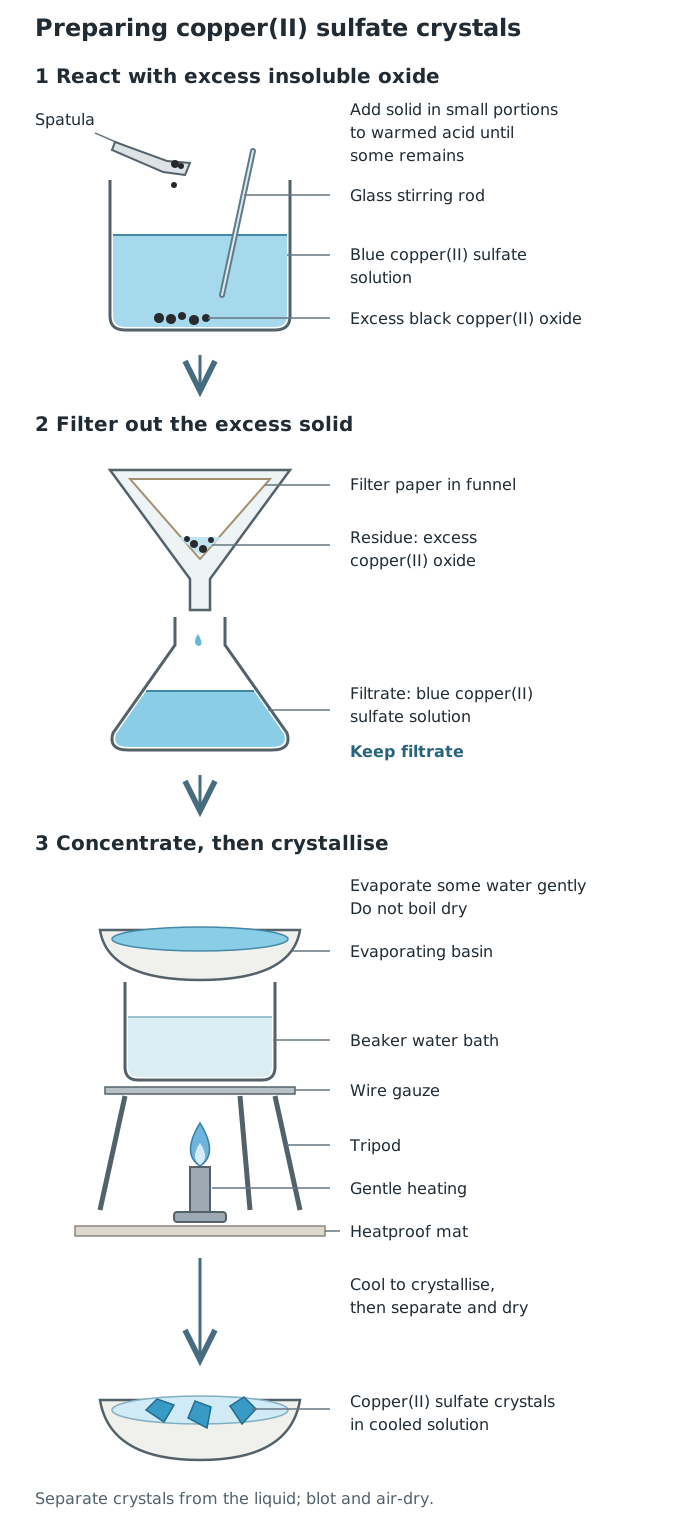
Excess insoluble oxide is filtered out before water is evaporated from the salt solution. Cooling then produces crystals.
Wear eye protection. Avoid contact with the acid and copper compounds, and handle hot equipment carefully. Use gentle heating to reduce the risk of splashing; dispose of copper-containing materials as instructed by the teacher.
The excess copper(II) oxide stays on the paper as the residue. The blue copper(II) sulfate solution passes through as the filtrate. Keep this filtrate: dissolved salt passes through filter paper, so filtration cannot remove it from the water.
Transfer the filtrate to an evaporating basin. Heat it gently over a water bath to evaporate some of the water. Evaporation removes solvent and makes the salt solution more concentrated.
Stop heating when the solution is close to saturation, with crystals beginning to appear at the edge. Do not boil it dry: strong heating can cause spitting and damage the crystals.
Leave the solution to cool. As it cools, less copper(II) sulfate can remain dissolved, so solid crystals form. Separate the crystals from the remaining liquid by filtration, then gently blot them with filter paper and leave them to air-dry.
Each stage has a different job: reaction makes the salt, the first filtration removes excess reactant, evaporation removes some water, crystallisation forms solid salt, and drying removes liquid from the crystals. This excess-solid method works because the unused reactant is insoluble and can be filtered out. A soluble alkali cannot be removed this way; an accurately measured acid–alkali reaction requires the titration approach.
| Acid | Salt ending |
|---|---|
| Hydrochloric, | Chloride |
| Sulfuric, |
Predict every product: metals give hydrogen; carbonates give carbon dioxide and water.
Write correct compound formulae before balancing an equation. Balance using numbers in front of formulae, never by changing their subscripts.
Use brackets when more than one compound ion is needed: magnesium nitrate is , not .
In soluble-salt preparation, keep the filtrate after removing excess reactant. The salt is dissolved in it.
Evaporate only some water, then allow crystals to form. Do not strongly heat the salt solution to dryness.
It can see this note and what your specification asks for.
Answers are free with an account.
1 free note left this week
Get more free notesYour answer sets when this note comes back for review, or marks it complete.
Was this note helpful?
Log in to tell us whether it helped, or to report a problem.
Last updated
Salt
An ionic compound formed when the hydrogen ions of an acid are replaced by metal ions or ammonium ions.
Ion
An atom or group of atoms with an electrical charge.
Effervescence
Bubbling caused by a gas being produced and escaping from a liquid.
Filtration
A separation method in which filter paper retains an insoluble solid while a liquid and its dissolved substances pass through.
Residue
The solid retained by the filter paper during filtration.
Filtrate
The liquid, including any dissolved substances, that passes through filter paper.
Crystallisation
The formation of solid crystals from a solution, for example as a concentrated salt solution cools.
Saturated solution
A solution containing as much dissolved solute as it can hold at a particular temperature.
Put your knowledge into practice — try past paper questions for Combined Science B
Salt
An ionic compound formed when the hydrogen ions of an acid are replaced by metal ions or ammonium ions.
Ion
An atom or group of atoms with an electrical charge.
Effervescence
Bubbling caused by a gas being produced and escaping from a liquid.
Filtration
A separation method in which filter paper retains an insoluble solid while a liquid and its dissolved substances pass through.
Residue
The solid retained by the filter paper during filtration.
Filtrate
The liquid, including any dissolved substances, that passes through filter paper.
Crystallisation
The formation of solid crystals from a solution, for example as a concentrated salt solution cools.
Saturated solution
A solution containing as much dissolved solute as it can hold at a particular temperature.
| Nitrate |
| Calcium | Sulfate |
| Copper(II) | Carbonate |
| Aluminium | Oxide |
| Ammonium | Hydroxide |
| Sulfate |
| Nitric, | Nitrate |
The metal supplies the first part of the salt name.
Choose the smallest whole-number ratio of ions giving zero total charge. Use brackets around repeated compound ions.
Write correct formulae first; then balance atom numbers using coefficients.
Warm acid → add insoluble solid in excess → filter → gently evaporate some water → cool to crystallise → separate and dry crystals.