

Loading…
Loading…
Loading…
OCR GCSE Combined Science B · J260
OCR J260 · Concentration Calculations and Titrations Check the specification (PDF) (opens in a new tab)
An acid forms hydrogen ions, , when it dissolves in water. An alkali is a soluble base: its aqueous solution contains hydroxide ions, . ‘Aqueous’ simply means dissolved in water.
Common laboratory acids are hydrochloric acid, ; nitric acid, ; and sulfuric acid, . Common alkalis include sodium hydroxide, ; potassium hydroxide, ; and calcium hydroxide, .
When an acid reacts with an alkali, neutralisation produces a salt and water:
For example, hydrochloric acid reacts with sodium hydroxide to produce sodium chloride and water:
The same essential change happens whichever of these acids and alkalis is used: hydrogen ions react with hydroxide ions to form water. This gives the general ionic equation:
The other ions remain in solution and make up the dissolved salt. In the hydrochloric acid–sodium hydroxide example, these are sodium and chloride ions.
A titration measures the volume of one solution needed to react exactly with a measured volume of another. If one solution has a known concentration, the reacting volumes and balanced equation can be used to determine the concentration of the other. This makes titration a useful form of quantitative chemical analysis.
Both acid and alkali solutions can be colourless, so their appearance alone does not show when enough acid has been added. A suitable gives a sharp colour change near the point when is just reached. The observed colour change is called the .
In the practical described here, hydrochloric acid is added to sodium hydroxide containing a few drops of phenolphthalein. Phenolphthalein is pink in alkaline solution and colourless in acidic solution. The endpoint is reached when the pink colour just disappears and does not return after swirling.
Use a 25 cm³ volumetric pipette with a pipette filler, a 50 cm³ burette held vertically in a clamp and stand, a conical flask, a white tile, a funnel and a beaker. The pipette measures a fixed volume accurately; the burette measures the variable volume delivered and its tap allows controlled, dropwise addition.
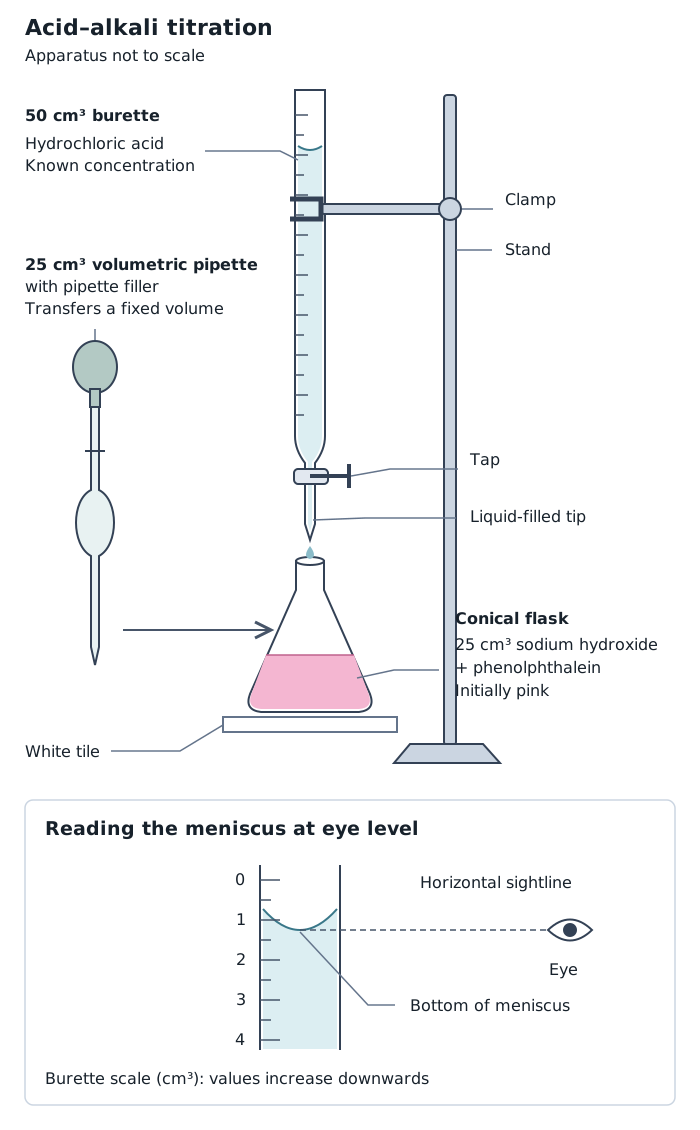
The pipette measures a fixed volume of alkali; the burette controls and measures the acid added. Read the bottom of the meniscus at eye level.
Before starting, wear safety goggles. Avoid acid and alkali splashes on skin or in eyes, and immediately wash skin splashes with plenty of water. Fill the burette below eye level to reduce the risk of splashing your face. Always use a pipette filler, never your mouth. Handle glassware carefully and report broken glass to the teacher rather than picking it up by hand.
Rinse the pipette with a little sodium hydroxide solution and the burette with a little hydrochloric acid before filling them. This prevents residual water from diluting the solutions being measured. The conical flask can be rinsed with deionised water: any water left there does not change the amount of sodium hydroxide transferred by the pipette.
First carry out a rough titration. Add acid while swirling the flask, stopping when the pink colour disappears. Record the final burette reading. The volume delivered is the titre:
The rough titre locates the approximate endpoint, allowing later titrations to be performed more carefully near it.
Rinse the flask with deionised water and prepare a fresh 25 cm³ portion of sodium hydroxide with a few drops of indicator. Record a new initial burette reading. Add acid fairly quickly at first, but slow down before reaching the rough titre volume. Near the endpoint, add acid one drop at a time, swirling after each addition.
Swirling ensures that the added acid reacts with the alkali throughout the flask rather than producing a local colour change. The white tile makes the disappearance of the pink colour easier to judge. Stop at the first lasting disappearance of pink and record the final reading. Continuing to add acid would overshoot the endpoint and give a titre that is too large.
Repeat with fresh portions until accurate titres agree closely. In this practical, a useful concordance target is agreement within 0.10 cm³. Calculate a mean using only the concordant accurate titres, excluding the rough result.
Record initial readings, final readings and calculated titres separately, with units in the headings. For example, suppose a student obtains the following readings, all in cm³:
| Measurement | Rough | Titration 1 | Titration 2 | Titration 3 |
|---|---|---|---|---|
| Initial burette reading | 0.00 | 0.20 | 0.10 | 0.30 |
| Final burette reading | 24.00 | 23.30 | 23.25 | 24.10 |
| Titre | 24.00 | 23.10 | 23.15 | 23.80 |
Titrations 1 and 2 differ by only 0.05 cm³, so they meet the chosen concordance target. Titration 3 does not agree with them. It should be investigated and another careful titration performed; its larger value could result from overshooting, but the numbers alone do not prove the cause. The rough result is not included in the mean.
Precision concerns how closely repeated titres agree. Repeatability means the same person can obtain similar results with the same method and equipment. Concordant titres support both, and further agreeing results give greater confidence that the agreement is not accidental.
Accuracy concerns closeness to the true value. Closely agreeing titres can still all be wrong: repeatedly overshooting the endpoint or consistently misreading the meniscus can affect every result. Repeating the experiment does not automatically remove such systematic errors.
A valid titration must measure the volume needed to neutralise the intended amount of alkali. A suitable indicator, an accurately measured fresh portion, thorough mixing and an appropriate stopping point all help achieve this. When evaluating results, consider both the agreement of the data and whether the method could have biased them.
Explain the reason for each practical step: swirling mixes the reactants; a white tile makes the colour change easier to see; dropwise addition reduces overshooting.
A titre is the final burette reading minus the initial reading. The initial reading does not have to be zero.
Exclude the rough titre and use only concordant accurate titres when calculating a mean.
Close agreement shows precision and repeatability, not necessarily accuracy: the same error could affect every titration.
Universal indicator is unsuitable for a precise titration endpoint because it changes through several colours rather than giving a sharp colour change.
It can see this note and what your specification asks for.
Answers are free with an account.
1 free note left this week
Get more free notesYour answer sets when this note comes back for review, or marks it complete.
Was this note helpful?
Log in to tell us whether it helped, or to report a problem.
Last updated
Acid
A substance that forms hydrogen ions, , when it dissolves in water.
Alkali
A soluble base whose aqueous solution contains hydroxide ions, .
Neutralisation
The reaction of an acid with a base. An acid reacting with an alkali produces a salt and water.
Titration
A method of measuring the volume of one solution needed to react exactly with a measured volume of another solution.
Indicator
A substance that changes colour depending on the pH of a solution.
Endpoint
The point in a titration at which the indicator changes colour, signalling when to stop adding solution.
Titre
The volume delivered from a burette during a titration, calculated as final reading minus initial reading.
Concordant titre
Titres that agree closely within a chosen tolerance.
Accuracy
How close a measurement is to the true value.
Precision
How closely repeated measurements agree with one another.
Repeatability
The ability of the same person to obtain similar results using the same method and equipment.
Validity
The extent to which a method measures what it is intended to measure.
Put your knowledge into practice — try past paper questions for Combined Science B
Acid
A substance that forms hydrogen ions, , when it dissolves in water.
Alkali
A soluble base whose aqueous solution contains hydroxide ions, .
Neutralisation
The reaction of an acid with a base. An acid reacting with an alkali produces a salt and water.
Titration
A method of measuring the volume of one solution needed to react exactly with a measured volume of another solution.
Indicator
A substance that changes colour depending on the pH of a solution.
Endpoint
The point in a titration at which the indicator changes colour, signalling when to stop adding solution.
Titre
The volume delivered from a burette during a titration, calculated as final reading minus initial reading.
Concordant titre
Titres that agree closely within a chosen tolerance.
Accuracy
How close a measurement is to the true value.
Precision
How closely repeated measurements agree with one another.
Repeatability
The ability of the same person to obtain similar results using the same method and equipment.
Validity
The extent to which a method measures what it is intended to measure.
Pipette a fixed volume of alkali into a conical flask → add a few drops of suitable indicator → record the initial acid burette reading → titrate while swirling → stop at the endpoint → record the final reading.