

Loading…
Loading…
Loading…
OCR GCSE Combined Science B · J260
OCR J260 · Acid Reactions and pH Check the specification (PDF) (opens in a new tab)
An aqueous solution is a solution in which water is the solvent. Acids produce hydrogen ions, , in aqueous solution. Alkalis are soluble bases and produce hydroxide ions, , in aqueous solution.
The pH scale measures how acidic or alkaline a solution is. The scale normally used at GCSE runs from 0 to 14:
For example, a solution at pH 2 is more acidic than one at pH 5. A solution at pH 12 is more alkaline than one at pH 9. pH describes the solution, rather than simply naming the substance dissolved in it.
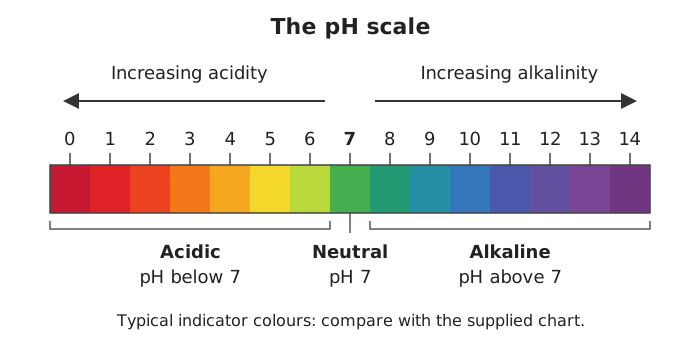
Universal indicator gives an approximate pH: use the colour chart supplied with the indicator.
Universal indicator is a mixture of indicators that gives different colours at different pH values. It is typically red in very acidic solutions, orange or yellow in less acidic solutions, green at neutral pH, and blue or purple in alkaline solutions.
To use universal indicator solution, place a small sample of the liquid in a clean test tube or spotting-tile well. Add a few drops of indicator, mix and compare the colour with the supplied pH chart, preferably against a white background. The chart gives an estimate of pH. Universal indicator paper can also be used: transfer a drop of the sample onto the paper with a clean glass rod and compare the developed colour with its chart.
A pH meter uses a probe to give a numerical reading, avoiding the need to judge a colour. If necessary, calibrate it using a buffer solution of known pH. Rinse the probe with distilled water, place its sensing end in the sample and record the reading once it has stabilised. Rinse the probe between samples so that one solution does not contaminate the next.
Wear eye protection when handling acids and alkalis, use small samples and avoid skin contact. Neither indicator testing nor meter testing requires heating or tasting a sample.
Concentration describes the amount of acid in a given volume of solution. A dilute acid contains relatively little acid in that volume; a concentrated acid contains relatively much more.
The volume matters. A large bottle of dilute acid may contain more acid in total than a small bottle of concentrated acid. To compare concentrations, compare the amounts of acid in equal volumes of solution.
Adding water spreads the same amount of acid through a larger volume, so the solution becomes more dilute. This changes its concentration, but does not change the identity of the acid.
Ionisation is the formation of ions. When an acid ionises in water, it releases hydrogen ions.
A strong acid is completely ionised in aqueous solution. Hydrochloric, nitric and sulfuric acids are the common GCSE examples. For hydrochloric acid, the ionisation can be represented as:
Here, means dissolved in water.
A weak acid is only partially ionised: only some of its molecules release hydrogen ions, while others remain as acid molecules. Ethanoic acid, found in vinegar, is a weak acid. Citric acid and carbonic acid are further examples.
Strength and concentration therefore answer different questions. Concentration asks how much acid is present per unit volume; strength asks how fully it ionises. Hydrochloric acid can be dilute and still be strong. Ethanoic acid can be concentrated and still be weak. Diluting a strong acid does not turn it into a weak acid.
Compare hydrochloric acid and ethanoic acid at the same acid concentration. Hydrochloric acid is completely ionised, whereas ethanoic acid is only partially ionised. The hydrochloric acid therefore has a higher hydrogen ion concentration and a lower pH.
Hydrogen ions also take part in reactions with suitable metals and carbonates. Under otherwise identical conditions, the strong acid generally reacts faster because more hydrogen ions are available to react.
For example, equal pieces of magnesium ribbon fizz more vigorously initially in hydrochloric acid than in ethanoic acid of the same concentration. The gas is hydrogen. With equal pieces of calcium carbonate, the hydrochloric acid produces carbon dioxide bubbles faster. These comparisons concern reaction rate, not a rule that strong acids must always produce more gas overall.
A pH reading alone does not identify whether an acid is strong or weak: hydrogen ion concentration depends on both the acid's concentration and its degree of ionisation.
pH does not change in direct proportion to hydrogen ion concentration. Instead, each decrease of one pH unit means a tenfold increase in hydrogen ion concentration:
A solution at pH 3 has ten times the hydrogen ion concentration of a solution at pH 4. A solution at pH 2 has times the hydrogen ion concentration of a solution at pH 4.
The relationship also works backwards: a tenfold decrease in hydrogen ion concentration raises pH by one. Thus, a hundredfold decrease raises pH by two. Apply this rule to changes in hydrogen ion concentration, rather than assuming it describes every change in the total concentration of any acid.
Neutral does not mean that hydrogen ions and hydroxide ions are absent. Both are present, but their concentrations are equal. This corresponds to pH 7 under the usual school conditions.
An acidic solution has a higher concentration of hydrogen ions than hydroxide ions, and its pH is below 7. An alkaline solution has a higher concentration of hydroxide ions than hydrogen ions, and its pH is above 7.
Alkaline solutions still contain hydrogen ions, but at a lower concentration than a neutral solution. Increasing hydrogen ion concentration lowers pH; decreasing it raises pH. This connects the whole scale, from acidic through neutral to alkaline.
Define acid strength using degree of ionisation, not simply the number of hydrogen ions.
Define concentration as the amount of acid in a given volume of solution, not the total amount in the container.
When comparing strong and weak acids, state that their concentrations and other reaction conditions are the same.
A lower pH means a higher hydrogen ion concentration. Each whole-number pH step represents a factor of ten, not an equal change in concentration.
Universal indicator estimates pH; a pH meter gives a numerical reading. Compare indicator colours with the chart supplied.
It can see this note and what your specification asks for.
Answers are free with an account.
1 free note left this week
Get more free notesYour answer sets when this note comes back for review, or marks it complete.
Was this note helpful?
Log in to tell us whether it helped, or to report a problem.
Last updated
pH
A measure of the acidity or alkalinity of a solution, related to its hydrogen ion concentration.
Acid
A substance that produces hydrogen ions, , in aqueous solution.
Alkali
A soluble base that produces hydroxide ions, , in aqueous solution.
Universal indicator
A mixture of indicators that changes colour across a range of pH values, allowing pH to be estimated using a colour chart.
pH meter
An instrument with a probe that measures the pH of a solution and displays a numerical reading.
Concentration
The amount of a substance in a given volume of solution.
Dilute acid
An acid solution containing a relatively small amount of acid in a given volume of solution.
Concentrated acid
An acid solution containing a relatively large amount of acid in a given volume of solution.
Ionisation
The formation of ions. In an acid solution, ionisation releases hydrogen ions.
Strong acid
An acid that is completely ionised in aqueous solution.
Weak acid
An acid that is only partially ionised in aqueous solution.
Neutrality
The condition in which hydrogen ions and hydroxide ions have equal concentrations. In the usual school pH scale, a neutral solution has pH 7.
Put your knowledge into practice — try past paper questions for Combined Science B
pH
A measure of the acidity or alkalinity of a solution, related to its hydrogen ion concentration.
Acid
A substance that produces hydrogen ions, , in aqueous solution.
Alkali
A soluble base that produces hydroxide ions, , in aqueous solution.
Universal indicator
A mixture of indicators that changes colour across a range of pH values, allowing pH to be estimated using a colour chart.
pH meter
An instrument with a probe that measures the pH of a solution and displays a numerical reading.
Concentration
The amount of a substance in a given volume of solution.
Dilute acid
An acid solution containing a relatively small amount of acid in a given volume of solution.
Concentrated acid
An acid solution containing a relatively large amount of acid in a given volume of solution.
Ionisation
The formation of ions. In an acid solution, ionisation releases hydrogen ions.
Strong acid
An acid that is completely ionised in aqueous solution.
Weak acid
An acid that is only partially ionised in aqueous solution.
Neutrality
The condition in which hydrogen ions and hydroxide ions have equal concentrations. In the usual school pH scale, a neutral solution has pH 7.