

Loading…
Loading…
Loading…
OCR GCSE Combined Science B · J260
OCR J260 · Transport Systems and Exchange Surfaces Check the specification (PDF) (opens in a new tab)
Every living cell carries out chemical reactions. To keep these reactions going, the body must bring useful substances to cells and remove waste products before they build up.
| Substance | Why it must be transported |
|---|---|
| Oxygen | Enters the body through the lungs and is delivered to cells for aerobic respiration, which releases energy. |
| Dissolved food molecules | Digestion produces small molecules, such as glucose and amino acids, which are absorbed in the small intestine. Cells use glucose in respiration and amino acids to make proteins. |
| Water | Enters through food and drink. It is a solvent: many substances dissolve in it, allowing them to be transported and take part in reactions in cells. |
| Carbon dioxide | Produced during aerobic respiration. It moves from cells into the blood, is carried to the lungs and leaves in exhaled air. |
| Urea | Formed in the liver when excess amino acids are broken down. It is carried in the blood to the kidneys and removed from the body in urine. |
Water therefore helps with both supply and removal. Dissolved food molecules can travel in the blood, while dissolved urea can be removed in urine.
An animal cell is surrounded by a partially permeable membrane. This means that some substances can cross it while others are restricted. The membrane is not simply an open boundary: its properties and transport proteins control what enters and leaves.
Substances cross cell membranes by diffusion, osmosis and active transport. These processes differ in what moves, the direction of movement and whether energy is required.
Particles move randomly. If a substance is more concentrated on one side of a membrane than the other, and it can cross the membrane, more particles move from the concentrated side to the less concentrated side than in the opposite direction. This produces net movement down a concentration gradient. Diffusion does not require energy supplied by respiration.
For example, a respiring cell uses oxygen, keeping its oxygen concentration relatively low. Oxygen can therefore diffuse into it from the surrounding fluid. The cell produces carbon dioxide, so carbon dioxide can diffuse out towards a region where its concentration is lower.
Particles still move in both directions. When concentrations become equal, there is no net movement, rather than no movement at all.
Osmosis is the net movement of water molecules through a partially permeable membrane from a more dilute solution to a more concentrated solution. A dilute solution contains less dissolved solute and has a higher concentration of water than a concentrated solution.
Imagine an animal cell placed in a concentrated sugar solution. If the solution outside is more concentrated than the cell contents, water leaves the cell by osmosis and the cell shrinks. In distilled water, water enters the cell by osmosis. The cell swells and may burst because an animal cell has no supporting cell wall.
The membrane is essential to this process: water can cross while the relevant dissolved solutes are restricted.
Sometimes a cell must take in a substance even when its concentration is already higher inside the cell than outside. Diffusion cannot produce net movement in that direction.
Active transport moves substances across a membrane from a lower concentration to a higher concentration, against their concentration gradient. Carrier proteins embedded in the membrane carry out this movement, using energy supplied by respiration. Unlike diffusion and osmosis, active transport therefore requires an energy supply from the cell.
For example, active transport allows glucose to be absorbed from the small intestine into the bloodstream even when its concentration in the intestine is lower than in the blood. This allows useful food molecules to continue being absorbed when diffusion alone would not bring them in.
A small, single-celled organism has a large surface area compared with its volume. Its membrane provides enough area for exchange, and substances have only short distances to travel within the cell.
As an organism becomes larger, its volume increases faster than its surface area. Its surface area:volume ratio decreases. There is less external surface available for each unit of living tissue that needs oxygen and nutrients and produces waste.
Many cells in a multicellular organism are also far from the outside surface. Diffusion alone is too slow over these long distances to supply them adequately.
Cubes provide a simple model for comparing size. A cube has six square faces. For a side length :
Calculate these separately, then write surface area:volume and simplify both sides by the same factor.
For a cube with sides of 1 cm, the surface area is and the volume is . Its ratio is .
For a cube with sides of 2 cm, the surface area is and the volume is . Its ratio is , which simplifies to .
Doubling the side length makes the surface area four times larger but the volume eight times larger. The larger cube has more total surface area, yet only half as much surface area per unit volume. Real organisms are not cubes, but the model demonstrates the problem caused by increasing size.
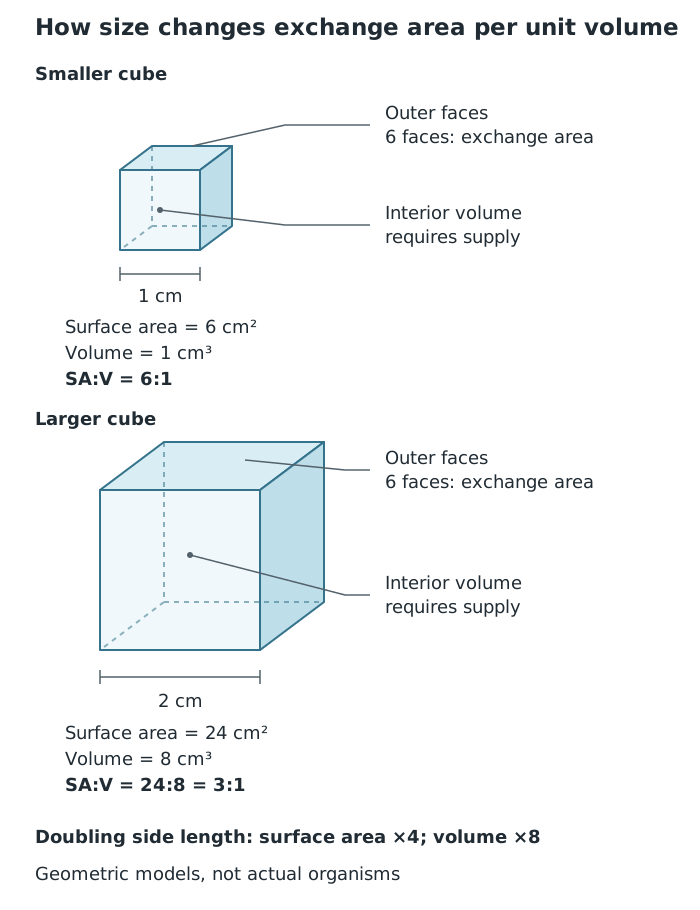
As size increases, volume grows faster than surface area, leaving less exchange area per unit volume.
Humans overcome these limitations with specialised exchange surfaces and a circulatory transport system.
The lungs contain many tiny air sacs called alveoli, providing a large surface area for oxygen to enter and carbon dioxide to leave. The small intestine has finger-like projections called villi, increasing the area available for absorbing digested food molecules. These surfaces increase the area for exchange without requiring a much larger body.
Thin barriers give substances a short diffusion distance. A good blood supply carries absorbed substances away, helping maintain concentration gradients. Breathing also maintains gradients at the lungs by bringing in oxygen and removing carbon dioxide. Moist gas-exchange surfaces allow gases to dissolve before crossing.
The blood then carries substances between exchange surfaces and tissues over long distances. Exchange across membranes occurs locally; blood flow provides transport around the body. Together, these processes supply internal cells and carry their wastes towards organs that remove them.
| Process | Net direction | Energy from respiration? |
|---|---|---|
| Diffusion |
For osmosis, state that water moves through a partially permeable membrane from a more dilute solution to a more concentrated solution.
Compare concentrations of the substance being transported: diffusion moves it down its concentration gradient, whereas active transport moves it against the gradient.
In surface area:volume calculations, include all faces, use consistent length units and show surface area and volume before simplifying the ratio.
A larger organism can have a larger total surface area but a smaller surface area:volume ratio.
Explain why both systems are needed: exchange surfaces provide enough area for exchange, while blood transports substances over long distances.
It can see this note and what your specification asks for.
Answers are free with an account.
1 free note left this week
Get more free notesYour answer sets when this note comes back for review, or marks it complete.
Was this note helpful?
Log in to tell us whether it helped, or to report a problem.
Last updated
Partially permeable membrane
A membrane that allows some substances to cross but restricts the passage of others.
Diffusion
The net movement of particles from a region of higher concentration to a region of lower concentration, down a concentration gradient.
Concentration gradient
A difference in the concentration of a substance between two regions.
Osmosis
The net movement of water molecules through a partially permeable membrane from a more dilute solution to a more concentrated solution.
Active transport
The movement of a substance across a cell membrane from a lower concentration to a higher concentration, against its concentration gradient, using energy supplied by respiration.
Solvent
A liquid in which another substance can dissolve.
Urea
A waste substance formed in the liver when excess amino acids are broken down, carried to the kidneys and removed in urine.
Exchange surface
A specialised surface across which substances move between an organism and its environment.
Surface area:volume ratio
A comparison of the surface area available for exchange with the volume that must be supplied: .
Put your knowledge into practice — try past paper questions for Combined Science B
Partially permeable membrane
A membrane that allows some substances to cross but restricts the passage of others.
Diffusion
The net movement of particles from a region of higher concentration to a region of lower concentration, down a concentration gradient.
Concentration gradient
A difference in the concentration of a substance between two regions.
Osmosis
The net movement of water molecules through a partially permeable membrane from a more dilute solution to a more concentrated solution.
Active transport
The movement of a substance across a cell membrane from a lower concentration to a higher concentration, against its concentration gradient, using energy supplied by respiration.
Solvent
A liquid in which another substance can dissolve.
Urea
A waste substance formed in the liver when excess amino acids are broken down, carried to the kidneys and removed in urine.
Exchange surface
A specialised surface across which substances move between an organism and its environment.
Surface area:volume ratio
A comparison of the surface area available for exchange with the volume that must be supplied: .
| Higher → lower concentration of the substance |
| No |
| Osmosis | Water: dilute → concentrated solution through a partially permeable membrane | No |
| Active transport | Lower → higher concentration, using membrane carrier proteins | Yes |
Animal cells lose water and shrink in a more concentrated solution; they gain water and may burst in a more dilute solution.
Increasing size → volume increases faster than surface area → smaller SA:V ratio.
Large multicellular organisms have too little external surface per unit volume and long diffusion distances. They need:
Write and simplify. Surface area uses squared units; volume uses cubed units.