

Loading…
Loading…
Loading…
OCR GCSE Combined Science B · J260
OCR J260 · Reproductive Hormones and Technologies Check the specification (PDF) (opens in a new tab)
Contraception means preventing pregnancy. It allows people to choose whether and when to have children. Methods work at different stages of reproduction: they may prevent an egg being released, stop sperm reaching an egg, or make fertilisation or implantation less likely.
Hormonal methods use hormones to alter reproductive processes. Non-hormonal methods work without administering hormones, for example by creating a physical barrier between sperm and an egg. Both groups contain several methods, with different benefits and limitations.
Normally, FSH from the pituitary gland stimulates an ovarian follicle, containing an egg, to mature. LH then triggers ovulation, the release of an egg from the ovary. Hormonal contraception can interfere with these signals.
The combined contraceptive pill contains synthetic versions of oestrogen and progesterone. Oestrogen inhibits FSH release, reducing the stimulation of follicles so that an egg does not mature. Suppression of the hormonal signals needed for ovulation prevents an egg being released and available for fertilisation.
Progesterone also helps prevent pregnancy by making the mucus at the cervix, the entrance to the uterus, thicker. Sperm find it difficult to pass through this mucus, making fertilisation less likely. Progesterone can inhibit FSH and LH and therefore prevent ovulation, although some progesterone-only pills do not consistently stop ovulation. Some hormonal methods also thin the uterus lining, making implantation less likely.
The synthetic progesterone-like hormones used in contraception are called progestogens. This explains the name progestogen-only pill; at GCSE, their effects are often described as the effects of progesterone.
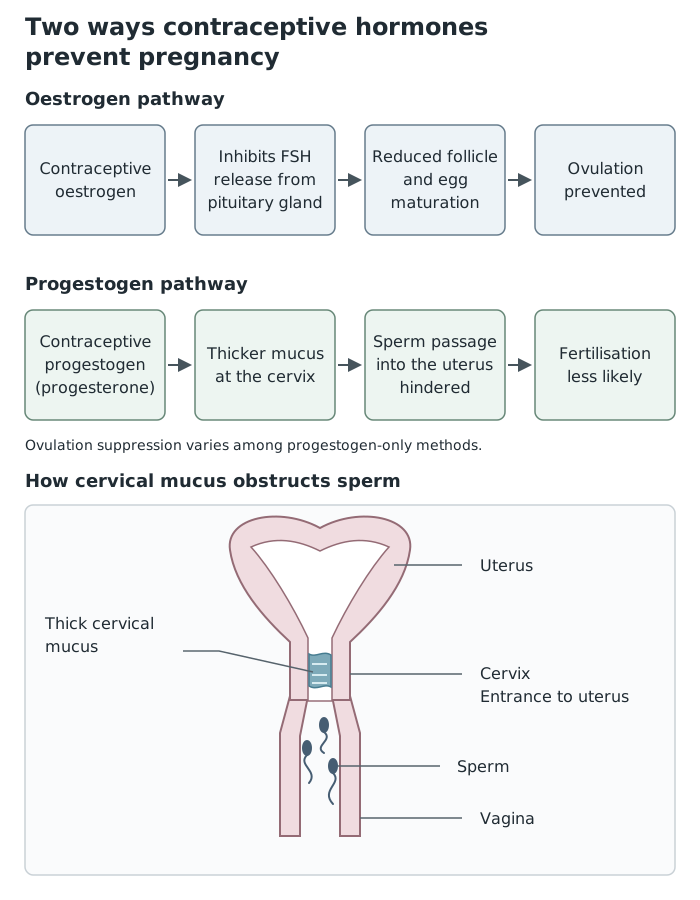
Hormonal contraception can prevent egg maturation and make it harder for sperm to reach an egg.
The combined pill is taken daily. A progestogen-only pill contains no oestrogen and is also taken daily, according to its timing instructions. Avoiding oestrogen can make it suitable for some people who cannot use the combined pill for medical reasons.
Other methods deliver hormones without a daily pill:
Long-acting methods reduce the chance of forgetting a daily dose. However, fitting or removing an implant or IUS requires a healthcare professional. An injection still depends on attending for the next dose on time.
Hormonal methods can cause side effects such as headaches, nausea, mood changes or irregular bleeding. Methods containing oestrogen carry a small increased risk of blood clots and are not suitable for everyone. None of these methods protects against sexually transmitted infections (STIs).
A condom is a barrier worn over the penis that collects semen, preventing sperm entering the vagina. Condoms also reduce the transmission of STIs. They contain no contraceptive hormones, but must be used correctly each time and can split or slip off.
A diaphragm or cap fits over the cervix, blocking sperm from entering the uterus. It is used with spermicide, a chemical that kills or immobilises sperm. Correct placement matters, and spermicide used on its own is less reliable than many other methods. Unlike condoms, diaphragms should not be relied on for STI protection.
A copper intrauterine device (IUD) is fitted inside the uterus. It releases copper ions that impair sperm survival and function, making fertilisation less likely; it can also prevent implantation. It provides long-lasting contraception without hormones and does not require action each day. However, fitting requires a healthcare professional, and it does not protect against STIs.
The distinction between the two types of coil is important: an IUS releases hormones, whereas a copper IUD does not.
Sterilisation prevents sperm and eggs meeting. In males, the sperm ducts are cut or blocked so that sperm do not enter the semen. In females, the oviducts are cut or blocked so that sperm cannot reach an egg. It is highly effective and avoids the need for repeated contraceptive use, but it is intended to be permanent. Reversal is difficult and may fail, so it is unsuitable for someone who may want children later.
Natural family planning involves identifying fertile days around ovulation and avoiding intercourse during that time. It avoids contraceptive hormones and procedures, but requires careful monitoring. Ovulation can be difficult to predict, particularly when cycles vary, so everyday effectiveness is relatively low.
Abstinence from sexual intercourse prevents pregnancy resulting from intercourse, but depends on maintaining that choice. Natural family planning and sterilisation do not protect against STIs.
Contraceptive effectiveness is usually compared over one year. Perfect use means following the instructions correctly every time. Typical use includes everyday mistakes, such as missing a pill or using a condom incorrectly.
| Method | Typical use | Perfect use |
|---|---|---|
| Implant | Over 99% | Over 99% |
| Hormonal IUS | Over 99% | Over 99% |
| Copper IUD | Over 99% | Over 99% |
| Injection | 94% | Over 99% |
| Combined or progestogen-only pill | 91% | Over 99% |
| Patch | 91% | Over 99% |
| Condom worn over the penis | 82% | 98% |
| Natural family planning | 76% | Estimated 91–99% |
For example, 91% effectiveness with typical pill use means that about 9 out of 100 users experience an unintended pregnancy during a year. Over 99% effectiveness means fewer than 1 out of 100 users experience an unintended pregnancy in that period.
The small difference between perfect and typical use for implants and coils reflects how little they depend on repeated user action once fitted. In contrast, pills must be remembered and condoms must be used correctly each time. The injection is not as reliable in typical use as an implant because repeat doses can be late.
There is no single best method for everyone. A useful evaluation weighs effectiveness, side effects, reversibility, STI protection and ease of use against the person's needs.
Someone who wants highly reliable, reversible contraception but often forgets tablets might prefer an implant or coil over a pill. A copper IUD offers high effectiveness without hormones, whereas an implant may suit someone comfortable using hormones. Both require professional fitting and neither protects against STIs.
Someone needing STI protection has a strong reason to use condoms. Using condoms alongside a highly effective contraceptive method can address both infection risk and pregnancy prevention. Sterilisation may suit someone certain they do not want future pregnancies, but its permanence is a major disadvantage for someone unsure about having children later.
A justified conclusion therefore links the method's mechanism and practical strengths to the person's priorities, while acknowledging its limitations.
Typical-use effectiveness over one year:
Perfect use is correct use every time; typical use includes mistakes. Long-acting methods reduce reliance on memory.
Compare reliability, side effects, reversibility, STI protection and convenience. Choose a method for the stated circumstances and justify the trade-off.
Explain a causal chain: inhibition of FSH → reduced egg maturation → prevention of ovulation.
When evaluating, compare advantages and disadvantages, then justify a conclusion using the person's circumstances.
Distinguish perfect use from typical use, and state that effectiveness figures refer to preventing pregnancy over a year.
Do not claim that hormonal contraception protects against sexually transmitted infections. Condoms reduce transmission; diaphragms do not provide the same protection.
Distinguish the hormonal IUS from the non-hormonal copper IUD.
It can see this note and what your specification asks for.
Answers are free with an account.
1 free note left this week
Get more free notesYour answer sets when this note comes back for review, or marks it complete.
Was this note helpful?
Log in to tell us whether it helped, or to report a problem.
Last updated
Contraception
The use of a method to prevent pregnancy.
Ovulation
The release of an egg from an ovary.
FSH
A hormone released by the pituitary gland that stimulates an ovarian follicle, containing an egg, to mature.
LH
A hormone released by the pituitary gland that triggers ovulation.
Barrier method
A contraceptive method that physically prevents sperm from reaching an egg.
Spermicide
A chemical that kills or immobilises sperm.
Implantation
The attachment of an early embryo to the lining of the uterus.
Perfect use
Use of a contraceptive method correctly every time, according to its instructions.
Typical use
Use of a contraceptive method in everyday life, including mistakes such as missed pills or incorrect condom use.
Sterilisation
A surgical contraceptive method that blocks or cuts the sperm ducts or oviducts and is intended to be permanent.
Put your knowledge into practice — try past paper questions for Combined Science B
Contraception
The use of a method to prevent pregnancy.
Ovulation
The release of an egg from an ovary.
FSH
A hormone released by the pituitary gland that stimulates an ovarian follicle, containing an egg, to mature.
LH
A hormone released by the pituitary gland that triggers ovulation.
Barrier method
A contraceptive method that physically prevents sperm from reaching an egg.
Spermicide
A chemical that kills or immobilises sperm.
Implantation
The attachment of an early embryo to the lining of the uterus.
Perfect use
Use of a contraceptive method correctly every time, according to its instructions.
Typical use
Use of a contraceptive method in everyday life, including mistakes such as missed pills or incorrect condom use.
Sterilisation
A surgical contraceptive method that blocks or cuts the sperm ducts or oviducts and is intended to be permanent.